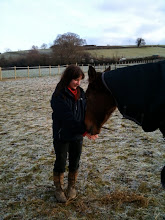
Today Spice had her 7th Barefoot Trim. It is now 6 months since she was de-shod and 8 months since she was last shod. I have been hacking out for up to an hour at a time 2-3 times a week with boots on her front hooves and nothing on her hinds and so far so good. :) She hasn't got foot sore at all and her hind hooves in particular are looking great. The white line gets tighter with each trim and the barefoot trimmer said her frogs are looking brilliant. Her front left hoof is still chipping a little at the bottom - nothing more than 5mm but it would suggest that the horn she is growing is still not that strong so i anticipate that these will take alot longer to fully transition (if ever). Whether she will ever be able to hack out barefoot on her front hooves all year round is debatable but on days when she isn't comfortable i can just slip her hoof boots on.
I haven't actually used my Renagade hoof boots yet apart from trying them on her in the arena. I have been using the easy care glove boots which are actually quite good providing you get exactly the right fit. I have them in two sizes one pair are for the beginning of the trimming cycle and the other pair are for the end. So far they have stayed on in walk and trot up hills and down hills but i must admit i haven't yet been brave enough to canter in them. I might use my Renegades for cantering as they have a better reputation for riding over rough terrain than the gloves do.
So far, i am still happy that i decided to go down the barefoot route and i am even prouder of deciding to do it with a horse that most people (including myself at times) would have thought too 'finely bred'. Whether i succeed in having a fully barefoot horse is still an unknown but what i do know is that with each trim that goes by Spices hooves become healthier and to me that is a success.
Showing posts with label Barefoot Transition. Show all posts
Showing posts with label Barefoot Transition. Show all posts
Monday, 19 July 2010

Saturday, 26 June 2010
167. Making Progress...
This evening i took Spice out for a walk as i hacked her out yesterday for the first time in weeks so didn't want to ride out twice in a row being that i have only just got back on her. She was brilliant on her hack yesterday and just as good if not better this evening. She started off a little unsure but soon relaxed and was 100% responsive to my cues. :) I was really pleased since it was the first time i'd been out with her on my own for weeks and we actually went for longest walk we've done so far. It's great seeing this kind of progress as it reassures me that i am doing the right thing. Her hooves are also looking great at the moment so fingers crossed they stay that way. :)
Thursday, 27 May 2010
140. Spices 5th Barefoot Trim...
Today i had Sarah my barefoot trimmer come to trim Spices hooves and overall i think she was fairly pleased. She agreed that the lameness (present before) had subsided and that apart from a few small cracks her hooves were looking in pretty good shape. So, all being well i should be able to ride her in the arena this weekend. :) She warned me against riding out on roads unprotected whilst the sole in her hind hoof thickens up but said that she thought she would be fine in hoof boots.
The only thing she mentioned was the 'clicking noise' from Spices back legs which first began back in February when she was lame and stiff from her abscess so i might get that checked out since it seems to be 'on' and 'off'.
Spice was also a complete angel for the barefoot trimmer today she stood so still almost as though she thought she was having a pedicure so i was really pleased with her. She did however give Pie a boot for attempting to eat what she thought should be her carrot so i wasn't best pleased with her then. Hopefully Pie will be o.k. although he did look slightly sore afterward.
Wednesday, 12 May 2010
126. The Barefoot Transition Continues...(aswell as the lameness)
Today i had the farrier come to see Spice to see if he thought that putting shoes back on her would eradicate the lameness but much to my surprise he suggested that i get her back checked as he thought the lameness could be muscular driven.
So, for now Spice stays unshod as he didn't see the point in putting shoes on if the lameness wasn't due to her hooves. He gave them a good check over and couldn't find any signs of abscessing or bruising so that's the good news.
I also asked him what his opinion of Spices hooves were and again much to my surprise he said that she had good hooves that were not genetically weak in anyway but that the quality/integrity of her hind hoof had obviously been compromised by the abscess and was therefore weaker than all the rest (hence the cracking).
So, at this moment in time i am once again undecided as to which way to go. If i arrange for the physio therapist to see Spice asap as well as get the vet to come and do a flexion test again i should hopefully have a clearer idea of what to do. If the farrier had have said 'she definitely needs shoes' i'd have had him put them back on her in a flash but as he didn't i guess all i can do is wait and see. God i've done 4 months so what's another month hey?
I just really need to get to the bottom of this lameness issue which hopefully i will do.
Monday, 10 May 2010
125. Horse shoes - a necessary evil?
So, i have made a decision with regards Spices hooves and unfortunately that is to put shoes back on her. Having persisted for 4 months with attention to diet, turnout and work load i feel i have given it my very best shot and now is the time to face up to reality. Someone once said to me that 'every horse can go barefoot but not every owner can' and at the time i believed this statement to be true but having seen Spice get progressively worse over the last 4 months i can honestly say that i don't think it is. Perhaps if Spice was never shod in the first place she'd have had more of a chance of succeeding - that i will never know but at present i believe her hooves are just to weak to go through the transition. She seems constantly uncomfortable and that's just being on grass without being ridden so i know that for her to be sound on roads even if it is at all possible would take another year at least and in the meanwhile what do i do watch her suffer and become so stiff she can hardly walk?
I feel that a lot of the barefoot stories you read always end in success but i'm betting that there's a hell of a lot that don't so i wanted to be honest and tell everyone about giving up because i think horse owners should try to remain as open minded about this subject as possible.
I do believe that it is Spice's genetics which have led to this failure (although i know there are barefoot thoroughbreds out there). But bare in mind that a typical thoroughbreds hooves are likely to be weaker than those of a native breed. Just like some humans have thin nails some horses have thin walls.
Just like some horses grow a thick winter coat some horses don't because some have been bred to be fine and fast so rather a horses coat is replaced with a rug as are its hooves replaced with shoes.
Why am i not going to put hoof boots on Spice? Because if she's lame in grass i don't believe hoof boots will make her sound. And what if i lose a boot during a ride and she steps on a sharp stone which punctures her sole and gives her another abscess? My friends thoroughbred horse had 9 abscesses in one year and that happened just being out in the field!
Of course there are other alternatives to hoof boots...plastic shoes which are undoubtedly better for your horse but at £175.00's a pair are also completely unaffordable for me at least.
http://www.imprintsport.com/
I am glad i tried going barefoot with Spice because i have learned heaps and it forced me spend some much needed time with her on the ground.
But i would like to point out to anyone else considering going barefoot that if your horse has genetically weak hooves then you may be fighting a losing battle - no matter how hard you try.
I guess the difficult thing is finding a professional who will give you an honest unbiased assessment of your horses hooves. I know two barefoot trimmers told me that genetically Spice had strong hooves but then again they were barefoot trimmers and i'm guessing a farrier would say the opposite and my vets comments were 'she has very flat soles and thin walls so you're probably going to have to put shes back on her'...so who do you believe?
Personally, i think the vets opinion is likely to be the least biased so i would probably start there and if they are of the opinion that your horse needs shoes - it probably does.
Spice is only a quarter thoroughbred, half appaloosa and something else so she isn't even 100% thoroughbred but looking at her you would probably think she was.
For those considering going barefoot, Linda Cowles from HealthyHoof.com offers the following advice...
Removing the shoes from a marginally sound horse and giving it a good trim doesn't miraculously cure the effects of years of imbalance, inappropriate diet, thrush or poor shoeing.
If your horse has been living with pain for months or years, be prepared to develop a simple therapeutic plan that will increase your odds of ending the tremendous emotional and financial drain you've experienced once and for all. Your horse can often be sound in a few months, but you need to be able to change how you feed him and manage his feet.
Healing Takes More Than A Good Trim!
Clients who proactively invest in supportive modalities like dietary assessment, acupressure, body work, dentistry, thorough saddle fitting, nutritional self-education and chiropractic, increase the odds that their horse will experience a good degree of soundness. Other rehab accelerators are instituting a routine exercise program; using boots and pads to improve movement quality; and improving the horses environment to eliminate the potential for thrush and laminitis.
The fact is, pathological horses need to develop and strengthen their internal hoof structures, and to do that they need consistent exercise with correct movement.
A horse that is hobbling around sore gets minimal benefit from the movement because toe-first movement, typical in horses with hoof pain, delays or prohibits that horses rehabilitation. Clients who invest in riding or rehab boots used with dense sole and frog pads to stimulate good heel, sole, and frog development, see comparably dramatic changes. Some horses need boots around the clock initially, but most do fine using boots only for exercise.
Plan To Succeed!
I suggest that all of my clients read the articles on Pete Ramey's http.www.hoofrehab.com web site and visit http://www.ironfreehoof.com/. These are two of the many places I go when I need answers or information. I'm humbled by the ability horses have to overcome years of imbalance and distortion, and by the depth of their owners care and compassion.
I also suggest that clients assess their horses diets and prepare to change how they feel about things like uncontrolled pasture access, grain and grazing muzzles. Safergrass.org http://www.safergrass.org/ and Dr Eleanor Kellon's site http://www.drkellon.com/ both give responsible owners a great place to start assessing diets.
Assessing Health & Level of Soundness Before & After Shoes Are Removed
I assess movement before and after a trim; movement assessment is one of the best tools a trimmer has.
When a horse is chronically unsound or has an extreme pathology, I suggest that clients have X-rays taken, and if it appears that the horse has metabolic problems, I also suggest testing the blood for glucose and insulin levels.
If a horse's pain could be structural or the result of muscle problems, chiropractors or body workers be consulted, and if a horse has symptoms that lead towards ulcers and gastric distress, a vet needs to be called in.
Soundness doesn't begin and end at the hoof.
Do all trimmers recognize all of these symptoms or suggest these tests? No. We aren't vets, and we aren't body workers, but seeing horses on a regular 4 to 6 week schedule and trying to help chronically unsound horses become sounder eventually teaches more perceptive trimmers to look for clues about the root cause of unsoundness.
If the previous farrier removed excessive amounts of sole, frog and bar when trimming, I suggest leaving the shoes on longer, allowing the sole to thicken and mature, and let the trimmer remove the shoes to ensure that its done correctly. When the sole has been excessively thinned, or the horse has laminitis, rehab boots and pads (I often suggest Old Mac's because they are also a riding boot) may be used around the clock until the sole has developed adequate density.
A good barefoot hoof care provider is in the business of improving a horses level of soundness, so if a horse is unsound, your trimmer should be interested - even if they can't resolve the problem personally. Unsoundness can be a result of body pain, tendon injury or internal problems. Keep your trimmer in the loop.
Emphasize Replacing Shoes with Boots & Pads - NOT Removing Shoes
Hoof protection is important immediately after removing shoes unless a horse has great feet and a perfect rehab environment. With some exceptions, I require clients to buy front boots. Sometimes rear boots are required.
Your hoof care provider should be able to fit and adjust a variety of boots, and should stock at least one brand of boots. They should be able to explain booting and padding to ensure that you understand the benefit of boots over shoes and to reinforce the value of booting through transitions.
Its a good idea to take regular pictures and take notes of your horses transition; it's easy to forget how bad a horses feet were when the transition started.
The Transition Process
Pull Shoes, Trim and Bevel, Fit Boots & Pads -- And Ride!! If your horse was sound in shoes? Once shoes are off, I suggest that my clients use boots when necessary for hand walking, turnout and stall use.
In essence, use boots if needed to keep horse moving correctly and comfortably. Many transitioning horses don't need boots except for trails, but boots are critical for tender feet, and inadequate booting results in significantly longer transitions.
Most horses coming out of shoes need some protection for trail riding, and many owners don't recognize poor movement, so if you aren't sure about the quality of your horses movement, get used to riding in boots. It'll pay off in the long run.
The Myth About Building Tough Feet - When I first started taking my horses barefoot, I was told to ride over gravel and rocky trails barefoot to "toughen feet up". It made sense, but my horses feet got progressively more tender until they could barely move in pasture. Their soles were too thin and immature from having years of shoes followed by inappropriate farrier pasture trims and imbalance to move correctly on hard, rough surfaces. Attempting to rush hoof development by riding barefoot when soles are tender will reverse or extend the transition period.
It takes most un-shod horses several months to a year to develop into a "Gravel Cruncher", and some horses will always need boots on tough gravel. A hint is that the better your horses diet is (low carb hay, low to no grain or molasses, no high carb pasture) the faster your horses feet will transition and the stronger they will become.
Properly fit boots are easy to use with a little practice, and vendors like Easy Care provide educational materials and support if your trimmer isn't available to help you. Your trimmer should stock and sell at least the EasyCare products (the industry leader) including the pads, but should also know about popular boots like Renegade and rehab boots like the Soft Rides.
Boots protect feet with flat soles, weak heel buttresses, sole bruising, white line separation and tender frogs. Horses that are extremely tender can be helped more by adding padding and boots full time for the first few weeks to accelerate their transition.
When Do Sole Pads Help Transitioning Horses? I put Easy Care Dome Pads in the boots of most of my coming-out-of-shoes clients; I like their density, the pads make the boots feel tighter, and the cushioning improves the movement of most horses. Some flat footed horses need Comfort pads, which are thinner.
When Do Frog Pads Help Transitioning Horses? If a horse has atrophied frogs and has compromised movement, I cut frog shaped wedges out of a foam kneeling pad (sold in garden departments) and tape the wedge to the sole of the boot where the frog will hit, then boot the horse and walk it out to see if it encourages better movement. If it does, I duct tape the frog pad firmly in place in the sole of the boot. EasyCare also sells frog pads.
How To Support Good Hoof Development During the Transition
Hoof and Frog Health - Oxine thrush soak and topical thrush treatments like Usnea, Pete's Goo and Oxine provide a way to eliminate Thrush forever. I suggest several days of daily 20 minute Oxine soaking sessions to most clients after the shoes come off. See my Links Page's Thrush section here:.
Environment - See my Passive Conditioning web page for information on providing a good environment for growing a better hoof , or my Links Page's Horse Environment section.
Regular Exercise - Provide a turnout environment that encourages the horse to exercise a few hours a day, or provide 1 hour a day of brisk hand walking or riding. Successful transitions are dependent on your horse getting adequate exercise in comfortable footing or hoof boots.
Good Nutrition - Diet is critical! High grain / alfalfa diets aren't healthy for your horse, and correct supplements support your horses rehab. If your horse has a history of laminitis or founder, has a cresty neck or is over weight, have your vet test it for Insulin Resistance and Cushing's. See my links pages selection of Diet links for more information. Safergrass.org http://www.safergrass.org/ and Dr Eleanor Kellon's site http://www.drkellon.com/ help owners start assessing diets.
Transitions Take Time
Transitions take time because the damaged and under-developed areas of your horses feet need to heal and grow strong. The only good way to "rush through a barefoot transition" is to follow the basic advice to the letter, get boots and pads for all four feet, and exercise your horse frequently and adequately. The more effort you put into your horses transition, the more your horse will get out of it.
Transition Requirements have a greater impact when you are trying to restore the soundness of an unsound horse.
Keep Your Horse Comfortable & Moving!
Transitions can be particularly uncomfortable for horses who were lame or tender before beginning a transition, and horses diagnosed with navicular, side bone and ring bone are usually sound once they are completely transitioned to barefoot. Their feet need to develop and their soles thicken and mature before that happens.
Early phase hoof discomfort is often caused by thrush or abscesses due to laminitis. Some of the discomfort a horse experiences in early transition phases may be due to thin soles, hoof remodeling or development.
Abscesses are particularly painful, and an an abscessing horse may act as if his or her foot is broken. When my clients describe an abscess, I suggest that they soak the foot in warm Epsom Salts water several times a day. I personally never dig abscesses out, preferring to soak the foot and encourage the abscess to vent naturally. See my Abscess Page for more information, and contact your hoof care provider with concerns or questions.
If your horse has abscessed, its always a good idea to recheck your diet, because mild (sub-clinical) laminitis caused by dietary imbalance is a common cause of abscessing. Laminitis can also be a result of vaccinations, hard riding or inappropriate trimming.
Responding To Skeptics Concerns About Barefoot
Once the shoes are off, take a good look at your horse and be honest with yourself and your skeptics about how comfortable or uncomfortable the horse actually is and why.
Under what circumstances is your horse uncomfortable, and how severe is that discomfort?
Does the discomfort go away when boots or boots and pads are used?
Do you use boots adequately?
Is the discomfort worse than it was when the horse was shod?
Has your hoof care provider been consulted about it?
Most of my clients describe conversations they have had with their friends, vets and associates about the advisability / sanity of barefoot transitions, and while they are comfortable with their decision to take their horses barefoot, they feel challenged by the skepticism and advice offered by people who see their horse slow down when it gets to a patch of gravel when walking around the barn without boots. I invite folks to watch me trim and ask questions even though it slows me down.
Horses *can* be hurt by invasive trims! There are many reports of horses being over trimmed, radically and unnecessarily, by well intentioned trimmers who were trained to use techniques now thought to be invasive. The best response to skepticism is to use a conservative trimmer with a history of being able to help horses like yours, then follow the necessary transition requirements and wait the skeptics out. Let your horses emerging soundness speak for you.
Every horse's transition is unique. Hoof care providers aren't all clairvoyant or psychic, so while they may have more expertise with tough transitions than owners, they can't miraculously make your horse sound or unsound. Hoof care providers trim feet to the best of their ability, most of us fit boots, suggest padding and give advice, but the bulk of the care and management of newly unshod horses is in the hands of their owner.
If Your Horse Isn't Moving Comfortably Without Boots After a Few Months...
PLEASE be open with your trimmer about how comfortable your horse is the day after a trim! I recently had a client whose draft horse I've trimmed for a year tell me that his horse is tender for a week after a trim, yet when I would go to trim the horse and ask how he'd been, I was told "fine". We can't help you if you try to not upset us with "bad news"!
Here are several reasons horses will be uncomfortable on "average" footing after a few months:
* Horses who were chronically unsound at the beginning of the transition may have internal problems that take time to heal or reverse.
* Horses on rich diets (any grain or grain based pellets, feed containing any molasses, oat and grain hays, green pasture) or with symptoms of Insulin Resistance, Cushing's, Laminitis or Founder.
* Horses with thrush
* Horses with chronic body pain or discomfort. Lameness is often a response to pain above the coronet band!
Early discomfort occurs because the horses feet need time to develop and toughen, but if your horse isn't moving well on good footing without boots after six months and if you have provided an appropriate diet (low carb grass hay, little to no grain), environment, exercise on good footing (flat, dry dirt, sand, deep pea gravel or or mats) or in boots, and you have treated for thrush even if you are sure your horse is okay, you need to revisit the situation. The trim may need to change! Or you may need to recheck your diet plan, saddle fit.
A vet or body worker assessment is advisable at this point, because the problem may be internal to the foot or leg.
We all hate moving from what may be an ideal barn for us, but if it isn't working for our horse and we can't modify the environment to suit our horse, moving is advisable. Barefoot isn't a quick fix or miracle cure, it's a lifestyle change for your horse.
Top Five Transition Challenges
Some horses feet have conditions that make their transition particularly challenging. Sometimes these challenges only impact the difficulty of the trim and don't impact the time it takes to transition, but some of the conditions extend a transition time out until the entire wall has re grown.
Thrush & Diet
I sound like a broken record on this, but Thrush and an inappropriate Diet are the primary reasons the horses I see have foot problems. When horses have tendon and ligament injuries? navicular? If you look at the hoof, you usually see contracted heels, imbalance, long toes, chipping walls, flare, and somewhere in that mess is thrush and a diet that is too rich for an equine.
Thin / Flat Soles
It takes several months of beveled trimming and solid hoof wall to allow for the development of a healthy, concave sole with adequate strength to support the "bony column" (the coffin bone and leg) and lift the sole above most gravel and debris.
A good bevel rounds the bottom of the wall so that it doesn't flare; instead, the beveled edge transfers pressure upwards from the walls edge towards the center of the hoof, encouraging the development of concavity and preserving the developing sole. It's important to find a hoof care provider who knows how to bevel the edge of the wall correctly.
Contracted Heels, Atrophied Frogs, Thrushy Frogs
Maintenance therapy includes having your hoof care provider trim the frogs loose flaps and open any cavities. The owner needs to soak the foot regularly until all signs of thrush are gone, then provide dry footing or deep pea gravel to insure that the thrush stays gone. Soft footing like shavings holds moisture and encourages thrush to develop.
See my Thrush article for more information
Laid Over Bars / Under-run / Under Developed Heels / Long Toes
These conditions can almost always be reversed with regular barefoot maintenance.
Laid-over bars - This condition occurs when there is inadequate depth in the hoof capsule for the bars to be upright, and its corrected by providing a good, non-invasive trim that allows sole to build a thick, durable dome that is capable of supporting the weight of the horse as its transferred to the coffin bone. Ritually thinning the sole in order to provide a surface to nail on shoes is the primary cause of the loss of capsule depth that results in laid-over bars.
Under-run and under developed heels - This is one of those "what came first, chicken or the egg" scenarios. Under-run heels are seen in conjunction with long toes; when a horse has a long inside toe quarter, it also has an under-run outside heel quarter. I feel that long toes are a result of toe-first landings, and my approach to correct them is to treat the horse for thrush (even if its not apparent) and keep the wall at the toes back in line with the coffin bone.
These horses, even when the condition is chronic, are usually sound in boots and pads for trail and arena work.
Depending on how long the horse has had this condition, it takes several months to restore the foot to a normal shape, and in the case of severely contracted or under-run heels, it may take several years. Sometimes the coffin bone has remodeled significantly, and we've seen that much of that remodeling is reversible to some extent.
Thin / Weak Poorly Attached Walls
Walls, Walls, Walls, Walls, Walls!!!
Thin, weak walls grow out fast once the shoes are removed and good circulation has been restored to the hoof. Dr Diane Isabel, a research partner of Dr Bowker's, did research on blood supply restriction in feet that are peripherally loaded, and while I don't have the study at the moment (it was quoted several times by Dr Bowker), my understanding is that blood flow into the hoof was reduced significantly (60% to 80%) when a hoof was peripherally loaded, i.e., shod.
What this means to you is that while a 8mm to 12mm wall thickness is "normal" on a shod horse, a healthy bare hoof wall quickly grows to be 15mm to 25mm thick, and is much denser than the wall on a shod hoof.
White line separation or a stretched white line is the bane of transitions and is caused directly by a too rich diet! Transitioning trimmers and owners wait for 4 to 5 months for the wall to grow a super solid hoof wall with a tight white line connection, but those changes are visible in a month or two on the right diet..
Wall Flare and dished walls - excessive wall length causes one side of the hoof to bend inward or bulge outward.
Wry foot - horse wears the outer walls excessively. This is often a result of chronic thrush but also typically involves diet.
Cracks - can be the result of coronet or tubule damage or wall imbalance
Linda Cowles Hoof Care
Serving the greater SF Bay Area & Northern California
Friday, 7 May 2010
123. Genetics - Thoroughbreds
Today i had the vet come out to see Spice as two of her hooves on her left side are still warm to touch and i thought she might have some thrush in her frog so wanted to make sure that it was that and not another abscess brewing.
The good news is the vet checked her hoof over with hoof testers and came to the conclusion that it wasn't an abscess and that she just had a mild case of thrush (probably due to her flat soles).
She said that i might have to shoe Spice in view of the fact that she has flat soles which could simply be due to her genetic conformation and therefore never likely to change making her more susceptible to bruising and abscessing.
In view of this i have decided to ask the farrier to look at her hooves and give me his opinion aswell as also talking to my barefoot trimmer about the matter.
I think at the moment i just want Spice to be happy and sound again which she hasn't been since going barefoot.
Having given it 4 whole months, with 24/7 turnout, a good diet and regular trimming i would now have expected her to be sound on grass and 100% ride-able but she isn't and i can't ignore this fact.
The vet has recommended a two week course of danilon in the hope that the inflammation in her hooves will decrease and the on-off lameness issues will cease. So, we will see how she is doing in two weeks time.
If it IS her genetics then i can only say that i think there should be a law against those that breed horses who clearly have no idea what they are doing. Breeding what was once such an incredible asset to the horse out of its genetics and leaving it with a hoof so poorly formed to the point that it would not survive without metal shoes on is in my view Barbaric, grossly irresponsible and simply unforgiveable.
It's like forcing two humans with genetically poor/weaker teeth and then breeding them again and again and again until they get to the point where by the age of 13 they have to have all their teeth replaced with false teeth.
Do those who breed race horses have no care for horses hooves? and should those that are clearly unqualified be allowed to breed?
Today, i cried on my friends shoulders because i was so tired of thinking about Spices hooves...do i feel guilty putting her through this? Yes...of course but i know that i have done every single thing with her best interests at heart. I was prepared to give up my time, money and enjoyment for the sake of giving her a healthier set of hooves and this decision was based on anything but selfishness.
Wednesday, 5 May 2010
122. False Sole - nature really is amazing...
Recently due to Spice losing the back quarter of her hoof wall i have noticed that she has developed some rather thick sole. Having done some research on the internet i now know this is 'false sole' which she has created to give her the support she needs until her wall grows back...when it does, the sole should naturally shed itself so should be left alone to perform this process...In time, the hoof will naturally create it's own concavity...
'False sole is live sole which is still being fed and develops because the foot needs this extra protection.
Often when we remove shoes, the heels, and wall are often not strong enough and break off, leaving a foot with very little height to protect the sole, therefore, the sole takes more pressure than it is designed to and compensates and creates false sole.
The false sole is there to compensate for a lack of other structure, the horse needs this extra protection, so to remove the sole which the horse has laid down to protect itself is a debatable procedure and as you have found out, the horse is sensitive!
The false sole will drop out when the foot doesn't require this extra protection, i.e. when the horse develops heels height, wall height and has a foot where each structure takes the correct amount of pressure. The concavity will come with time when the foot recovers and functions as it should.
The structures of the foot are designed to work in equilbre with each other, where one doesn't function as it should, another steps in..
Creation of false sole is basically the sole stepping in for a lacking of another structure, therefore, the foot should be assessed to identify the weak structure and the conditioning work can be structured to stimulate this structure.
Re infection in the sole.. that is also questionnable.. it is very very unlikely that infection will reach the dermal layer through false sole unless there is a puncture wound, and any bacteria will only be surface, and quite frankly.. by removing sole, you are exposing sensitive sole, which may not be fully keritanized, which is equally a lot closer to the dermal layer, therefore, common sense.. exposing the more permeable sole to infection!
I would ask nicely not for the sole to be carved.. and when the horse is sound, get stimulating the feet on all surfaces, maybe give a little arnica (?) as if the horse is sensitive he may have bruised himself.. and if you are worried about keeping the feet clean, something like cider vinegar works nicely.. or negerol from the vets/pharmacy..
Hope this helps, and don't worry the false sole will budge when the foot feels it doesn't need it anymore.'
tazilla
Tuesday, 4 May 2010
121. Lame to Sound...

Yey! Spice is no longer lame! It seems that the crack caused by her re-occurring abscess was definitely the cause of her lameness as now she is completely sound again and her hoof is looking so much better. I'm so happy, i can't wait to start doing stuff with her again - it's crazy how much i miss spending time with her.
I've also just spent £300's on some hoof boots which i am hoping will give me peace of mind when out hacking as there's no way i want to risk Spice getting another abscess - at least not until i am sure the soles of her hooves have really thickened up. So, fingers crossed the boots fit her as i've heard that getting the fit right is essential for success.
I purchased easyboot gloves by easy care from http://www.thesaddleryshop.co.uk who i found really helpful and professional.
Hopefully they will arrive Saturday and in the meantime i should be able to start lunging her and at least riding in the arena. :)
I also came across another style of hoof boots yesterday via my facebook group called 'pony sandals' which can be purchased from: www.journeyman-leather.co.uk http://www.journeyman-leather.co.uk/ponysandals.html They look interesting and comfortable but my only concern was how durable they would be as being made just out of leather i would expect them to wear down pretty quickly. I did however have the opportunity to speak to the lady behind the creation and she said they can last from 4 to 12 weeks depending on terrain and horse so i'd definetly be interested in trying them out. Although i might need to save the pennies...! If anyone thinks barefoot horses are cheaper to maintain...think again...because they're not! They require regular trims, special attention to diet and quite often some form of hoof protection whether it be hoof boots, vettec, or pony sandals...all of which costs money! But hopefully, it will all be worth it. :)

Saturday, 1 May 2010
118. Barefoot Trimming
Today Spices crack (which was only just dangling on yesterday) finally came off just in time for the trimmer to give it a trim so i am pleased to say they are looking a lot prettier. :) Now that the crack has grown out i expect and hope that Spice's lameness on that hoof will subside as otherwise it would indicate that there is another problem besides the crack which was causing her to be lame. :( However, having lost half of her heel and a chunk of her wall it is hardly surprising that she is tender on it. I would hope that by the end of the month she would be sound again (providing the hairline crack above, where the second abscess burst) does not turn into anything larger. Fingers crossed it doesn't!
I will be so glad when i can finally ride Spice out again. From my experience so far I would strongly suggest to anyone considering going barefoot to wait at least 3 months before riding out on roads and to only do this when they are sure the sole has grown thick enough to provide sufficient protection against punctures. I can't help but think that if it weren't for riding out barefoot so soon after Spice had her shoes removed none of the above would have happened. If i could go back in time i'd definitely have used hoof boots but...you live and you learn.
I found a brilliant website the other day which sells lots of natural based products specifically for barefoot hooves... http://www.barefootbasics.co.uk/products.htm
Friday, 30 April 2010
117. Patience...
I haven't had much to report lately as due to Spices hoof i haven't been able to do much with her. However, the good news is the crack has almost grown out to the point where it is only just hanging on so i am hoping that tomorrow Sarah (our trimmer) will be able to just file it off and give it a good tidy up. Fortunately, the sole is looking surprisingly healthy in comparison to a few weeks ago with some good thickness. So it will just be the wall which has come off with the crack which will need time to build up. Hopefully, once Sarah has been Spice will be more comfortable and as of next week i can start long reining and lunging her again. If i do this for one month she should then be fit enough to ride again.
I have decided to buy some hoof boots for her for when i ride out on the roads so that at least for the summer she has added protection as although her soles have really built up it has still only been 5 months since she was last shod so theoretically she is still in her transition phase.
The hoof boots i have chosen to buy are the easy-care glove boots, i like the fact that they look quite flexible and that they are also rated as one of the easiest hoof boots on the market to put on.
http://www.easycareinc.com/our_boots/easyboot_glove/Easyboot_Glove.aspx
Monday, 12 April 2010
100. Trotting Poles
Alex and Fenna doing some pole work...
Due to Spices abscess I still have to limit her work load so all i did today was long rein her over some trotting poles in the arena and walk her around the yard and through the entrance again. She was very good and listened to my commands attentively. However, there is still a slight reluctance to go through the entrance gate and although she responds well when i prompt and encourage her I'd really like to get to the point where she didn't even think about not going through as only then will i feel that she is accepting my authority and me as her leader. She is definitely a quick learner though as it has only taken two attempts to get her to this point which is a long way from turning around in the opposite direction and trying to jump back into the field! I think she has definitely learned that there is no way i am 'giving in' (at least on this).
With regards her barefoot transition I must admit that at the moment i am feeling very frustrated, i wouldn't mind not going out if i could ride her in the arena and practice maneuvers and jumping or even just longe her but due to her abscess re-occurring i can't do any of these things. I feel as though i have done so much ground work with her that now is the perfect time to start riding her in order to solidify our bond and i guess i'm beginning to get 'bored' of doing the same old same old which makes me think that Spice must be getting bored too.
I read recently that it only takes 5 months for the sole to regain the thickness needed to be barefoot so in view of the fact that it has been almost five months since she was last shod she should now have reached this stage although i guess with wear and trimming she may still have a couple of months to go. But in view of this, if she is still getting abscesses in a couple of months time i think i may have to admit defeat. I am definitely going to see how she goes in hoof boots but i do wonder how comfortable the boots will be and if they will cause any rubbing/soreness.
Thursday, 1 April 2010
87. Groundwork, Hooves & Magnesium Update...
Today i took Spice for a 15 minute walk around the village and she was absolutely brilliant, so trusting and so attentive. Every day i take her out i see how she improves. I definitely think the magnesium has had an effect on her too. It was quite windy today but she remained calm and relaxed from the moment we left the yard to the moment we got back. When i think back to how nervous and agitated she was when i first tried to lead her away from the herd i realize just how far we have both come. I can't wait to ride her out. Her hooves still seem to be holding up well which is good so my aim is to start riding her out daily for 30 minutes at a time so they get used to walking on hard ground. The last time she was shod was back in November so she has now had almost 5 months of growth. I can't believe how quick it's gone. I am hoping that within 3 months i can hack her out daily for 1hr at a time with no problem. The loveliest thing about doing things with Spice is knowing that she actually enjoys doing them she stands at the gate waiting for me to arrive and even after i've given her food still stands there almost as though she is waiting for me to 'catch her'. But I never want to get to the point where i have to 'catch her' i like the way we seem to 'catch' each other. :)
Thursday, 18 March 2010
78. Barefoot Trims & Horse care which way is the right way?
Sometimes i wonder why professionals can't just agree on the best way of doing something and do it. It surprises me that even professionals in the same field of work have such different ways of doing things and makes me wonder as a horse owner how can you ever be sure which way is the right way? Just doing a 2 minute search on google i managed to find five different methods of barefoot trimmimg...
The Strasser Method
Natural Balance Hoof Care
Martha Olivo
The HPT Method
AANHCP The Wild Horse Trim
Spice has her next trim in just under 5 weeks so i really hope that by this time her abscess has fully healed. Due to there still being a hole in her sole i have to be careful about taking her out on the roads for at least two more weeks otherwise i risk it getting punctured and re-infected. So it's a bit of a waiting game. The podiatrist who came and trimmed my friends horses hooves today said that the best thing to do with abscesses is to just leave them and let them heal naturally rather than digging a hole and draining it there and then but what do you do when you have a vet standing in front of you with 7 years experience saying the opposite and a horse that is so lame they can't walk?
At the minute i am feeling a little frustrated with all the contradictory advice/literature. It seems the more i ask and the more i read sometimes...the more confused and uncertain i become...and i'm guessing i'm not the only one...
Saturday, 13 March 2010
71. Unbiased Viewpoint on Barefoot Transition...
It's now day 18 of Spices abscess and it is still draining ever so slightly from the hole which the vet made but i noticed when taking off the poultice today that it now seems to have sealed over with a whitesh yellowish film...from what i read this is good and means it is healing over and within 5 days or so there shouldn't be any reason to keep applying a poultice as by this time the hole will have healed over enough to resist getting punctured. I have read however that it is advisable to wait a further two weeks before taking her onto roads which could have sharp stones.
Having read many articles on barefoot transition i have found that most tend to be quite biased and i thought that since i am embarking on this journey it would be wise to get an unbiased viewpoint which is likely to be more realistic. The following article i found is perhaps the least biased article i have read so far...
Barefoot Transition
Horse owners who own a shod horse and wish to pull the shoes and allow their horse to go barefoot will experience what is known as a barefoot transition period. This is the period during which the horse becomes accustomed once again to going without shoes. During the period when the horse was shod, the shoes and the way the hooves were trimmed hindered the function of the hooves. Since the parts of the hooves respond like muscles, the parts that were unable to function became weak and atrophied. This led to hoof deformity and may have resulted in hoof and lameness problems to one degree or another. When the shoes are pulled and the hoof is left alone, eventually the parts of the hoof will begin to function naturally again and will strengthen. If left alone, the hoof will naturally shed the deformity through the processes of flaring, splitting, cracking, chipping, and breaking off. This is not cause for alarm but is Nature's way of shaping the hoof so that all parts can perform their functions. As the hoof begins functioning normally once again, the parts that atrophied will grow back and regain their strength and functionality. This is most important for the internal hoof structures...the parts of the hoof that you can't see. When the hoof deformity has been shed and all parts of the hoof are able to function normally again and when all structures of the hoof have regenerated and recovered their functionality, then it is said that the horse has made the transition from shod to barefoot.
It is vitally important to realize that this process takes time...it is equally important to realize that hoof structures that have been chronically weak and underdeveloped for years as a result of shoes, improper trimming, or detrimental environments may never be able to fully heal and regain full functionality. In other words permanent damage may have been done to the hoof structures. In this case a horse would be said to have made the transition when the hooves have recovered as best as they can. This will be the case for the majority of horses who have been shod for a number of years or who have lived, especially the first months and years of their lives, in stall or paddock confinement.
There's a lot of talk going around now about barefoot horses, and most of it concentrates on a certain kind of trim, usually referred to as a "natural trim" or a "barefoot trim" or a "mustang trim." If you've been influenced by the barefoot trimming/natural hoof care movement, you may have the idea that the transition period from shod back to barefoot will be relatively easy and short....the shoes are pulled, the hooves are trimmed a certain way every four or six weeks, there will be rapid improvement in your horse's hooves, and after five or six months, you'll have a barefoot horse that you can ride wherever you want to. It all seems so easy...it seems that this certain kind of "natural trim" works magic on the hooves. After all, isn't that what happened in all the success stories you read or heard about? Having a barefoot horse seems to be all about this "magic trim," and it is promoted as being able to work wonders, as being able to take a horse with severe hoof deformity and severe hoof weakness and turn it into a horse with rock-crushing hooves within just a few months.
But, unfortunately, for most people, it's not going to work out that way. In reality the "magic trim" proves not to be so magic, and depending on your particular horse, the transition period may not be as easy and quick as those in the barefoot trimming/natural hoof care movement may lead you to believe. You might soon realize that the success stories which are so publically bragged about are in fact well-chosen success stories...and maybe that's why barefoot gurus are branching out and have signed hoof boot endorsement contracts.
I've received numerous calls from people who've tried the "magic trim," fully expecting it to work wonders changing their horses' hooves into rock-crushers...but whose experiences have been somewhat less than expected. Initially most were convinced the problem was that their trimmer was not doing the "magic trim" properly, and if they could just find a trimmer who REALLY knew how to do the "magic trim," they could experience the magical results. The exaggerated claims made by the barefoot trimming/natural hoof care movement about the magic trim have caused problems for hoof care professionals from all corners, for, intentionally or not, they have led many horse owners to believe that ANY horse can magically have rock-crushing feet in just a few months with the application of the magic trim. And when it doesn't work, whose fault is it? Well, of course, it's the trimmers fault! The trimmer obviously didn't know how to do the magic trim properly.
The hoof care industry is really a commercial venture, and it's full of personalities. I got a call from a woman with a horse who had previously foundered and who she suspected was a chronic founder horse. She had been through all the farrier/vet recommendations, with the wierd shoes, chopped-off toes, and high heels...and, as is usually the case, her horse hadn't done so well. But, this woman had a lot of money, and she eventually contacted one of the personalities in hoof care who came up and got rid of all the junk her horse had been fitted with by the vets and farriers...and the horse naturally showed some improvement. At that time, the horse was not in a founder state, and the symptoms it was showing were not in fact from the founder at all, but the results of the conventional founder treatments that had been applied. So, when she went with the natural hoof care guy and discontinued the treatments, naturally her horse improved. Anyway, it was going to be impossible for this personality to continue regular hoof care on her horse, so she needed to find someone locally. The problem was that this guy had basically convinced her that he was one of only a handful of people in the entire United States who understood horses' feet and who understood how to do the "magic trim" properly, and that the only way her horse wouldn't plunge back into lameness was that if he could instruct someone in the area exactly how to maintain her horse's hooves. You see, he convinced her that it was this "magic trim" that had saved her horse, and he also convinced her that only he and the people he instructed knew about this "magic trim." So, she called me to ask if I would be willing to come up and let this guru enlighten me and bring me out of the deep darkness of ignorance about hoof care and then take over care of her horse's feet. I politely told her no. It wasn't only that I had no intention of being a groupie around a personality in hoof care, it was also that I realized that if she did indeed have a chronic founder horse, the horse would eventually founder again, and when it did I would be the one left holding the bag, as the conclusion would be that I wasn't doing the magic trim properly....that I was not doing it as well as the guru did. And that is in fact what happened...the horse eventually foundered again, and the poor guy who did agree to be enlightened by the guru and took over the hoof care got blamed for the founder incident....because, you see, it MUST have been that he wasn't doing the "magic trim" properly. It HAD to be that way, because the guru had "cured" founder with his magic trim, so if the horse foundered again, there was no other explanation than that the trimmer was not doing exactly what the guru had told him to do.
I've just seen so many people who got taken by the gurus, who believed the stuff about the magic trim, who didn't realize that the success stories were well-chosen success stories, and who believed that having a barefoot horse was going to be that easy. And then I've seen what happened as they experienced the reality of the promises made by the barefoot trimming movement....eventually they became disgusted, believed barefoot riding to be impossible, and went back to horseshoes.
Now, I like barefoot horses and don't like to see people get disgusted and go back to horseshoes. I've worked with a lot of people who were genuinely trying to get rid of the shoes and the problems they can cause and ride a barefoot horse. But the fact that the barefoot trimming/natural hoof care movement has sort of taken over the whole area of barefoot horses in an attempt to sell and prmote a certain kind of trim has created a lot of problems for those who realize that there is a LOT more to having a barefoot riding horse than just a "magic trim." It's caused so many unrealistic expectations among horse owners. Barefoot riding IS possible, but your success or failure with barefoot is not going to hinge on the magic trim. In fact, in many cases, the magic trim may actually contribute to barefoot failure. And, depending on your horse, the transition period may well be a lot longer than the few months the barefoot trimming movement talks about...and even with the magic trim, you may never experience the results you read about in the well-chosen success stories. So let's look briefly at what does matter if you want to transition a horse from shod to barefoot.
The most important thing is the condition of your horse. A horse that's been shod and maintained with an abnormal hoof setup for years is going to have pathologically weak and underdeveloped hooves. This will be true not only for the structures you can see, but most importantly, for the structures inside the hoof that you can't see. Everything will be thin, weak, and underdeveloped, and it will have been that way for years. In order for you to have success riding this horse barefoot, that entire hoof, inside and out, is going to have to change....become strong and well-developed. That's not going to happen in a few months. Realistically it might take years, and the fact is that on an older horse, who's 10 or more years old, it may never totally happen. In other words, no matter what you do, that horse may never have hooves like it would have had without the years of deformity the shoes caused. No doubt you'll see improvement, but such a horse may never be like the barefoot riding horses you hear about in the success stories.
A second factor is how the horse is used. The hooves will adapt themselves to the environment which the horse lives on and to the stresses they encounter on a daily basis. This means that if your horse lives in a grass pasture, its hooves will become adapted to the grass pasture and not the hard, rocky trails with tree roots that you normally ride on. If you house your horse on grass pasture and ride for extended periods on severe terrain, you probably won't have much luck barefoot. If you house your horse on terrain similar to what you ride on, it'll be better, but keep in mind even then....your horse is used to walking over that terrain without your weight on his back. When you ride, you are putting different stresses on the feet and changing the way the hoof mechanism operates. If you ride often, the hooves will adjust to that, because your riding is part of the normal, daily environment and normal, daily stresses the feet are exposed to. But if you just ride only occasionally, you'll have to take it easy if you want to ride barefoot.
There's a third factor. The growth and renewal rate of the parts of the hoof exposed to wear will depend on what the horse is exposed to on a daily basis. A shod horse will have a slow growth and renewal rate. When you pull the shoes, the rate will speed up, but that takes time and will be as a result of necessity...in other words, the feet may show signs of increased wear to the point it may alarm you, and as a result, the horse may be sore. If you house your horse in a soft grass pasture, this probably won't be an issue, but if you house it in more varied terrain, it may....because the shoes have insulated the hooves from the rougher terrain, and it will take time for the hooves to adjust to this terrain after the shoes are no longer there. Eventually, if you can have patience and realize what's happening, the growth and renewal rate will catch up and provide what the horse needs for its daily wear....but this won't happen overnight.
Regarding the magic trim, it's very important to realize that your horse is not living in the same environment that the wild horses lived in who were the foundation for the so-called barefoot model. It's also important to realize that your horse's daily routine is different....it's not running 25 or 30 miles per day over rugged terrain. So....don't expect your horse's feet to ever look like that mustang model. Horses' hooves are the product of the environment and daily stresses they're exposed to. Nature knows how to adapt each horse's foot to what is required for that particular horse in that particular environment. Your horse does NOT have to have feet that match the barefoot model in order to have natural hoof function. In fact, since your horse lives in a different environment and its feet are exposed to different stresses each day, if you allow someone to take nippers and a rasp and force the feet to match the barefoot model, you will HINDER natural hoof function. A natural hoof is not dependent on looks, but function. To read more about this, please refer to the articles on A Natural Hoof and Natural Hoof Care.
There is no doubt that shoes and/or stall and paddock confinement result in hoof deformity that often leads to lameness and hoof problems down the road, as the horse ages. This is the reason for the increasing interest in barefoot. You can take any horse and transition it to barefoot. BUT....the barefoot trimming movement has somewhat misled people, because it is a commercial enterprise that has something to sell--trimming services and trimming education, and lately, hoof boots. They have been very good at promoting themselves and the boots for which they have endorsement contracts....after all, if you do an internet search on barefoot horses, you'll mostly get results about a certain kind of trim, and it may seem that this trim will allow you to transition any horse to barefoot with just a short, easy transition period. This makes it seem like having a barefoot riding horse is all about a certain kind of trim. But that is absolutely not true. Just because you can transition any horse to barefoot does NOT mean that you will be able to do exactly the same things with it barefoot that you did when it was shod. It'll be different....especially on an older horse who had a lot of hoof deformity, it may be unreasonable to ever expect that horse to develop rock-crushing feet. On any horse who's been shod for a number of years, and on any horse who was born in and lived the first part of its life in stall or paddock confinement, you can expect a lot of hoof deformity, especially on the inside where you can't see. The transition period for such a horse will be a lot longer than just 5 or 6 months, and you probably won't experience this smooth, magical transition you might expect from reading the well-chosen success stories.
The most important factor in determining how much trouble you can expect during a transition period is the condition the horse's feet are in when you begin. On a younger horse with little pre-existing hoof deformity, expect a relatively brief and easy transition. But on a horse who's 8 or 9 years old and has lots of hoof deformity, expect a longer and more troublesome transition. And please realize that no trim will give a horse magic feet....you probably won't be able to keep a horse standing in a grass pasture for a month and then ride it barefoot on a 4-hour trail ride over harsh, rocky terrain...and no trim will change that.
When I talk to someone about the possibility of barefoot, I tell them first of all to stop and think and use their instincts and common sense. The barefoot movement has largely become a commercial enterprise, and the promoters have developed sort of a barefoot establishment around their magic trim and most of all around themselves, so that "barefoot" has basically come to mean the application of their magic trim. The existence of that establishment has basically shut out any discussion of barefoot that does not recognize that trim as primary. Their monopolization of the subject of barefoot has in itself lent credibility to their claims and promises. We live in a society where we are not taught to think critically, not taught to question, but rather to believe what we're told.....if someone has certain credentials and has published books and leads seminars and has founded an organization, then we don't question what they say. I talked with a woman who recently retired from teaching on the college level. She said that where our educational system has failed is not that we don't teach enough science and math, it's that we don't teach students to THINK...to think for themselves. Instead, we basically teach them to believe what they're told. This is apparent in the society as a whole. On the political level, we don't need the details, we don't need to know what happened....."Trust us...we know best." On the medical level, we don't need to know the details and intricasies about our diagnosis and treatment options, we only need to know a broad-brush summary from one perspective and then are expected to blindly follow the recommendations..."Trust me, I know best." If it's in print and/or if the person saying it has credentials, we're conditioned to not question. Who are we to dare question? But really, I have faith in my own instincts and common sense, and I try to teach other horse owners to have faith in their own instincts and common sense...even if it means going against those who have made themselves into personalities and have amassed credentials. That's hard to do....but I think that to understand hoof care, and horse care in general, we really have to step back a little and take some time to just think, and let our insincts and common sense guide us.
Barefoot is undoubtedly best for the horse. But it may not be best for all horse owners. Whether or not your horse can go barefoot is really not dependent on your horse, it's dependent on you, on what's important to you. There are no horses who "need" shoes for themselves, there are only horses who need some form of hoof protection because of what their owners do with them. So YOU are the determinant of whether of not your horse "needs" shoes. Some horse owners' main concern is the health and well-being of their horses, and they will adjust how they keep their horses and how they use their horses accordingly. Barefoot is suited for them. But some horse owners' main concern is being able to use their horses for whatever uses they want whenever they want to do it. For those horse owners, being able to use their horses is more important than the long term well-being of the horses. If that describes you, then barefoot is probably not right for you. That doesn't make a moral judgment, it just describes reality.
I got a call from a very nice couple who wanted to keep their horses barefoot. They had two horses, both around 15 years old, who had been shod all their lives and who were used occasionally for trail riding. They had seen the hoof deformity that the shoes had caused, and they were attached to their horses and cared about them, so they had tried barefoot. But they had believed the success stories from the barefoot trimming/natural hoof care movement and expected a short and easy transition to barefoot and then to have two horses who could stand for 6 weeks in a grass pasture and then be ridden barefoot over hard, rocky trails for 6 or 7 hours. It didn't work out that way. Their horses had severe hoof deformity and very weak hooves, and after a 5-month period, their horses still couldn't walk up a gravel road without being sore. They tried the hoof boots that the gurus endorsed but didn't feel they were suitable for their horses. My heart went out to them, because they really didn't know what to do. They had these two horses, who they wanted to be able to ride occasionally...that's really the reason they had them...but at the same time, they were genuinely concerned with their long term well-being. They first wanted to be mad at farriers, but I tried to remind them that a farrier's job is to make a horse rideable, and that a farrier can't really be blamed for the lameness problems shoes might cause, because after all, a farrier is just responding to customer demand, and it should be clear to a horse owner that nailing metal shoes on a horse's hoof is not good. There's a trade-off....you chance sacrificing your horse's soundness down the road so that you can ride today, so that you can do with your horse what you want to do with it. I told them that, considering the age of their horses and the condition of their feet, what they wanted to do was asking too much....you can't take two older horses with severe hoof deformity who stand in a soft grass pasture and expect to be able to ride them barefoot occasionally over harsh terrain. It just isn't reasonable. But yet from what they had heard from the barefoot trimming/natural hoof care movement, they thought they could...after just 5 months. And they ended up feeling betrayed and going back to horseshoes....but at the same time feeling guilty, because they knew the shoes were harming their horses' hooves. Sometimes it isn't possible to have it all; sometimes we have to make a choice. What's more important to us? That's a question that every horse owner must answer for him- or herself.
For a realilstic and extended discussion of how to choose and maintain a barefoot riding horse, as well as to learn how all wild horse feet do not match the mustang model, please refer to the manual Maintaining a Natural Horse.
Wednesday, 10 March 2010
64. Spices first ever Barefoot Trim!
So, today i had the podiatrist come out to see spice for her first barefoot trim and i am pleased to say she was happy with her progress.
With regards the hoof abscess she has said to keep dry poulticing the hoof with the abscess for the next week so the internal structures of the hoof start to rebuild without the risk of any further infection/puncture as what is there at the moment is quite soft.
Apart from the walls being thin and slight flaring (something which is to be expected after de-shoeing) she said spice is doing well and that the holes from the where the nails were are almost grown out. I asked her today about whether she really thought spice was going to be able to hack out barefoot and she said that she is 100% certain that she wont have any problems. She also said that she wouldn't expect spice to get any more abscesses and that once the abscess has fully healed over i should be able to hack her out barefoot on tarmac for 30 mins without any problems. Overall, i am really pleased, i feel the visit has given me the encouragement and confidence i needed to carry on with the transition and fingers crossed spice will not suffer from any more abscesses. She is also almost 100% back to normal in terms of her comfort levels which makes me feel much better. Will keep you all posted over the next few weeks with regards her progress.
Monday, 8 March 2010
61. Day 13...Spices abscess continues...
Today we took off what we hoped would be Spices last poultice but there was still a smell of puss on the poultice which would indicate that it is still draining albeit ever so slightly as visually there was next to nothing on it. So, my first thoughts were to apply yet another poultice and assess the situation tomorrow. However, Spice was behaving quite frantically with it being so windy and looked as though she was going to be a bit of a nightmare to keep still so reluctantly i postponed applying the poultice with the view of coming back to do it later.
I came back roughly 4 hours later to apply the poultice which was actually quite easy due to the fact that spice was happy to stand still for me but her hoof was full of mud due to being outside so it was quite a job cleaning it. I only hope that i managed to clean away the debris from the draining hole so that if there is anything left to drain it has an easy escape but as i said it was quite difficult.
I'm so over the whole hoof abscessing thing. It's times like this when you wish you had a stable just because it would be easier treating a horse in somewhere clean, dry and out of the wind than in an open muddy field.
Sunday, 7 March 2010
60. Applying the last poultice day 12
Quick update on spices hoof abscess, it's almost finished draining now i think as there was only the smallest amount of puss on the poultice today so with any luck it will have stopped draining by tomorrow. Am actually quite bored of writing about it now...Am really looking forward to being able to do some groundwork with her as i haven't been able to do any for the past two weeks!
Saturday, 6 March 2010
59. Saying goodbye to Spices Hoof Abscess - Day Ten!

Hoorah! Spices hoof abscess definitely seems to be on the mend, as you can see from the poultice above the abscess is still draining but hardly anything has come out over the past 24hrs so it is definitely on it's way out. I wasn't sure whether to apply a wet poultice today or a dry poultice but since she has had a wet for the last three days and there's hardly any muck draining i thought perhaps a dry one would be better. She is also far less lame in fact she's walking fine now so all good signs. I'm hoping that we will only have to dry poultice it for another three days at most and that then we will be able to leave it alone and let nature do the rest. My only hope is that it doesn't come back like it did before...I'm not sure how long it will take for the hole which was made to grow out and for her hoof to be sound in general but hopefully the podiatrist will be able to tell me more on wednesday.
Friday, 5 March 2010
58. Day nine of spices abscess...

So, it's day nine of spices abscess and it is still draining...once again there is not quite as much puss on the poultice as yesterday and it is also not as dark but there is still a fair amount.
On the plus side there was no wind and the sun was shining so spice stood still without me even putting a lead rope on her...If only she could be like this all the time...
Thursday, 4 March 2010
55. Day eight of spices hoof abscess

So, it looks as though Spices abscess is still draining, there was quite a bit of puss on the poultice but not quite as much as yesterday and not as dark which i am guessing is a good sign. She made it really hard to apply a poultice today though. It was a bit windy and being the skitty horse that she is she just wouldn't stand still. How my friend got the poultice on i don't know. I just hope it stays on otherwise i fear we'll probably be back to square one. I still think if you can go barefoot you should and physically/genetically i think spice can but i fear that the process of getting her may be far more difficult than i first perceived. If she was a quiet natured horse that was calm and had no problems with standing still the job of applying a clean poultice and dealing with the issues of going barefoot would be easy but as she is not and it seems likely that she may get more abscess whilst in transition i am doubting whether or not i will be able to continue this path. Feeling a bit down about the fact that sometimes just doing the simplest of things with spice seem sooo difficult. Yet seconds later she is the calmest, softest and easiest horse to be around...?! SIGHS...
Subscribe to:
Posts (Atom)