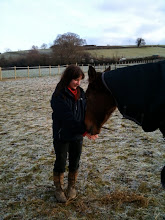
Yesterday i made the hard decision to put shoes back on Spices front hooves. Having watched her become more and more uncomfortable over the past two weeks even when in the field due to the ground being so hard (we have had no rain in weeks) i felt it was unfair to keep her barefoot. I am still intending to keep her hinds unshod as she doesn't seem to be in anyway sore on them i.e can walk over any surface easily even with a rider on her back so i see no reason to put shoes on them. But if they too become sore i would not hesitate to do the same. Do i feel like i've failed? In one way yes but in another way no. I do think that with the right diet, exercise plan and environment Spice may have been able to stay barefoot but i don't think i'd have been able to ride her across anything other than roads. I definitely would have had to avoid riding across stoney tracks, going down steep hills and also limit the number of times i hacked Spice out each week to avoid wearing them down too much. I know shoes are not ideal but then neither is leaving a horse in a field that you can't ride because they are too sore to get fat. Hoof boots are a great idea but i would be reluctant to canter or gallop in them having seen them come lose and twist around even in trot.
As always horsemanship is a balancing act. You can't just think about a horses hooves you have to consider the whole horse and having seen the difference front shoes have made to Spices movement i am 100% certain that i made the right decision. I would love to keep her hinds unshod but as always i will see how it goes...for now our barefoot journey has half come to an end....
Showing posts with label Shoes. Show all posts
Showing posts with label Shoes. Show all posts
Saturday, 7 May 2011

Tuesday, 27 April 2010
113. No Shoes Versus Shoes
Today, i feel myself once again becoming disheartened with the state of Spices hoof, the crack caused by the abscess bursting through the coronary band is looking worse than ever and is of obvious discomfort to Spice (visible lameness in trot) so i find myself pondering over what to do and becomming ever so increasingly frustrated with the differing opinions and advice.
Having changed podiatrists after my first podiatrist recommended that i ride Spice daily for 30mins a day every day and her getting an abscess just 72hrs later i am even more less confident about my judgements and choices.
All i want is the best for Spice but after 3 months of on/off lameness abscessing and reading articles like the one below i can't help but question my decisions...
The Natural Barefoot Horse Movement
posted by citizen.K on Tuesday, June 24th, 2008
Horseshoes are not evil. Marketing schemes might be.
Believe it or not, they are calling it a movement. Barefoot, natural trimming franchises are the new hot trend in horse care. It is a beautiful scam that has been developed specifically to target the inexperienced horseman or horsewoman. The fad has swept the horse world off its shoes and into new barefoot ground where lots and lots of horses are gimping around wishing the pain would stop.
How this movement came to be is a mystery, but Dr. Hiltrud Strasser, a German veterinarian, has been credited as the first to develop this new, radical, strong woman craze on “natural” holistic hoof care. Dr. Strasser has been described as “a rebel”. A woman who isn’t afraid to stand up to conformity. A woman who created a system, of hoof care conformity, to break conformity. A woman with a method, no, a state of mind, that asks all horse owners to think alike on the care about their horse’s feet.
Of course, those in the barefoot movement believe if you aren’t following this new, trendy, horse care method, you must be abusing your horse (for more on that concept, if you haven’t already, stop by the pro-clicker training comments). People who are completely brainwashed by a method or system see only black or white. Of course, if you aren’t clicker training, you MUST be training your horse by brutally beating them. Again, if you aren’t using natural barefoot trimming, you MUST be torturing your horse with horseshoes. Oh the humanity!
Farrier work should under no circumstances cause lameness, footsoreness, shortened stride, or any other displays of pain or discomfort.
As another genius horse person marketing scheme, the target audience, once again, is middle aged women who are hypersensitive to notions of bad things happening, anywhere. The Strasser barefoot method, the clicker training method, and the natural horsemanship method all exist, thrive on, and cultivate scare tactics to further their followings and resulting profits. That sound familiar to anyone?
Yet, do any of these people realize that fitting their horse into this Strasser method of trimming, or any other natural “balance” barefoot trimming method is like making every person wear the same size shoe? How is that correct, or natural? Or pain free?
The Barefoot movementers say trimming every horse foot exactly the same is the way “nature intended”, but yet, they call it abusive to nail a shoe on a horse’s foot, a shoe that fits that horse and enables comfort, traction and shock absorption?
Dr. Strasser has stated herself that her trim may cause death to a horse. What??? Oh, right, but it’s because the horse’s heart cannot heal from the abuse of shoes and a stall. What reasonable person reads that and thinks, “Yes, I need to free my horse from the abuse of a stall and shoes, so I will trim my horse with this method. If he dies, at least I freed him”?
That’s just nuts.
Don’t get me wrong. Dr. Strasser has some good points outside of actually touching a horse’s hoof. Yes, some horses, and almost all pleasure, pet and/or trail horses should live outside 24/7. But, a few of my own horses who lived their first 3 years outside 24/7 would not be happy being outside 24/7 now. No matter what, not every horse can be cared for the same.
Let’s say that again.
Not every horse can be cared for the same.
This is where the “nuts” part of the natural barefoot/Strasser trim comes into play. Each horse’s individual temperament, conformation, health, and job necessitate different care.
And long before Dr. Strasser hit the foot care scene, fore-thinking equestrians knew frequent trims (meaning, weekly, every other week, etc.) and low angles could be beneficial to keeping a horse’s foot balanced, most especially for corrective shodding or treating, for example, navicular and founder.
But, NOT EVERY HORSE’S FOOT IS THE SAME!!!! There is a lot more to equine hoof soundness and happiness than just cutting off so much hoof that the horse’s body has no choice but to increase bloodflow to the region.
Dr. Strasser no doubt has credentials to back up her hoof anatomy knowledge, but all in all she has zero practical, statistical data proving successes of her methods. As stated elsewhere, her insistence that horseshoe nails numb the equine’s foot is so off the wall unproven or tested that it doesn’t even rise to the level of hypothesis. The Strasser trim is also often marketed as a do-it-yourself system (just the right confidence builder insecure women need!), but hoof care is a science that can not be taught by reading one book or attending one clinic. Doing so, buying into a DIY “natural” barefoot trim attitude gives one just enough knowledge to do serious damage.
Trimming a hoof should never, ever leave a horse footsore.
Many horses have been euthanized after a Strasser trim, and horse owners and natural barefoot “farriers” alike have been charged in animal cruelty cases for using the Strasser trim and causing pain and suffering to horses. Horses dying and owners being charge for cruelty themselves should be enough of a red flag for everyone to stay away from Strasser’s naturally balanced, hoof care trimming method. Yet, there are still many advocates for Strasser’s scheme, and even more Strasser franchises going up around the world.
Some barefoot, natural horse care fanatics do actually see the Strasser trim as not only too radical, but also risky for their horses’ health. But, even these natural barefoot fanatics still don’t see any other option besides “natural” balanced, barefoot horse trims. Now available WITH shoes! Adding shoes to a naturally balanced, barefoot horse trims is like adding a McDonalds meal to your vegan, organic diet!
Now, the other methods of “natural” hoof and whole horse care have involved many different “developers”, thus creating different factions of followers. The common thread with each, “unique”, best-ever-everything-else-is-murderous-system is that they are all following the word natural. If barefoot trimmers are following “natural”, wild horse practices, why are they trimming their feet at all? Are there wild farriers that live out in the plains where the wild horses stop every once in a while to get their feet trimmed (and what’s natural about a horse sitting, or playing with a rubber ball?)
Moreover, susceptible people often forget that horses are no longer wild. You cannot put the genie back in the bottle. Just willing your horse’s foot, with a knife, to take the shape of a mythical, perfect, naturally existing horse hoof of yesteryear will not make it so. Taking a horse with horrible feet and cutting them with a stencil does not make them perfect, great, or natural, no matter how long you try.
So many inexperienced backyard breeders have produced so many terribly conformed horses; a special barefoot hoof trim will not conquer their genetics. In many cases, it may be your responsibility to put shoes on a horse with foot problems instead of mandating the horse conform to your needs as a system follower.
“I don’t see any lameness, he just doesn’t like to walk on rocks.”
The fad within this barefoot market is so strange to me. In so many ways, why not just find a great farrier? A great farrier is going to leave a horse barefoot if that is what is best for the horse. I have had many barefoot horses, some of which competed through 4′ jumpers barefoot even, only to get shoes on for bigger fences, for better traction, or for shock absorption. Since all of these horses that were able to live and compete barefoot also had awesome feet, my farriers would leave them without shoes until needed.
The most memorable experiences I’ve had with natural barefoot trimming, or natural balanced trims, were witnessing the soreness the horses experience after a trim, even after receiving these trims for over a year. These horses would be footsore for over a week AFTER a barefoot trim. The horses were in agony when walking through rocks, or walking on concrete.
Are there no hard surfaces in the wild?
I would be told, “Oh, that’s normal”, or in some cases, “I don’t see any lameness, he just doesn’t like to walk on rocks.” No horse my farrier has ever left barefoot has ever, ever been footsore. Not on rocks, not walking to and from pastures, not on any surface at any point.
Having a farrier work on your horse, whether you put shoes on or not, should under no circumstances cause lameness, footsoreness, shortened stride, or any other displays of pain and/or discomfort. You should be able to get on and ride your horse with no problems immediately after your farrier works on him. If you can’t, have a lengthy conversation with your farrier. If it happens a second time, find a new farrier. If that farrier is you, please stop playing farrier.
The number one most important element in horse care, and horse training, is uniqueness. Every horse is unique and must be treated and cared for as an individual. Following methods, fads, or systems limits the ability to tailor for your horse’s conformation, temperament, personality, and health. Why do all these radical people think that every horse should fit into a mold? What is even more interesting is that these are the people who claim other horse people are just scared of change or something new. When it comes to “natural” horse practice dissident, fear of the new is not an issue. Most good horse people take knowledge from every reputable source, method, and system, pull out what might be useful, and apply it when it is applicable. But above all, responsible horse people know THERE IS NO MOLD.
There is no magic button, no magic book, no magic savior, or no magic set of beliefs that will cause a horse to bond with you. Your program of beliefs are not special, and you are not suddenly rising to the top of all whom ever cared for horses, simply because your system title includes a derivative of the word “nature”.
And in this world, there are a lot of conventional farriers that shoe horses who don’t necessarily need it. It is also very true that a horse that has worn shoes for a long time will need time to adjust to being barefoot. Without the accustomed support of a shoe, hoof walls may chip and crack for a few trims until the nail holes grow out and the hoof becomes stronger, but never should this adjustment period include footsoreness.
And though it’s obvious the closed minded nature of anyone buying into these “natural” themed horse care/training, marketing schemes bothers me, the natural barefoot trimmers actually make me angry. Natural trims cause pain and suffering for far too many horses.
One thing is for sure, I’ll never give up horseshoes. I absolutely love torturing my horses by mounting, cold, cruel metal to their feet. The classically trained, traditional farrier and I have such a laugh at all the discomfort the horses experience while being shod! Oh, and the hot shoeing!
The courtesy and manners my horses show the farrier are surely just done out of fear; their blackened hearts singed from years of unnatural hoof trims, metal tearing their mouth apart, and all the abuse from spurs, whips, and nosechains. In fact, one of my horses is so dull and hates the farrier and the evil shoes he tacks on so much, that he stands perfectly still and tries to play with the handkerchief in the farrier’s back pocket!
Silly, tortured horse!
Shoes or no shoes, lets work away from the marketing schemes. Horse people are already crazy enough without all this bad propaganda.
Sunday, 24 January 2010
13. Going Barefoot...

Spice in her new pasture...24/7 turnout as it should be and our first chance to try going BAREFOOT!
Once i had moved Spice to her new pasture where the turnout was 24/7 i knew i would have a much better chance at attempting to go barefoot. So, I changed her diet from a high sugar haylage she was used to having at her old yard to a low sugar haylage and changed her scoop of high sugar pony nuts to a scoop of high fibre low sugar alfa beat and a handful of chaff. After one month i then decided to book an appointment with my podiatrist. I'd seen the same podiatrist a couple of months earlier at my old yard but at that point she recommended that i leave spices shoes on as all of her hooves were warm and had a strong pulse indicating that she could be laminitic - she'd mentioned that the main reason why she felt spices hooves were likely to get sore if her shoes were taken off was due to her being on a high sugar diet due to the fields being fertilised and also therefore having a mineral imbalance such as magnesium deficiency due to the fertiliser used.
So, on the 22nd January 4 weeks after arriving at our new yard, having left her shoes on for 10 weeks (which would give the hoof the chance to grow before attempting to go barefoot the podiatrist came to assess Spices hooves for a second time. Much to my surprise, she was delighted with Spices hooves and was not reluctant in the slightest to remove her shoes - the temperature of the hooves had returned to normal and her pulses were now as they should be - weak. So, within a matter of minutes i had a barefoot horse! So far Spice has not displayed ANY signs of soreness and only slight cracking has occurred on the back hooves. I have been recommended by my podiatrist to walk her on hard smooth surfaces i.e tarmac twice a week for 30 mins or 4 times a week for 15 mins and so far all is good. It had now been 15 days since her shoes were removed so her hooves have now had 3 months to grow. However, since the hoof takes approximetely 8 months to replace itself i anticipate it being a further 5 months before they are in 'tip-top condition'. Fortunately though this fits in with what i want to do with her and will prevent me from becoming impatient with her progress so i see it as a blessing. The podiatrist is next visiting on the 3rd March (6 weeks after shoe removal) so i will update you as to how her hooves are doing then....
During my research, I found the following articles useful when deciding whether or not to go Barefoot...
Nutrition is one of the most important things to get right, with any horse.
With a horse that is barefoot, it is essential - you can have the best trim
in the world, but if your horse is not getting the diet it needs, its all wasted!
Dietary problems are often the main cause of footiness in horses, and barefoot horses are no exception. Your trimmer is the best person to advise on diet, so talk to him/her first of all - it is too big a subject for this site alone!
A horse’s diet should be based on forage - in fact most lightly worked horses need only grass, hay or haylage, plus minerals. Let your horse’s condition be your guide, and if you need to feed more, opt for low starch, high oil feeds.
Check vitamins and minerals - provide a free choice supplement, and ideally have your forage analysed to check for deficiencies. Avoid cereal/sugar based supplements.
Avoid mollassed feeds, and scrutinise ingredient lists; “low sugar” is not the same as “NO sugar”!
Variety is the spice of life! Forage that has lots of varieties of grasses, rather than one species, is usually better. Beware of forage that has been heavily fertilised, or treated with fungicide/herbicide.
Beware of too much grass - footiness due to high fructan levels is extremely common and can occur in ANY horse, including fit horses. It is a particular danger where magnesium levels in forage are low - either naturally or due to nitrate fertilisers.
Be especially careful in spring and autumn, and monitor your horse’s performance, restricting grazing if necessary. High doses of drugs (wormers, hormone injections, steroids etc) can also cause hoof problems.
Magnesium deficiency can show up as footiness on hard or rough ground, and many diets (equine and human!) are deficient. You can safely add magnesium in various forms and your trimmer should advise you about dosage, availability, and the best form to feed.
Spice is currently having ad lib high fibre low sugar haylage, one scoop of happy hoof, 45ml of magnesium and a 45g of a herb mixture (specially for hooves) including Clivers, Meadowsweet, Rosehips, Garlic, Kelp, Nettles, Mint. Links to some of these products can be found below...
http://www.spillers-feeds.com/en-gb/united-kingdom/SpillersHorseFeed/products-and-stockists/spillers-fibres/happy-hoof/
http://www.feedem.co.uk/horse-117/horse-food-185/spillers-236/spillers-horses-laminitis-13038.htm?utm_source=froogle&utm_medium=ppc&utm_term=13038&utm_campaign=froogle
This photos show high desert in Arizona - the sort of terrain which crafts the incredibly strong feet of wild horses.
The land here is very dry, and very rocky...typically there is less than 10 inches of rain per year.
Hooves in this environment become amazingly capable, but its a far cry from the UK!
In the UK, we have totally different conditions - Exmoor, for instance can have 70-100 inches of rain per year.
In this environment, horses won’t naturally develop “rock-crunching” hooves - this is partly because of the wet, soft ground and partly because their diet is much richer - we grow grass!
But we need our barefoot horses to have rock-crunching “desert” hooves so that we can ride on rough, stony ground, and on roads, not just fields and arenas.
The solution is to mimic much tougher conditions, so that hooves become stronger too.
You don’t need to make huge changes - you can provide dry, stimulating, abrasive terrain by keeping a horse in a stable or shelter for part of the day, and you can restrict grazing by turning out in a dry lot with hay or haylage instead of a green field.
You might even be able to create a track, which maximises movement but limits access to grass.
We know that too much turnout on lovely green grass is NOT terribly good for hooves, but its good for our horses to have the chance to move freely and socialise.
Instead of turnout in fields, putting a track round the edge of the field is a simple way of restricting grazing and encouraging movement. This idea was first mooted by Jaime Jackson, who has written a book called “Paddock Paradise”.
My horses, and Sarah Braithwaite’s have been kept on tracks for a number of years and thrive on it.
Tracks can be as complex or as simple as your space and budget allow, from a simple cordon of electric fence around the edge of a field to a system of interlinked yards over multiple different surfaces.
The essentials are enough space and feed stations to prevent bullying, good shelter and (ideally) varied surfaces to stimulate hooves.
If you are laying a track for winter use, you will need good drainage and a surface which doesn’t poach, but if you only need to use your track in summer then you can get away with just fencing round the edge of a field.
The trick is to be inventive - waste ground, old yards and areas of hard-standing are all great ways of providing varied, well-drained surfaces - and they come cheaper than “pony paddocks”!
Thankfully due to the variation of the Uk Climate our grass paddocks change with the seasons so that what may have once been a soft spongy grass paddock can quickly change to a rock hard icy paddock so we are somewhat lucky with the english weather because whether we keep our horses on grass or not they will still expereince the sensation of different terrains which will help strengthen our horses hooves.
The trim we use is consistently effective and safe, and non-invasive, allowing us to have happy horses, with balanced feet, that are as capable, or more capable of high performance than they were when shod.
A UKNHCP trimmer/farrier can give you good advice - a trim is individual to each horse - you can’t set “rules” as every hoof is different.
A trim for a hard-working barefoot horse is not the same as a pasture trim - the aim of the two is different, and a pasture trim will not normally be adequate to optimise hoof health in a barefoot horse.
Having said that, there are an increasing number of farriers who have experience of barefoot performance, and its worth talking to your farrier first.
Here are our top tips:
Trimming
• When choosing a trimmer or farrier, look for someone who has many successful barefoot horses on their books.
• Expect a good trimmer or farrier to ask about your horse’s diet, environment and exercise, and to advise you on changes if necessary.
• Your horse should be as or more comfortable after a trim as before (the exception is a horse with a metabolic disorder or a poor diet).
• Your trimmer or farrier should have professional indemnity insurance and should work co-operatively with other professionals.
• A good trimmer will handle your horse kindly but fairly, and will take time to answer your questions.
I chose to use a barefoot trimmer rather than a farrier as i had read and heard that farriers only know how to do a 'pasture trim' which is not appropriate for a horse which you intend riding out.
The website address of the barefoot trimmer i am using is: http://www.sarahoofgirl.com/ She is absolutely lovely and is highly competent both at dealing with horses in general and trimming. I cannot recommend her highly enough.
I was recommended to her by my friends equine sports therapist who is also excellent: http://www.horse-back.co.uk/
Subscribe to:
Posts (Atom)