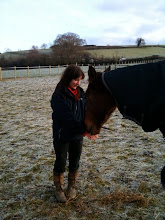
Today, i walked Spice in hand just around our yard as being the spooky nervous horse she is even a walk around the yard can provide a valuable training exercise...
She was fine when walking with me inbetween her and the hedgerow but as soon as we turned around to go back which meant she was inbetween me and the hedgerow she felt far more anxious and found it difficult to focus on me.
So, i wondered how i could reward her for focusing on me when she did so that it would encourage her to focus on me more and spook less at the activities going on behind the hedgerow.
I came up with the following reward...every time i felt her get anxious to the point that she increased her speed or tried to overtake me i stopped her and made her stand still and only until she was looking at me for direction would i let her walk on 'away' from the scene of her distress thus giving her a reward for focusing on me rather than what she was spooking at.
I repeated this activity three times until eventually i had her nose to my shoulder the whole way and there was no speeding up or getting overly anxious at any point.
I found this a very valuable exercise and will continue to use this method outside of the yard.
Sometimes even the smallest things me and Spice do together teach me so much...
Showing posts with label Trust. Show all posts
Showing posts with label Trust. Show all posts
Wednesday, 17 March 2010

Monday, 15 March 2010
74. Natural Horsemanship Versus Traditional Horsemanship
I read an interesting discussion on a horse forumn tonight about the differences between natural horsemanship and traditional horsemanship...so i copied and pasted one of the contributions made by a user below...
'I would also like to point out what i see as the main difference between what you would define as NH natural horsemanship and TH traditional horsemanship.
The success of TH seems to be directly related to how quickly you can get the horse to be more afraid of you, the trainer, than what you are actually doing to the horse at that time. For example... washing a horse for the first time. TH methods would probably include tying the horse to something solid and blasting it with the hose. Some TH methods would probably include some amount of whip use every time the horse moved and eventually the horse shuts down to the water being hosed on it because it is under so much pressure from the trainer every time it reacts to the water.
Thus you have made the horse more afraid of the punishment it is going to get from the trainer, than the actual process of being washed...amazing!
Alternatively NH would include a thorough desensitizing process done slowly and within the horse's realm of comfort. It might even be done over the space of a few days. You would start with the water as a trickle, then just trickling the water up their legs. as soon as the horse got nervous about the water you would go further down the leg to the last area where the horse was comfortable.
Gradually you would work in this fashion to get the horse acclimitised to the water running over its entire body. During the process the horse would be under very little pressure from the trainer, and be allowed to 'think' about the process of being washed. He would think 'this isn't hurting me' and 'this isn't endangering my life' and at the end of this process you would have a horse that would be comfortable being hosed, and one that has respect for its trainer at having let the horse deal with it at its own pace.
I have re-trained a little welsh pony who had been subjected to the first TH method i described. The result was that he was ear shy, would try and flip himself over in the wash bay, and struggle and fight to get away from the water. After following the NH method i described i had a pony who would happily stand in the wash bay and let me wash his face without so much as trying to pull away from me. It went from being a traumatic and fearful experience, to a pleasant and gentle experience. result = happy pony!!
This girls answer completely describes what i am trying to do with Spice. As some of you may have already read, I had a situation with Spice when i first started riding her out alone where every time she came across something she felt afraid of or unsure about she would spin around and attempt to rear if i tried to spin her back round...the advice i got at the time was exactly as described above with regards traditional horsemanship...make yourself even more frightening than the object of her fear and she will soon pass it and you'll have solved the problem. Traditional horsemanship is a tradition because it DOES work...I have seen it with my own eyes...However, i have also seen that it constitutes to a very detrimental relationship between the horse and its owner, one where the owner has respect and obedience from the horse but not because the horse wants to be respectful and obedient but rather because it is forced to be. These relationships seem to be completely devoid of emotion on both sides and end with a horse which is often indistinguishable to the rest of the horses through having retired their personality for the sake of avoiding a beating, which many would describe as learned helplessness.
Traditional Horsemanship gets results quicker than Natural horsemanship that much is true but isn't part of the fun the journey of getting there in the first place?
I feel Spice respects me more and more every day not because she 'has to' but because she wants to and i like this feeling a lot.
'I would also like to point out what i see as the main difference between what you would define as NH natural horsemanship and TH traditional horsemanship.
The success of TH seems to be directly related to how quickly you can get the horse to be more afraid of you, the trainer, than what you are actually doing to the horse at that time. For example... washing a horse for the first time. TH methods would probably include tying the horse to something solid and blasting it with the hose. Some TH methods would probably include some amount of whip use every time the horse moved and eventually the horse shuts down to the water being hosed on it because it is under so much pressure from the trainer every time it reacts to the water.
Thus you have made the horse more afraid of the punishment it is going to get from the trainer, than the actual process of being washed...amazing!
Alternatively NH would include a thorough desensitizing process done slowly and within the horse's realm of comfort. It might even be done over the space of a few days. You would start with the water as a trickle, then just trickling the water up their legs. as soon as the horse got nervous about the water you would go further down the leg to the last area where the horse was comfortable.
Gradually you would work in this fashion to get the horse acclimitised to the water running over its entire body. During the process the horse would be under very little pressure from the trainer, and be allowed to 'think' about the process of being washed. He would think 'this isn't hurting me' and 'this isn't endangering my life' and at the end of this process you would have a horse that would be comfortable being hosed, and one that has respect for its trainer at having let the horse deal with it at its own pace.
I have re-trained a little welsh pony who had been subjected to the first TH method i described. The result was that he was ear shy, would try and flip himself over in the wash bay, and struggle and fight to get away from the water. After following the NH method i described i had a pony who would happily stand in the wash bay and let me wash his face without so much as trying to pull away from me. It went from being a traumatic and fearful experience, to a pleasant and gentle experience. result = happy pony!!
This girls answer completely describes what i am trying to do with Spice. As some of you may have already read, I had a situation with Spice when i first started riding her out alone where every time she came across something she felt afraid of or unsure about she would spin around and attempt to rear if i tried to spin her back round...the advice i got at the time was exactly as described above with regards traditional horsemanship...make yourself even more frightening than the object of her fear and she will soon pass it and you'll have solved the problem. Traditional horsemanship is a tradition because it DOES work...I have seen it with my own eyes...However, i have also seen that it constitutes to a very detrimental relationship between the horse and its owner, one where the owner has respect and obedience from the horse but not because the horse wants to be respectful and obedient but rather because it is forced to be. These relationships seem to be completely devoid of emotion on both sides and end with a horse which is often indistinguishable to the rest of the horses through having retired their personality for the sake of avoiding a beating, which many would describe as learned helplessness.
Traditional Horsemanship gets results quicker than Natural horsemanship that much is true but isn't part of the fun the journey of getting there in the first place?
I feel Spice respects me more and more every day not because she 'has to' but because she wants to and i like this feeling a lot.
Friday, 12 March 2010
70. Consistency, consistency, consistency...
Lately, i have had a bit of a revelation...which may seem completely obvious to most horsey people (in fact i'm sure it is) but to me it was a word that i had simply heard or read along with many others that had simply gone in and sat there rather than actually being activated. That word is...consistency. I am beginning to realize that it absolutely imperative that every single interaction i have with Spice is based on consistency.
From the smallest thing like putting her halter on and not letting her continue to eat her hay whilst i do so, to standing her still and only letting her take a step when i ask her to, to slowing her down if she changes her pace without me asking her to. I always need to be 'in charge' and need to demonstrate this whilst i am interacting with her in every way i can...this doesn't mean bossing her about it simply means not letting her make the decisions. I need to be the one doing the asking and (if need be) the one doing the telling only if of course i believe the request to be reasonable which if i didn't i shouldn't be asking her to do it in the first place. On an emotional level I need to know and feel that what i am requesting is reasonable and fair so i feel that i am justified in telling her to do it. I think that's where preparation comes into play...Is it fair to expect a horse that is terrified of tractors to listen and obey to your commands if you have made no effort to ever introduce the stimulus to them? Is beating your horse past the object of it's fear (as many a horseman would do) fair when you have never made an attempt to build their confidence??? I don't think so but sadly i know many people who would disagree with me.
Is dismounting as soon as you have your horses focus and leading your horse past the scary object if it builds up their confidence really that detrimental to your relationship? Afterall, you are still leading them...
I am also realizing how important it is to make sure you have your horses attention at all times as only then can they focus on you and look to you for direction and leadership, therefore the second you don't have their attention it's essential that you get it back...otherwise you create a potentially dangerous situation.
I think this is the hardest thing i will have to endure with spice as because she is incredibly aware of her surroundings and is very sensitive and very alert to any noise or movement she can easily be distracted during our interactions. I need to re-direct her focus onto me as soon it starts to drift...even when i tractor appears round the corner...and whilst i am managing to do this on the ground successfully i still do not know if i will be able to do the same when i am on her back...My plan is to have lots of sessions with her in the arena with an object of her fear and test my skills out then rather than out hacking so i myself can build up my confidence. So, i will let you know how it goes...
From the smallest thing like putting her halter on and not letting her continue to eat her hay whilst i do so, to standing her still and only letting her take a step when i ask her to, to slowing her down if she changes her pace without me asking her to. I always need to be 'in charge' and need to demonstrate this whilst i am interacting with her in every way i can...this doesn't mean bossing her about it simply means not letting her make the decisions. I need to be the one doing the asking and (if need be) the one doing the telling only if of course i believe the request to be reasonable which if i didn't i shouldn't be asking her to do it in the first place. On an emotional level I need to know and feel that what i am requesting is reasonable and fair so i feel that i am justified in telling her to do it. I think that's where preparation comes into play...Is it fair to expect a horse that is terrified of tractors to listen and obey to your commands if you have made no effort to ever introduce the stimulus to them? Is beating your horse past the object of it's fear (as many a horseman would do) fair when you have never made an attempt to build their confidence??? I don't think so but sadly i know many people who would disagree with me.
Is dismounting as soon as you have your horses focus and leading your horse past the scary object if it builds up their confidence really that detrimental to your relationship? Afterall, you are still leading them...
I am also realizing how important it is to make sure you have your horses attention at all times as only then can they focus on you and look to you for direction and leadership, therefore the second you don't have their attention it's essential that you get it back...otherwise you create a potentially dangerous situation.
I think this is the hardest thing i will have to endure with spice as because she is incredibly aware of her surroundings and is very sensitive and very alert to any noise or movement she can easily be distracted during our interactions. I need to re-direct her focus onto me as soon it starts to drift...even when i tractor appears round the corner...and whilst i am managing to do this on the ground successfully i still do not know if i will be able to do the same when i am on her back...My plan is to have lots of sessions with her in the arena with an object of her fear and test my skills out then rather than out hacking so i myself can build up my confidence. So, i will let you know how it goes...
Thursday, 11 February 2010
38. How to make your horse more confident...
Case Study...
Millie was a Thoroughbred X, 6 year old mare who had been with her current owner for two years. Millie lived with four other horses and as a herd they had access to shelter but lived out 24/7.
Millie's problem was very obvious and very dangerous. If she found herself in a challenging situation when out on a hack she suffered from complete fear. Her reaction to problems was to bronc wildly and once she had unseated her rider she would either bolt for home or stand still and freeze.
Millie's problem was very obvious and very dangerous. If she found herself in a challenging situation when out on a hack she suffered from complete fear.
Previously Millie had limited training and experience of humans. She had the minimum of handling up to the age of 18 months old, with a farmer leaving her turned out with a herd of horses. Millie had virtually no handling after that, up until she was four. She arrived with the new owner wearing a broken head collar and having been herded on to the trailer.
Her new owner had equine experience as a child and had got back into horses three years earlier. She was very keen to help Millie and understand her horse's behaviour. When Millie initially arrived it took two weeks to get her head collar on. She escaped twice while being lead, hated being tied up and was always tense and nervous. Millie had been sent away to receive some training and this had made some improvement in her behaviour. However, the trust had gone between horse and rider and the dangers of Millie's behaviour now meant that she was not being ridden out or taken anywhere.
Possible causes of behaviour
* Lack of training and experience as a youngster
* Pain
* Lack of confidence and problem solving skill
* Lack of trust between horse and owner
* Owner confidence very low
Solving the Problem:
Pain is always the first possible area to be considered when dealing with problems and after an initial examination it was recommended that Millie was checked by a vet to establish if she was experiencing pain. Some physiotherapy followed that veterinary check.
Millie might have been six years old but she only really had two years experience and not all of that had been good. Essentially, Millie was a feral horse when she arrived with her new owner. In these situations it is best to forget the physical age of the horse and think about their age in relation to the amount of training they have experienced. In this case Millie was really about one and half years old. It was not surprising that Millie was unable to deal with problems out riding when she was terrified by a sheet of plastic on the floor of the sand school. She was also unable to accept the long lines on her body. When working with problem behaviours we have to find out just how small the comfort zones are, and what the animal will tolerate before we can write a shaping plan or begin training.
Equines have not evolved to have a great problem solving ability. Evolution has equipped them to "run" away from anything they find fearful and to avoid anything that might be dangerous. If they cannot escape, then using fight behaviour may be their only option for survival. In the wild, equine problem solving revolves around their normal behaviours such as, running, kicking, rearing, bucking, biting and any variable or multiples of these behaviours. In domestication they have to apply these same problem solving behaviours to the situations that they find themselves in. Domestication is really the process of limiting the use of these natural problem solving behaviours and teaching the equine more appropriate responses to the problems they may encounter. It is important to remember that problem behaviours are rarely a problem for the horse; they are only a problem for us humans.
Millie's training had to start all over again, with the emphasis on teaching her a calm relaxed new way of solving problems, while building trust between her and her owner. Shaping plans were created to allow her to learn standing still as a way of solving problems. Standing still when faced with a problem is not a naturally occurring evolutionary tactic. However, in domestication it is vital. The shaping plans involved the use of counter conditioning and systematic desensitisation to introduce Millie to having all areas of her body touched, right up to her happy acceptance of the long lines.
Other shaping plans involved allowing Millie to learn how to deal with different obstacles such as plastic sheets, bunting and water etc. The use of the obstacle course is to build confidence and problem solving ability, but this can only happen if the trainer recognises there is a difference in the learning that takes place when an equine is made to deal with something it fears and when it is allowed to learn that it can deal with its fear. Millie had to learn how to deal with problems so when out riding she could give her owner a chance to guide and direct her through difficult situations and so that she was relaxed enough to listen to her riders directions.
The shaping plans led Millie through dealing with obstacles and problems while being led in the school, in the yard and the field. Then the training progressed to being long lined over the obstacles in the school, yard and field. The next step was to ride Millie through and over the obstacle course in the school, yard and field. Doing difficult and challenging tasks successfully together builds trust in the relationship between horse and human.
Once she was happy with all this training, Millie was led in hand on the road to familiarise her to the most common routes and situations she was likely to encounter. From here short rides began to take place gradually increasing in the distance and duration.
During the four months of training, Millie's owner had to learn to long line, which she did on another older very experienced calm horse. A great deal of importance was placed on the owner's ability to use small steps and to stick to a written shaping plan. Millie was never forced to do things but her comfort zones were gently stretched. Millie's owner also had to learn that there was not going to be a relaxed hack for quite some time, she treated all her rides as a training session until Millie was confident and calm in all the possible situations she encountered. After all this training Millie and her owner were able to relax more and begin to just go for a hack.
Often the ability to deal with very difficult problems is just down to the trainer's readiness to take the time required to do the correct training thoroughly, and the ability to use good clear shaping plans to break large behaviours down in to small manageable steps.
Millie was a Thoroughbred X, 6 year old mare who had been with her current owner for two years. Millie lived with four other horses and as a herd they had access to shelter but lived out 24/7.
Millie's problem was very obvious and very dangerous. If she found herself in a challenging situation when out on a hack she suffered from complete fear. Her reaction to problems was to bronc wildly and once she had unseated her rider she would either bolt for home or stand still and freeze.
Millie's problem was very obvious and very dangerous. If she found herself in a challenging situation when out on a hack she suffered from complete fear.
Previously Millie had limited training and experience of humans. She had the minimum of handling up to the age of 18 months old, with a farmer leaving her turned out with a herd of horses. Millie had virtually no handling after that, up until she was four. She arrived with the new owner wearing a broken head collar and having been herded on to the trailer.
Her new owner had equine experience as a child and had got back into horses three years earlier. She was very keen to help Millie and understand her horse's behaviour. When Millie initially arrived it took two weeks to get her head collar on. She escaped twice while being lead, hated being tied up and was always tense and nervous. Millie had been sent away to receive some training and this had made some improvement in her behaviour. However, the trust had gone between horse and rider and the dangers of Millie's behaviour now meant that she was not being ridden out or taken anywhere.
Possible causes of behaviour
* Lack of training and experience as a youngster
* Pain
* Lack of confidence and problem solving skill
* Lack of trust between horse and owner
* Owner confidence very low
Solving the Problem:
Pain is always the first possible area to be considered when dealing with problems and after an initial examination it was recommended that Millie was checked by a vet to establish if she was experiencing pain. Some physiotherapy followed that veterinary check.
Millie might have been six years old but she only really had two years experience and not all of that had been good. Essentially, Millie was a feral horse when she arrived with her new owner. In these situations it is best to forget the physical age of the horse and think about their age in relation to the amount of training they have experienced. In this case Millie was really about one and half years old. It was not surprising that Millie was unable to deal with problems out riding when she was terrified by a sheet of plastic on the floor of the sand school. She was also unable to accept the long lines on her body. When working with problem behaviours we have to find out just how small the comfort zones are, and what the animal will tolerate before we can write a shaping plan or begin training.
Equines have not evolved to have a great problem solving ability. Evolution has equipped them to "run" away from anything they find fearful and to avoid anything that might be dangerous. If they cannot escape, then using fight behaviour may be their only option for survival. In the wild, equine problem solving revolves around their normal behaviours such as, running, kicking, rearing, bucking, biting and any variable or multiples of these behaviours. In domestication they have to apply these same problem solving behaviours to the situations that they find themselves in. Domestication is really the process of limiting the use of these natural problem solving behaviours and teaching the equine more appropriate responses to the problems they may encounter. It is important to remember that problem behaviours are rarely a problem for the horse; they are only a problem for us humans.
Millie's training had to start all over again, with the emphasis on teaching her a calm relaxed new way of solving problems, while building trust between her and her owner. Shaping plans were created to allow her to learn standing still as a way of solving problems. Standing still when faced with a problem is not a naturally occurring evolutionary tactic. However, in domestication it is vital. The shaping plans involved the use of counter conditioning and systematic desensitisation to introduce Millie to having all areas of her body touched, right up to her happy acceptance of the long lines.
Other shaping plans involved allowing Millie to learn how to deal with different obstacles such as plastic sheets, bunting and water etc. The use of the obstacle course is to build confidence and problem solving ability, but this can only happen if the trainer recognises there is a difference in the learning that takes place when an equine is made to deal with something it fears and when it is allowed to learn that it can deal with its fear. Millie had to learn how to deal with problems so when out riding she could give her owner a chance to guide and direct her through difficult situations and so that she was relaxed enough to listen to her riders directions.
The shaping plans led Millie through dealing with obstacles and problems while being led in the school, in the yard and the field. Then the training progressed to being long lined over the obstacles in the school, yard and field. The next step was to ride Millie through and over the obstacle course in the school, yard and field. Doing difficult and challenging tasks successfully together builds trust in the relationship between horse and human.
Once she was happy with all this training, Millie was led in hand on the road to familiarise her to the most common routes and situations she was likely to encounter. From here short rides began to take place gradually increasing in the distance and duration.
During the four months of training, Millie's owner had to learn to long line, which she did on another older very experienced calm horse. A great deal of importance was placed on the owner's ability to use small steps and to stick to a written shaping plan. Millie was never forced to do things but her comfort zones were gently stretched. Millie's owner also had to learn that there was not going to be a relaxed hack for quite some time, she treated all her rides as a training session until Millie was confident and calm in all the possible situations she encountered. After all this training Millie and her owner were able to relax more and begin to just go for a hack.
Often the ability to deal with very difficult problems is just down to the trainer's readiness to take the time required to do the correct training thoroughly, and the ability to use good clear shaping plans to break large behaviours down in to small manageable steps.
Subscribe to:
Posts (Atom)