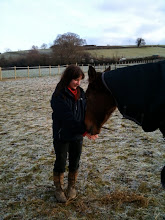
Tonight i schooled Spice in the arena and now I'm absolutely buzzing! She was incredible in every way and i even had her working in an outline with a bitless bridle! Something i've never done before but she did it without me even asking her to! The barefoot treeless saddle that i'm using is 100% flexible in all ways and i think this is what is making the difference. Spice is completely free to move in anyway she likes without the restrictions of any rigid parts. Why more people don't use treeless saddles i'll never know ah yes it's that old age thing called 'tradition'. Boy are they missing out. After the initial 'wearing in period' with these saddles you can actually feel every single movement of your horse which is amazing. I even managed to sit to Spices canter properly for the first time too (which is something i have always struggled to do in a treed saddle.) I hardly had to use my legs because she understood my verbal cues (thanks to all the lunging i've been doing with her.) and i even got her to back up on a verbal cue!
Anyway i have titled this post 'It's the little things that count' because i have recently noticed a huge change in Spices overall demeanor. For example...
*Spice used to toss her head away every time i used to take off her head collar.
*Spice used to toss her head about as i used to tighten her bridle.
*Spice never used to stand still when i tried washing her after riding.
*Spice always walked at her own pace when led rather than at mine.
The list goes on...they were all small things in and of themselves but together they were all signs that Spice was not respecting my authority/leadership.
Julie Goodnight a natural horsemanship trainer said that often, it's better to give your horse one harsh correction than to keep nagging them and giving them small corrections.
I have really taken this idea on board and have seen a massive improvement in Spice.
For the first time i actually feel confident that i could ride Spice out on my own without any big arguments something that until very recently i never thought i'd be able to say.
I am so glad that i decided to go Barefoot with Spice because it has forced me to confront all the issues i had with her on the ground rather than on her back which is a far safer place if you are having issues! If you don't have respect from your horse on the ground you definitely wont have their respect on their back and they will continue to question your leadership. In my view, to attempt to improve your relationship with your horse without addressing the problems you have on the ground would be completely counterproductive.
Although I know that i still have a way to go with Spice I am so proud of what i have achieved so far and am so grateful to the internet...to be able to learn from some of the best trainers in the world for free has been incredible. I'd have been lost without it.
Showing posts with label Respect. Show all posts
Showing posts with label Respect. Show all posts
Monday, 28 June 2010

Sunday, 4 April 2010
91. Long Reining...
As usual Spice has given me a headache...It's 2.24am in the morning and i find myself lying in bed 'thinking over' everything that happened yesterday. The first feeling i felt after what happened when i tried to get Spice to go towards the gate yesterday was disappointment. I was disappointed in Spice. All i could think was how dissappointed i was that after all our work she had failed the task i had set before her but really it was me that had failed...
Is it a case of long reining her out of the yard first so i learn what to do with my reins without the risk of getting injured in the process?
Or is it simply a case of simply being more authoritative, firmer, stronger and quicker and in effect 'forcing her to go' as when Spice is flatly refusing to listen to me even before i attempt to communicate with her she is completely disrespecting my authority.
Anyway, tomorrow i have decided to long rein her in the arena and try to perform a variety of transitions so i can get her 'listening' to me and then long rein her out of the yard and then repeat these exercises whilst riding her...
Will let you all know how it goes providing i'm still alive to tell the tale...
One thing is for sure...i never imagined just 'how much learning' was involved in riding!
Friday, 26 March 2010
Sunday, 14 February 2010
39. Herd Behaviour...
After i did some ground work with Spice today i decided to sit and watch the herd for a while to see if there was anything i could learn about leadership...
As soon as i put Spice back into the pasture i noticed that she immediately started 'dominating' all of the horses who were as we think of it 'beneath' her. She used what could only be described as threatening, aggressive behaviour to do this and sure enough it worked - she managed to re-affirm her position as being above them in the herd putting herself in second place to fen the herd leader.
What i also noticed was that as soon as spice launched an attack on a horse 'beneath' her that horse would quickly follow suit and launch an attack on the horse they deemed to be 'beneath' them.
However, during this process i noticed that there were two horses that did not to take any notice let alone part in the shananigans and this was Fen the herd leader and her yearling pie. In fact, apparently they did not once feel the need to re-affirm their position...and throughout the whole ordeal remained completely calm and unphased by it.
What i noticed next though was even more interesting. Once spice had moved the rest of the herd around she walked over to where fen was and started grazing by her side. Then as fen moved away towards the rest of the herd spice followed and she continued to stay beside fen for quite some time until things had calmed down and everyone was grazing.
Knowing that spice is the most nervous horse in the pasture and definitely the least bold led me to wonder something...could it be that because spice is more insecure than the other horses she feels the strongest need to be looked after and has learned that in order to feel safe she must be able to stay near to fen her leader and that the only way of making sure this happens is to be 'higher' than the rest of the herd so no one can move her away from this safe place?
It seems to me that spices attacks on the other horses were not what at first glance look to be aggression based attacks based on her wanting to assert her authority and leadership over them but actually fear based motivated by a deep sense of self preservation. She isn't bold enough to ever be the herd leader and doesn't want to be which is why she never challenges fen but it seems she recognises that to be 'best buddies' with the herd leader is the safest position to be in and so wards off any horse she feels could threaten this position.
Fen on the other hand is an extremely calm horse and seems to have an inner sort of confidence, she doesn't seem to have or need to be looked after by another horse and so doesn't have any need to try to battle her way through to 'any position' is this why she doesn't take part in these attacks?
Fens yearling Pie, is also calm but does he know that no matter what position he is in (which is currently the bottom) that his mum will always protect him over any other horse and therefore like fen feels no need to fight for position?
For years, it seems we have assumed that horses which dominate other horses do so because they are re-affirming their positions as being the leader of that horse the more bolder and more confident...However having thought about everything i saw today...it seems that it is not the bolder more confident horse that attempts to put another horse in it's place for seemingly no reason but actually the less confident.
The only time i saw fen exert any dominance over any of the other horses was when she wanted to go in a certain direction and they were in her way - However, she never attempted to use violence or aggression to do this - more often than not she was most polite and merely suggested that they move for her to which they all obliged.
So what does this say about leadership?...well on reflection i think it says alot - it seems to suggest that by taking an un aggressive approach and being calm, fair and polite your horse will actually want to be with you and do as you ask because they know that you keep them safe and self preservation is what comes first to all horses. So provide a safe place for your horse and he/she will want to be with you just as spice wants to be with fen.
In human terms i think of it like this...in our life when another human puts another person down - it's often because they are insecure about themselves and are merely projecting their feelings of insecurity onto someone else. However, it is rare that such a person will ever attempt to put someone they see as 'popular' down in fact often as humans we will try to 'suck up' to the more 'popular' person and go out of our way to please. For instance if you befriend the most popular person in school the chances are they'll look after you and protect you from ever getting bullied or picked on. I wonder if this could be similar to what horses do...
Of course i could be completely wrong about all this... i've simply tried to look at things and make sense of them...
Thursday, 11 February 2010
38. How to make your horse more confident...
Case Study...
Millie was a Thoroughbred X, 6 year old mare who had been with her current owner for two years. Millie lived with four other horses and as a herd they had access to shelter but lived out 24/7.
Millie's problem was very obvious and very dangerous. If she found herself in a challenging situation when out on a hack she suffered from complete fear. Her reaction to problems was to bronc wildly and once she had unseated her rider she would either bolt for home or stand still and freeze.
Millie's problem was very obvious and very dangerous. If she found herself in a challenging situation when out on a hack she suffered from complete fear.
Previously Millie had limited training and experience of humans. She had the minimum of handling up to the age of 18 months old, with a farmer leaving her turned out with a herd of horses. Millie had virtually no handling after that, up until she was four. She arrived with the new owner wearing a broken head collar and having been herded on to the trailer.
Her new owner had equine experience as a child and had got back into horses three years earlier. She was very keen to help Millie and understand her horse's behaviour. When Millie initially arrived it took two weeks to get her head collar on. She escaped twice while being lead, hated being tied up and was always tense and nervous. Millie had been sent away to receive some training and this had made some improvement in her behaviour. However, the trust had gone between horse and rider and the dangers of Millie's behaviour now meant that she was not being ridden out or taken anywhere.
Possible causes of behaviour
* Lack of training and experience as a youngster
* Pain
* Lack of confidence and problem solving skill
* Lack of trust between horse and owner
* Owner confidence very low
Solving the Problem:
Pain is always the first possible area to be considered when dealing with problems and after an initial examination it was recommended that Millie was checked by a vet to establish if she was experiencing pain. Some physiotherapy followed that veterinary check.
Millie might have been six years old but she only really had two years experience and not all of that had been good. Essentially, Millie was a feral horse when she arrived with her new owner. In these situations it is best to forget the physical age of the horse and think about their age in relation to the amount of training they have experienced. In this case Millie was really about one and half years old. It was not surprising that Millie was unable to deal with problems out riding when she was terrified by a sheet of plastic on the floor of the sand school. She was also unable to accept the long lines on her body. When working with problem behaviours we have to find out just how small the comfort zones are, and what the animal will tolerate before we can write a shaping plan or begin training.
Equines have not evolved to have a great problem solving ability. Evolution has equipped them to "run" away from anything they find fearful and to avoid anything that might be dangerous. If they cannot escape, then using fight behaviour may be their only option for survival. In the wild, equine problem solving revolves around their normal behaviours such as, running, kicking, rearing, bucking, biting and any variable or multiples of these behaviours. In domestication they have to apply these same problem solving behaviours to the situations that they find themselves in. Domestication is really the process of limiting the use of these natural problem solving behaviours and teaching the equine more appropriate responses to the problems they may encounter. It is important to remember that problem behaviours are rarely a problem for the horse; they are only a problem for us humans.
Millie's training had to start all over again, with the emphasis on teaching her a calm relaxed new way of solving problems, while building trust between her and her owner. Shaping plans were created to allow her to learn standing still as a way of solving problems. Standing still when faced with a problem is not a naturally occurring evolutionary tactic. However, in domestication it is vital. The shaping plans involved the use of counter conditioning and systematic desensitisation to introduce Millie to having all areas of her body touched, right up to her happy acceptance of the long lines.
Other shaping plans involved allowing Millie to learn how to deal with different obstacles such as plastic sheets, bunting and water etc. The use of the obstacle course is to build confidence and problem solving ability, but this can only happen if the trainer recognises there is a difference in the learning that takes place when an equine is made to deal with something it fears and when it is allowed to learn that it can deal with its fear. Millie had to learn how to deal with problems so when out riding she could give her owner a chance to guide and direct her through difficult situations and so that she was relaxed enough to listen to her riders directions.
The shaping plans led Millie through dealing with obstacles and problems while being led in the school, in the yard and the field. Then the training progressed to being long lined over the obstacles in the school, yard and field. The next step was to ride Millie through and over the obstacle course in the school, yard and field. Doing difficult and challenging tasks successfully together builds trust in the relationship between horse and human.
Once she was happy with all this training, Millie was led in hand on the road to familiarise her to the most common routes and situations she was likely to encounter. From here short rides began to take place gradually increasing in the distance and duration.
During the four months of training, Millie's owner had to learn to long line, which she did on another older very experienced calm horse. A great deal of importance was placed on the owner's ability to use small steps and to stick to a written shaping plan. Millie was never forced to do things but her comfort zones were gently stretched. Millie's owner also had to learn that there was not going to be a relaxed hack for quite some time, she treated all her rides as a training session until Millie was confident and calm in all the possible situations she encountered. After all this training Millie and her owner were able to relax more and begin to just go for a hack.
Often the ability to deal with very difficult problems is just down to the trainer's readiness to take the time required to do the correct training thoroughly, and the ability to use good clear shaping plans to break large behaviours down in to small manageable steps.
Subscribe to:
Posts (Atom)