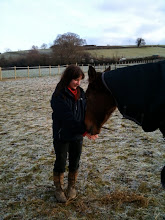
I wrote this for a friend who was interested in the "different" way I do things with my horses.
How Horses Get Your Meaning
If I could only tell you one thing about getting along with horses, it would be this:
Horses figure out what you want by noticing when you RELEASE the pressure that you use to ask them to do something.
In horse society, horses don't very often use their voice to communicate. Instead, they communicate by "feel." They use body language to "push on another horse's personal space." The pushed-on horse tries to do something to make the pressure stop. When he does what the other horse wanted, that horse stops pushing on him, thus communicating, "Yes, that's what I wanted. Thank you."
By the same token, a horse can use body language in a way that invites another horse to come closer for friendship or play.
When we ask a horse to do something, it helps to be very clear about what we want, especially when asking the horse for something that's new to him or something horses don't normally do. For example, "Please go in that washroom" is a large and vague request. "Please move your left front foot forward" is small and specific. We can answer the moved foot by releasing our pull on the lead rope; and building on that "Yes" we can ask for additional footsteps, each answered with a release, that will soon get the horse into the washroom.
The timing of the release is what tells the horse exactly what we asked for. If we release just as a certain foot steps forward, the horse can figure out that our request was about that foot. If we're late, and release two or three seconds after that foot moved, we are actually telling the horse that "the right thing" was something else (let's say he turned his head toward the window) that he was doing just as we released. The next time we ask, he will try looking toward the window again, thinking he's got the right thing, and get scolded. You can see how a horse could get pretty confused. Then he gets called "stupid."
The timing of the release is so important that you will have to develop your own ability to focus on what you are doing with your horse. The better your own focus gets, the better your horse will understand you and the better you two will get along.
If you didn't know that it's the RELEASE that says "Yes" to the horse, you'd just continue your pressure while he is doing what you asked. This will generally result in one of two things happening:
* Not receiving the information that he already understood what we wanted, the horse continues to try doing different things in search of a release. Some of what he'd try might be much bigger moves than what we're prepared for.
* Not finding any release from our pressure, the horse eventually gives up and tunes us out. He decides the pressure is uncomfortable but meaningless. Before long we'd end up with a non-responsive horse. The dullness carries over to other areas. For example, if we keep a constant pressure on the lead rope while leading a horse, then when we ride him we will find him unresponsive in that situation too, which we call "hard-mouthed."
When you ask your horse to do something new, or you ask someone else's horse to do something, the horse has not-a-clue what you want. Give him time to try some different things to figure out what you want.
Suppose I stuck my finger in your ribs and said, "Do it!" You'd say, "Do what?" If I just kept on saying, "Do it," you'd have to try some different things till you figured out what "it" was. Now, suppose it was something less than obvious, like reaching down and tapping your heel --- Well, this is the situation we put our horses in all the time. We have to be always thinking how we can set up the situation to help them figure out what we want, and we have to give them the instant release-of-pressure that says, "You got it!"
Part of setting up the situation to help a horse understand would include making a clear mental picture of the horse doing the asked-for motion. The best riders and horse-handlers run a continuous mental movie for their horses to pick up on. It takes a lot of focus and discipline to do this, but it makes a big difference in the level of communication and understanding.
The Leader
The second thing I'd tell you about getting along with horses, would be:
A horse always wants to know who the leader is. He is always looking for a good one.
The horse is a prey animal. Horses always have to keep in mind that in the next instant they could be eaten for breakfast. Safety comes from living in a group that is led by a smart, capable horse who has good judgment in many situations.
Therefore, whenever two or more horses meet in the contrived situation of domestic living, the first thing they want to figure out is, "Who is going to be the leader?" It seems that a horse is extremely uncomfortable when he doesn't know who's the leader. They are all capable of leadership; some enjoy it more than others. Most of them don't much care whether it's "me, or somebody else," they just want to know who it is.
When a horse meets a human in the contrived situation of domestic living, as soon as he makes sure he's not going to be the human's breakfast (because he can tell by the way we walk up to him that we're a meat-eating sort), next he wants to know whether he or the human is the leader. In the horse's mind, one or the other has to take the job. If the human doesn't act like a capable, trustworthy leader, the horse will step into those shoes, and he will do what he thinks is best, which may be different from what we wanted.
Horses seem to use two different styles of leadership among themselves. Since humans easily get side-tracked into notions of domination, the leadership style that we tend to notice and use with horses is called the "alpha" or "boss" style. This is the "show him who's boss" or "always let him know you're the bigger horse" way of dealing.
In established herd situations, close observation shows that while most horses quickly get out of the way of a bossy horse, their body language speaks loudly of resentment and resignation. Further, a band of horses led by an "alpha" horse tends to frequent bickering among themselves.
A less-noticed leadership style that is probably more prevalent among the small bands in established herds, is the "passive" or "chosen" leader. This horse doesn't try to gain followers, but goes quietly about its business, avoids fights, conserves energy by observing a social situation before taking appropriate action, and is consistent in its behavior. These horses end up being followed by a peaceful band that interacts respectfully, going out of their way to be polite and fair with each other.
These observations, described more fully in Mark Rashid's new book, Horses Never Lie, give us a clear choice of ways to deal effectively with our horses. Both are valid leadership styles in horse society; the difference is in the attitude of the followers.
The alpha horse's followers are there because they have to be, and their attitude toward the leader is one of dislike and resentment.
The chosen horse's followers are there because they want to be, and their attitude shows in willingness and cooperation.
While there must be some horses out there that do better with an "alpha" leader, it sure seems more fun to become a "chosen" leader for your horse. A horse that wants to be with you will be relaxed, learn easily, and give you everything he's got and his heart besides.
So here are the kind of things to do to become a chosen leader:
* Be polite, precise, and consistent in asking the horse to do things.
* When his attention wanders off elsewhere, gently and consistently invite it back to you.
* Some horses are so scared of people that they seem quiet but actually have a glassy-eyed, out-of-body look. These ones need lots of stroking, scratching, and massage. The TTEAM bodywork and groundwork taught by Linda Tellington-Jones lindatellingtonjones.com can be very helpful here.
* Do groundwork to develop your communication skills. Using as light a touch as possible (but as much as needed), ask the horse to move the head, the front end, the rear end, come forward, back up, etc. Thank the horse for each move with some stroking (not patting).
* Stay awake and present. If your attention wanders off elsewhere, the horse knows it and will take leadership the moment you "leave." Also, the moment you get scared.
There is additional good thinking about leadership and about treating your horse well physically and mentally, on http://equinestudies.org, in the Forum section fielded by Dr. Deb Bennett.
Respect and Riding
You will get along with the horse better if you respect him for who he is -- just as you want him to respect you. My definition of respect would be:
"You have a right to exist, to be who you are, and to see things your own way; therefore I will neither harm, ignore, nor belittle you."
Part of respecting the horse is learning to be the best rider you can be; while, from his side, the horse is learning to carry you the best he can.
The horse already knows how to move gracefully. When we sit on him, our clumsiness, unclear communication, and lack-of-balance make him have to do extra things to keep from falling over. Thus he appears to be ungraceful.
Learning to ride well is learning to BE in cooperative, moving balance with the horse's movement, and learning to DO less and less until you are just sitting there thinking about where the two of you are going and in what style of movement.
It is well worth your learning some Centered Riding, Feldenkreis Movement, or Alexander Technique; or getting Rolfed (a type of bodywork that realigns the body for greater range-of-motion and better balance). If you do any of these, it will help your horse a lot.
www.centeredriding.org
www.feldenkrais.com
www.alexandertechnique.com
www.rolf.org
www.rolfguild.org
When you can get yourself completely out of the horse's way, he will give you all that he has to give, and you will know grace.
Lightness. It Exists.
The horse is a creature of lightness. He responds like lightning to what goes on around him. If he were not, he would never have survived millions of years of being hunted by the large cats.
For the safety of both the human and the horse, most often beginning riders are started out on horses who are patient or dull enough to put up with a beginner's un-balance and crude communication skills. So we arrive at a notion of the horse as slow, stupid, clumsy, and hard-of-steering, and we adjust our learning-to-ride to this notion. Unfortunately, this is profoundly discouraging to both horse and human.
I want you to know that another way, the way of being light with the horse, does exist, and that it is awesome. There is such a thing as two beings thinking and moving as one. The horse can and will give you instant response, fluid motion, and athletic beauty that will move you to tears. It is his nature to do this, not something we have to teach him. The first time you experience the all-giving of a horse, it will change your life. Forever after, you will want that again!
Luckily for both horse and human, learning to ride does not have to be a gradual uphill road with lightness only occurring after years of work. Rather, total lightness may occur rather soon; the first time, maybe when you find a good position by accident, but then with increasing frequency and in longer moments, until after years of work you can get many lightnesses, some lasting several minutes, nearly every time you ride.
Lightness: Two Styles of Communication
When an "alpha" horse asks another horse to do something, there is a progression of increasing signals or pressures. For example, if April tells Music to "get away from my dinner," the pressures might be:
1) April pins her ears back at Music. If there is no response,
2) April snakes her head at Music. If there is no response,
3) April swings around so her rear end faces Music. If there is still no response,
4) April kicks Music.
In practice, Steps 2, 3, and 4 rarely need to happen, because Music is familiar with the progression and will move as soon as Step 1 occurs. That is one way to lightness. We can use progressively bigger signals till we get a response; the next time, the horse will respond earlier in the progression, until finally he will respond to the light signal, which we can then fade until it is no more than a fly landing.
If we use the "chosen leader" style, we can avoid the "bullying" aspect of increasing pressure, and end up with a willing rather than a resentful horse.
Use light pressure with your hand, or a rein, etc. to ask for a move. Stay at the same pressure, and feel for the horse's "try." You might even close your eyes so you can feel very subtle movements in the horse. When you feel any change, release the pressure. Ask again, lightly; again feel for the horse's "try," and release. The horse is tentatively saying, "Is this kind-of what you want?"
Your light requests and quick releases give him confidence to make a bigger try, such as shifting his weight slightly in the direction you're asking, or beginning to lift a foot off the ground. Soon, with your respectful feedback, he will figure it out.
Notice that when a horse "gets it," he will "chew it over" with his mouth. While he is chewing on it, let him be; this is an important step in his understanding something for future use.
You can add to the horse's reward by stroking after every "try." (In the equine vocabulary, patting most closely resembles kicking.) When the horse finally understands your request and responds fully, stroke some more and just stand there peacefully with him for a few minutes. Horses love it when they can be with you and not have to be always doing something. It's a major, rewarding release of pressure for them.
Once a horse has understood something, there is no need to drill him on it. Repetition after understanding just makes him bored and resentful. Most of the moves you're asking for are things you use every time you ride, anyhow. Try to have a real reason for a request. My mare will move over for me in the stall with a finger-touch on her hair, but falls asleep when I "practice" with her in the arena.
More on Leadership
Becoming a good leader for a horse means you have to work on two things in yourself: improve your timing and improve your integrity.
A fun way to improve your timing is to use clicker training with your horse. Clicker training was invented for teaching dolphins how to do tricks. It is now becoming widely used with dogs. Horse people are just discovering it.
The clicker (or any other brief sound) is used to MARK the asked-for behavior, such a moving a foot in the desired direction, followed by a reward that the horse has learned to associate with the click. Some horses don't care about food, you have to find some other reward that your horse likes enough to work for. For example, there are dogs that work better for a thrown frisbee than for food.
My horses' attitude toward learning improved 100% when I discovered clicker training. They love to know exactly what I want. They love to figure out "how to get Marjorie to click me." They enjoy having a "playday" in bad weather or when I don't want to ride.
I've used the clicker to get them doing all types of leading and groundwork without a halter, to freelunge with better position and movement than they ever got when lungeing in sidereins, and to do tricks such as climbing up on a pedestal (or a rock in their pasture) with just room enough for all four feet, which improves their balance and trust.
Clicker resources are: the book that started it all, Don't Shoot the Dog by Karen Pryor, which explains the principles of operant conditioning, and Clicker Training for Your Horse by Alexandra Kurland, both available with a clicker from www.clickertraining.com or 1-800-472-5425. This store, Sunshine Books, also has videos on clicker training for dogs which can help you with your horse. Another source of clicker training books and videos is www.dogwise.com or 1-800-776-2665.
We all have integrity problems toward our horses, because in this culture we are surrounded with the notion that humans are superior beings, and that therefore being insensitive and disrespectful toward animals doesn't matter in the greater scheme of things. Someone once asked Tom Dorrance, the great horseman and teacher, for a few words everyone could take home to chew on, that might improve their horsemanship. Tom thought for a while and said, in his slow, quiet voice, "Man looks down on the horse." Tom Dorrance recommends Kinship With All Life by J. Allen Boone, a little book that will give you a different way to think about equality of being.
Prey and Predator: A Matter of Awareness
Horses are much more aware of us than we are of them. A human can spend a lifetime around horses, totally oblivious to a profound difference in point-of-view -- a difference horses notice the first time they meet us and always have to take into account in their daily dealings with us. The horses' awareness of this difference sometimes causes them to act in ways that the human misinterprets into human terms.
The horse is a prey animal. His place in the food chain is always the-one-eaten. His food is grass, he has no fangs or claws, he has nothing to protect him but his split-second perception and fleet-footedness. His eyes and ears are placed to see and hear all around. He's hard-wired to scoot first and think later. When he approaches the water hole, he circles around and stops often to check for lions.
The human, though sometimes prey, has many predator characteristics. We have binocular vision, in common with the cat family, the dog family, and the hunting birds. Binocular vision allows us to judge distance -- exactly how far we are from our quarry. We tend to walk directly to the water hole; we look one another straight in the eye; we look prey animals straight in the eye; and we walk directly to them.
While it may never occur to us that we act this way, the horse notices the difference and is rightfully scared by it. So, if we want to get along well with horses, we need to learn to stop acting like a predator. The less we act like a predator, the more the horse can let down his guard and feel safe in our presence.
We know that fear prevents learning. Therefore, the less we act like a scary predator, the better our horses can learn what we want them to do.
Some things we can do to act less in the predator role:
* Until the horse knows you, don't look him straight in the eye. Look at his nose or his feet, and use your soft-eyes (peripheral vision) when you look at his eyes.
* When you walk up to a horse, a curve may make him more comfortable than a straight line. Stop at the edge of his "personal space" (the place where he gathers himself to move away) and wait for his permission to enter (he relaxes and stays where he is).
* The human emotions of anger and holding-a-grudge seem not to exist in horse society and are scary to horses. When you get angry (and it happens to the best of us) get yourself away from the horse till you cool down. YOU ARE SCARY TO HIM.
Groundwork
So often we think of the horse as a sort of motorcycle. That's what riding lessons are about: you brush the horse, put on the saddle and bridle, hop on, and VROOM off we go.
On the other hand, the thing that's so attractive about horses, and what's different about them from motorcycles, is that they are alive. Why do some of us get hooked on horses instead of motorcycles? Isn't it that we get that glimpse of the horse as a fellow being, a "someone" we might be able to relate to? Haven't most of us heard and read tantalizing stories of horse-human bondings and partnerships?
Groundwork is about the horse-human relationship. The horse IS a fellow being. He IS a "personality." He DOES enjoy getting to know us. He CARES about figuring out what we want, and he LIKES building the partnership of intent and action.
How are we to build a partnership between creatures so different as horse and human?
Human language is a very complex thing -- so complex that only humans are able to use and understand it. Horses can't.
Therefore, we use groundwork as a way to show humans how to get along in horse language.
The horse's mind is able to deal with very high levels of logic. Any time a horse is not operating in fear mode, he is using his reason to figure out and deal with the goings-on around him. Some of his priorities are different from ours, because he is a different creature, but he is using logic. Our side of building a partnership is to learn what the horse's priorities and assumptions are, and become fluent in horse-logic so that we can "speak the horse's language" at all times in our daily life together.
I have seen horses be so pleased when I manage to be horse-logical. They LIKE to understand what I'm saying to them. They LIKE to "get it." They LIKE the security of really knowing what I want and not having to guess.
Groundwork allows you to simplify what's going on, so that you have time to figure out horse priorities, assumptions, and logic. Groundwork gives you time to develop your patience (calmly continuing your request until the horse really responds) and your timing (when to release to best be understood).
Doing groundwork "at liberty" gives you the space to practice your dance with the horse. If I walk over here, where does the horse go, and when? Can I move in such a way that he will turn at the third post and go the other way? How politely do I need to move, not to provoke resentful kicking and tail-swishing?
I watched a skilled groundworker playing with a very fearful mare. The woman flowed like water, alternately urging and melting with her body language, matching every nuance of the mare's movement. The mare calmed down from a tight, head-in-the-air gallop, to a relaxed trot, and before long walked up to make probably the first human friend in her life.
If we watch the horse moving well without our weight bothering him, then when we ride we can give him a clearer mind-picture of himself moving well.
The first time you try groundwork, it may take a while just to figure out one piece together. Some of the parts-of-movement that you can play with over a period of weeks would be:
* Relax at the poll. Head can twirl a half-inch to the left and right on the first neckbone. This unlocks the whole topline so that he can move freely. (Stand in front of the horse, hold the head gently, press gently to ask for a slight head-twirl to one side, release; repeat to other side. After several head-twirls you'll notice the head lowering toward the ground and the horse relaxing.)
* Hindquarters step sideways, left and right.
* Front end steps sideways, left and right.
* Step backwards, relaxing all the way along the neck and back and down to the hind feet.
* Walk sideways, left and right, with a relaxed bend through the body. Have the horse face a fence or wall so he can't go forward.
* Leading: walk beside us, on both sides, with halt, back up, walk forward, trot, slow to walk, and halt.
* Make a circle around us, to the left and right; change directions with a nice rocking back onto the hindquarters.
* Human stands three feet from the wall, horse goes between us and the wall, to the left and the sright. (You'd want him to be able to do this before you tried loading him in a trailer.)
Some good places to learn about groundwork, with pictures to help:
Problem Solving by Marty Marten, and Natural Horse-Man-Ship by Pat Parelli, both in the Western Horseman series.
Groundwork by Buck Brannaman.
True Horsemanship Through Feel by Bill Dorrance.
The Trail Less Traveled, a natural horsemanship magazine.
Teach "Give to Pressure"
One of the most useful tools we have, when asking a horse to "go here, back up, move over please, etc.," is to put a finger on the part of the horse's body we would like to move, or apply pressure with the halter or bridle to change the direction of his head. A horse that has learned to move away from our touch with any required part of his body has learned to "give to pressure."
Horses are not born knowing this. They learn it from their mother in their first day of life, in regard to horses they respect. In regard to horses they don't respect, and to predators (remember, they know we are predators), their tendency is to push against the pressure.
It's frustrating and dangerous to deal with a horse that doesn't politely move over when you politely ask him to. Therefore it's well worth a few minutes every day, ongoing, to teach your horse to move at your fingertip request.
Doing a lot of this work will also help a horse that "pulls back when tied" (breaks halters). He most likely learned how to break the halter before he understood "give to presssure."
About Cussedness
Horses are kind of like a deer or a rabbit: Fear is never far below the surface. The horse is easily made afraid for his life.
As a social creature, he's also afraid of doing the wrong thing and displeasing us -- more so, the more we matter to him.
We humans often ask for what we want in a way that's foreign to the horse's way of understanding. Horses get scared, confused, or frustrated by the lack of horse-clarity, and then they do things we'd rather they didn't do.
We humans live in a society where there are people who manipulate and take advantage of us. Through our human-colored glasses, we manage to see horses' confusion and their actions of self-preservation as one more instance of human "cussedness," and we relate to them as though they were "out to ruin our day."
This mis-perception on our part causes us a lot of trouble with our horses. Horses are creatures of amazing goodwill. They are truthful and direct in their dealings. If asked clearly and politely, they seem more than willing to do what we ask, and interested in getting along with us.
When a horse comes up with something different than what I wanted, rather than scolding or punishing, it works better to stop, take a look at the whole situation, and think about what the horse didn't understand (or what other factors, including pain, might be getting in his way). Then I can try different ways of presenting what I want, till I find one the horse can understand. Sometimes it takes going home and sleeping on it.
Avoid Wrecks
Wrecks are scary for horses. Some horses never get over a bad wreck. It can take months or years of painstaking work to undo the mental damage. If you care about your horse and his training, think ahead and avoid dangerous situations.
An important reason for doing some pre-ride groundwork is to avoid wrecks. Do a little groundwork every time before you ride, until you're sure the horse is with you mentally and not wandering off in the wild blue yonder.
Keep your horse away from situations that might call for better communication than what you, yourself, have with this particular horse.
For example, until you can do a reliable halt from the walk and the trot, don't expose the horse to a situation where you might need to ask him to halt from the gallop. Until you have a reliable back-up on level ground, don't expect the horse to safely back out of a trailer. Until the horse thoroughly understands "give to pressure," don't tie him up or crosstie him.
Use a safe place such as an arena to check out what your horse knows, to teach him what he doesn't know yet, or to learn yourself how to ask him for different moves. Then you can go "outside" knowing you have some communication to use in emergencies.
Domestication and Safety
Horses are a creature of the open plains. There is nothing in their hard-wiring that gives them the slightest clue about how to deal with most of what they run into daily in their dealings with human settlements: fences, long tunnels leading into small, dark caves (what lives in caves? bears and lions...), wheelbarrow handles sticking out to puncture them as they go by, being tied up by the head, tangled green water snakes, following a rope, etc.
We humans have to spend a good bit of time explaining all these things to every horse that gets born into our domestic world so that, understanding, they can keep themselves out of trouble. Even so, any horse that gets frightened can suddenly revert to the open-plains mentality: "Scoot first, think later. Struggle for your life". Then you have a wreck on your hands -- you or your horse spending big bucks to get patched up.
So: wear a helmet, wear boots with a heel to catch the stirrup, move the wheelbarrow before you lead the horse down the aisle, and don't wrap the lead rope around your hand. Keep a calm awareness of your escape route, should you need to leap out of the way in the next instant.
Don't hurry the horse. Be clear and consistent in your communication. Make sure he understands the foundation of each idea before you go to build on it.
Imagination and Responsibility
Human beings are the animal that has imagination. What I mean by imagination is that we are able to picture something that doesn't exist in the present situation, and take steps to make our picture become reality. Horses seem not to have this ability.
Therefore, whenever there is a difficulty between horse and human, it is the human's responsibility to imagine how good things could be, and to show the horse how to get there in a way that he can understand. I think horses appreciate what we do to make their lives and their work better, and that is part of why they enjoy us and like to do things with us.
Love is more than just a feeling. It's thinking well about your horse.
Showing posts with label Horse Psychology. Show all posts
Showing posts with label Horse Psychology. Show all posts
Tuesday, 2 February 2010

Monday, 1 February 2010
32. Anthropomorphism...
The attribution of human characteristics to non-human creatures...
As humans i can't help but think that we have an overwhelming tendancy to only ever see things from our own points of view.
A perfect example of this was when i was riding back one day after a long hack with a couple of other riders. It was a hot summers day and there were plenty of horse flies around which had been pestering our horses for most of the ride.
About a 100 or so yards away from our stables (on our way home) i noticed that Spice started to reach her neck around towards her girth area.
Having never experienced her doing this before i immediately thought that she must be uncomfortable somewhere so after a few more attempts and also noticing that the poly pad i'd been using had slipped over to one side i decided to dismount to see if i could ease her discomfort.
Upon dismounting the girls i was with both gave each other a smirky look which i noticed and asked them to explain. One of the girls replied: 'you've got to learn that horses are clever and will try it on' - i was surprised by how sure these girls were that my horse having never before 'tried anything on' would devise a plan so cunning as this. Did she really think that whilst hacking out my horse had thought that if she made it look as though she was in pain or uncomfortable by reaching her neck around to her girth area that i would take pity on her and get off?
Needless to say, Spice never attempted to swing her head around in an effort to make me dismount ever again. So if she was intelligent enough to devise the plan - she certainly wasn't intelligent enough to remember to use it!
This experience along with many other similar experiences has led me to believe that as humans we are guilty of attaching our own thoughts and emotions to situations and have a strong tendancy to only look at things from our own points of view. I would employ horse owners to look at things from the horses point of view in order to gain a better understanding of your horses feelings.
From ALL of my experiences so far with Spice - i can honestly say that she has always been 100% genuine, a horse in my opinion never 'lies', never 'takes the piss' and certainly never concocts plans.
Monday, 25 January 2010
31. Natural Horsemanship Essay...
Equine Competitive Sports Psychology (ECSP)
There are a few definitions for ‘sports psychology’ offered by various psychologists as well as coaches and sports professionals.
A science that deals with the mental and emotional aspects of physical performance.
is one that fits fairly well I think. Another is;
Sport Psychology is the study of the psychological and mental factors that influence and are influenced by participation and performance in sport.
Until now, it appears there has been nothing or little recorded or written about the psychology of equine competitive sports. This may be due in part because of the fact that this is a competition where a human and another specie are partnered together with the goal of high level performance and winning in various disciplines, as opposed to participation by a single human. This unique situation prompts delving into not only the psychology of excellent performance by the human, but the horse as well. An in depth inquiry into the mind and psyche of the horse is essential along with the same study of the human psyche. This is where many problems arise as the horse is a very different creature than a human. Great misunderstanding and lack of knowledge of horses abounds worldwide. There are many great riders who know little of the true nature of the horse they are riding. This lack of understanding prevents many fine equestrians from achieving the higher levels of competitive success. Certainly the practice of visualization, conscious breathing, acquiring technical skills, regular and appropriate training and practice of a particular discipline will go a long way to assist good performance. But there is something more required in the partnership of the horse and human in order to achieve the upper levels in competition.
This is the development of mutual trust. If the human does not really understand the mind of a horse, the tendency is to go to forcing the animal to comply when it shows resistance with a request, to produce enough fear in the animal that it fears the human more than what is asked by the human. Of course many good riders win and do achieve a degree of competitive success without knowing much about the horse they are riding, fewer have developed mutual trust. Their only thought is to win with little concern for the well being of the horse other than cursory interest within the competitive environment. Eventually, the horse’s behavior often times shows fear. Then frustration levels increase until, even the most talented horse becomes unruly, uncooperative and actually dangerous to the human and itself.
Many times in my international travels I see somewhat high level competitive horses with little to no respect or trust for the humans handling or around them. They have never been trained to develop trust or respect for humans. The focus during their entire lives has been being ridden. Therefore, when a situation comes up that prompts a fearful reaction by the horse, they tend to want to leave the situation as quickly as possible as opposed to trusting the human enough to hang in there with that human and attempt to move through their fear. This is when the human takes the appropriate role as the wonderful, trusted leader for the horse. Horses are not slaves. They are supposed to be obedient. They are truly supposed to be ‘partnered’ with and led as being led by the great dance partner. There is supposed to be earned mutual trust and respect, understood skills acquired by both and a bond that has a strong connection at it core based on this earned trust. Unfortunately, it is only occasionally I see a human stepping up to the plate of earning the trust and respect of a horse. It is rarely I see competitive horses so well and appropriately handled and trained that they trust the humans with it much at all and vice/versa. Often it is only the groom who develops a modicum of trust with a competition horse. As a horse is a prey animal, eaten by predators, it has a huge flight response to a fearful situation or thing. This ‘fearful thing’ could be a jump, flash from cameras, loud noise like applause, loud music, sounds of traffic, a piece of plastic blowing in the breeze or
some invisible ‘monster’ lurking behind a bush. So many different things can produce a fearful response in a horse the list is endless. This fearful reaction can cause a rider to fall, get seriously or mortally injured and, least of all, to lose the competition. Some humans really do care about and have understanding and compassion about the natural fear that horses can have and react to. Some humans couldn't care less. They have no relationship with the horse even when on its back. These humans may occasionally win some ribbons and trophies. But, they will never achieve the long term higher levels of performance enjoyed by those few who seek to know and understand the horse they are riding and have that special relationship based on mutual trust.
The desire and ability to assist a horse through a fearful situation, to the outcome of confidence and trust is huge in ECSP. A human must want to know and understand the fear that can be within a horse. They must have the strong desire to discover the source of that fear and assist the animal learning that there is nothing really to be afraid of. Getting angry at a fearful horse is a sure fire, quick way to failure in any endeavor with that animal. First there must be compassion. A fearful horse is just like a fearful child, only dangerous. As we would show compassion and kindness to a child who is afraid, we must do the same with our horses. Once we come forward with this compassion and kindness, we can then take on the role of skillful leader/teacher and assist that individual in discovering for it self there is really nothing to fear.
This is how trust and respect are earned with horses; initially, it is our ability to ask for and receive simple, quiet movement by the horse as the beginning step to becoming the great and trusted leader for a horse. Our skill at requesting slow, precise and exact movement from a horse, one-step-at-a-time, will insure that horse will learn to trust us and be quite willing to, at least, attempt to comply with our requests. If a horse is properly and gently trained to respect the boundaries of a human handling it on the ground, it will tend to most often respect the leadership of the human who is in the saddle. It is a sad commentary on humans that so very few great relationships exist between horses and humans throughout the world. It is such a simple thing to accomplish. First the desire to help the horse trust (feel) it is safe has to be in place. Then a human needs to want to be a good leader for the horse and to assist the horse in gaining confidence through the elimination of as much fear from the life of the horse as possible. Then comes the relatively simple skills required to accomplish this. Again, those skills are the abilities of the human to gently and skillfully direct and guide all movement of the animal when that person is with it. This is perfectly logical as this is what the herd leader does with the horse herd in the wild. The rest of the herd trusts and follows that leader easily and willingly. That leader helps assure the survival of the herd. She is revered and protected by the herd. Her authority is unquestioned and unchallenged, again, because she helps assure survival of the herd through her knowledge and leadership abilities. The herd leader does not induce fear into the other members of the herd. She does not punish even the rambunctious younger members of the herd. She will, however, provide an appropriate consequence for unwanted behavior from a herd member. This approach sets up a learning situation rather than creating resentment and anger. She earns their trust and respect through her wonderful leadership. It’s that simple.
So, along with appropriate breath control (proper and conscious breathing), being in the best physical shape possible, practiced and skillful technique, a calm and focused mind and the acquired ability to visualize a great outcome of the competition, comes a great and trusted partnership, a wonderful joining of different species in a common goal. This goal is similar to the goal of great dance partners who have come together though practice, knowledge, skill, compassion, kindness and earned mutual trust and respect to offer up a wonderful example of excellence in partnership, shared talents and the best performance possible. Certainly this is a winning combination that cannot be beat.
SEE ALL OF FRANKLIN'S ESSAYS
30. Natural Horsemanship Essay...
How do Horses Show Affection?
Horses are extremely affectionate. If you get a chance to see them in the wild they are mutually grooming each other, scratching each other, leaning gently into each other, sharing breath with each other (a very intimate activity done by putting their noses together and sharing the air). These are all manifestations of affection. Mares and their foals are always nuzzling each other and the babies are always rubbing up against their moms. Sometimes they hang their heads over each other’s necks and gently hug with their necks. When a horse gently brings his head even slightly in your direction, it is affection and acknowledgement (unless you are holding a treat in your hand or pocket, then it is probably about the treat). The low, soft ‘nickering’ sounds they make at each other are other ways they show affection. However, love is the great carrot and the great treat. Real, unconditional love is the best form of affection and the greatest gift we can bring to our horses.
On the human end this is usually what occurs: We unconsciously reach into the animals face and want to pet and touch his muzzle (nose). If I reached into someone’s face and petted their nose, it would be rude, thoughtless and disrespectful. We do it to horses all the time. We think because he brings his head to us curiously checking us out that it’s OK to pet his nose. Or if he is sniffing us to investigate and get to know us that they are all right with us touching their faces. They do not have arms and hands and do not touch each other in this manner and, additionally, what we are doing is uninvited. We are touching their faces for us not for them. Most of the time they try to move their heads away from the oncoming hand, but to no avail. They react to the intrusion by moving their heads sideways or up and down. But we do not notice this reaction. We want to pet that soft nose and what we want takes all our attention, not the horse’s reaction to what we are doing. This is unfair and disrespectful to the horse.
When we reach into a horse’s physical space, no matter what, we stop its affection coming back towards us. Horses focus on one thing at a time. They are consciously either giving or receiving input, but not both simultaneously. So if the horse is trying to show us affection (which they really want to do) and we take it as an opportunity to input (touch or pet) them, we immediately stop their attempts at being affectionate towards us. This creates lop sided relationships with humans and horses where the human is always inputting the horse with what they think is affection. The horse, meanwhile, never really gets a chance to show it’s affection to the human. Stand and receive the horse’s affection. Keep your hands and arms down. Let them nuzzle you and gently bring their heads to you. Be still and quiet with your mind and body if you want to join with them. Empathize with the feelings you get from the horse. They live empathetic lives and look for that in their companions. Certainly you can put your arms around your horse and hug him, scratch him or reassuringly stroke him. He will get that you mean to be affectionate. But wait and do it when invited by the horse’s demeanor and body language.
When a herd leader wants to allow affection from another horse, she turns sideways and seemingly ignores that horse (goes about her business of grazing). She allows the other horse to approach her and show acknowledgement and affection. It may not involve actual physical contact. But, rather feelings of acknowledgement and acceptance shared and demonstrated through body gestures, postures and mutual awareness (empathy).
I encourage humans to be more like horses and perhaps understand that less is more with horses. By that I mean we could try not to be so forward with horses. We could try to make our desires requests rather than demands. We can chose to lead like Gandhi; lovingly, firmly and quietly. We could abandon leadership like Mussolini, with his loud, controlling, fear based dictatorship. I can now understand the kind of humans who only want to be with horses. There is no self-serving ego to deal with, nor trickery or dishonesty with the horse. There is not much drama either. The horse is impeccable and that’s a fact. They are honest, no matter what. They have personalities and disorders like we do but not the ego.
When your loved ones are affectionate with you know how it feels. It’s the same with horses. Loving touches are noticeable and stand out more than casual physical acknowledgement like hand shakes and pats on the back. Tune in to how you feel when your horse is showing you attention. Receive the attention/affection and just say ?Good Boy?. There is no need for anything else. You will both understand what has occurred. You will have been mutually affectionate as giving and receiving are actually the same thing.
If you are able to establish a great amount of mutual trust with your horse, this will lead to more affection and a stronger bond. Being a great parent/leader is a wonderful way to show affection for your horse. Being the great Mom or Dad for your horse means you are there for his feelings of safety and trust first and foremost. What kinder and more wonderful way to show affection than attention to another’s sense of well being. What is more affectionate than kindness? What feels more wonderfully loving than kindness? In the face of the most fearful and potentially dangerous horse, kindness is the major component in its rehabilitation (just as with an abused human). Giving your best is affection also. When your horse gives you his all and the best he’s got that is his affection coming straight to you.
I guess I could sum this up by merely saying; if it feels like affection and you are not holding a carrot, it probably is. Don’t try to figure the horse out too much. I think it is better to experience and empathize with how he feels. That is the real key.
SEE ALL OF FRANKLIN'S ESSAYS
29. Natural Horsemanship Essay...
The Horse/Human Connection
Majestic, noble, proud, magical, mystical, powerful, naturally beautiful, living-breathing art, the embodiment of grace athleticism and strength. These are just a few of the ways humans describe horses. We also attribute to the horse some of the qualities we humans strive for in ourselves. Qualities such as loyalty, integrity and honesty are part of the horsesnatural being. A horse always gives us an honest response to what is presented to it. It does not have an ego to cloud its perception.
Horses and humans have been joined since the first newborn foal was taken from its deceased mother mare and raised by its captors. Before that and since many horses have been food for humans and been their prey. But as soon as we had the knowledge and ability to raise a horse from infancy we had to make a very important choice. The decision is whether to lead this young creature into the rest of its life, as a domesticated animal, through force (i.e. fear-based control) or to lead it through trust, respect, knowledge and mutual agreement (i.e. love). One way produces a slave, a being whose actions are motivated by fear of punishment, a captive. The other way produces a willing partner, a loyal and trusted friend. It builds a relationship with respect and trust at its core.
The question becomes, how do we lead this wild, magnificent creature who is more powerful and bigger than we are, without using the force that produces a slave. The first part of the answer comes through learning about the horse and it's language. This is done by observation of the animal in its natural state, in the wild. How it communicates with other herd members. The dynamics of it's social structure and how older horses teach and discipline the younger ones (who is the boss and why). Understanding the behavior we observe is just as important as seeing it. In the case of horses, they are a herding-prey animal. This means they are naturally flighty and fearful. Always sensitive to any aggressive energy. The highest ranking female (mare) dictates the movements of the herd. When and where to stop for food and water, and, in fact, all major decisions concerning the herd are made and directed by this "alpha" mare. She is assisted by subordinate mares who help carry out her wishes. The dominant male (stallion) guards the flanks. He protects his breeding mates from being stolen by would-be rivals and protects the herd from predators attacking from the rear.
Some of the earliest memories young horses have is of how their mothers and other older herd members communicated with them. This was done through body language, touch and sound, along with other sensory stimulation. We must learn this language in order to communicate with the horse in such a way as not to produce fear but rather to promote feelings of safety and security in the horse. When the horse has all the assurance it needs to know it is safe, it will want to "join" with us in kind of a communion of spirits. After all, we are not separate from nature. Like the horse, we need to feel safe within ourselves in order for our lives to flourish. The horse is always ready to be our willing and loyal partner but only to the degree we are willing to extend peace, respect and love to this most magnificent creature.
Through interaction with horses we can learn to know ourselves better. They show us who we are by reflecting ourselves back to us whenever we enter their space. Either calm, peaceful and confident or nervous and fearful will be their response depending on which we bring to them. This is all done in the moment, on the spot, when its happening. We need to learn Equus, the language of the horse. When you begin to learn this language, not only will you gain insight into the nature of horses, but into your being as well. You'll discover that some of the basic needs and concerns of horses are the same as ours. This gives us a different perspective for dealing with these issues in our own lives. We experience horses as not so different and separate from us. Through horse "whispering" you'll come to know the kindred spirit that is Equus. You will reawaken and remember your connection with all life and receive the great benefits that this wisdom brings.
SEE ALL OF FRANKLIN'S ESSAYS
28. Natural Horsmeanship Essay...
The Maui Horse Whisperer Experience
A "Horse Whisperer" is accurately a very astute horse listener. The term "whisperer" refers to the soft, gentle way the energy (i.e. communication) flows. John Rarey, one of the first modern day horse tamers, wrote in 1850, "A good horseman should never be fearful or angry in the presence of horses." In her 1998 Equis Magazine articles "Secrets of the Horse Tamers", Emily Kilby writes, "...the man who would take up taming, he must have the delicacy of touch and feeling of a woman, the eye of an eagle, the courage of a lion, and the hang-on pluck of a bulldog." Throughout recorded history, similar and even loftier language has been used to describe people who are successful with horses. It's all true! Just like Robert Redford displayed in the movie "The Horse Whisperer", thoughtfulness, gentleness and sensitivity, perceptiveness, confidence and quiet strength must all be in place in order to have a truly successful relationship with horses. It takes the same qualities and awareness for us to have successful and rewarding relationships with each other.
Horses are great teachers. To work with and effectively communicate with horses, one must be calm and centered. Clearly, the same can be said for communication between human beings. Besides dramatically reducing the stress levels in ones body, being calm and centered opens the channel for intuition to speak. Intuition is the voice of the heart, the higher self, our "sixth sense." With intuitive communication, one can be assured the exchange will be peaceful, honest and successful. Horses are always intuitive and they can awaken that quality in us.
As we learn the language of the horse and begin to communicate with them, they help us see into ourselves at deeper and deeper levels. Horses can help us face our fears, learn about love, develop intuition, reveal self-defeating patterns and connect with our spiritual depth. And horses are always willing to assist us in our growth. The question is— are we willing to open and learn from our equine friends? For myself and many others, the answer is definitely "Yes!"
Across the country and around the world equine facilitated programs are proving the healing, informative and nurturing power of on-the-ground and in-the-saddle work with horses. There are programs for equine facilitated mental health development: mental illnesses from schizophrenia, to autism, to Attention Deficit Disorder are being treated with dramatically positive results. Spas such as the world class Miraval in Tucson are using horses in their stress reduction program. For many years, therapeutic horsemanship has been a great blessing for large numbers of physically challenged individuals. National organizations such as the North American Riding for the Handicapped Association (NARHA) and the Equine Facilitated Mental Health Association (EFMHA) have been created to train practitioners and support related programs nationally. Fortune 500 companies are having their upper management take leadership training programs at horse ranches in Colorado, Arizona and California.
These effective programs are springing up throughout the country because we have begun to "listen" to what these wonderful animals are "telling" us about who we are as individuals and as human beings in relationship with the world around us. In part, we share "the spirit" of the horse. The qualities we celebrate in humans are the same qualities we attribute to horses: loyalty, courage, integrity, heroism and honesty.
The mission of The Maui Horse Whisperer Experience™ is the skillful use of the human-equine relationship to develop mindfulness, self-awareness and understanding toward the goal of enhancing the lives of those who participate in these fun, unique and extraordinary programs. Several programs have been developed for varied participants and applications. No matter who the specific program is designed for, we guarantee that every Maui Horse Whisperer Experience will be filled with beauty, insight, fun, laughter and growth. Simply put, our mission is to enhance the lives of all our participants, including the horses.
SEE ALL OF FRANKLIN'S ESSAYS
27. Natural Horsemanship Essay...
What does it take to become a horse trainer?
1. What are the ups and downs of being a horse trainer?
The main 'up' is turning the fear of a big 'flight' animal like a horse, into 'trust'. Helping 'fear' to become 'trust' in any individual, be it human or animal, is a very worthwhile and special endeavour. The big 'down' of this profession is having to deal with the humans and their misconceptions, misunderstanding, projections and unfounded opinions about horses. The horse is the easy part of the equation and very honest and straight forward. Getting the human, with their egos and self serving ways, on track appropriately with the horse is the hard part.
2. How do you become a horse trainer? (like what kind of schooling do you need?)
I grew up with horses and that helped a lot. I was lucky. But the main ingredient is education about horses. Read about them, volunteer at stables and theraputic riding centers, observe trainers working with horses whenever possible, read as many books on horses and horse training as you can find and remember the 'golden rule' of horses, "The Horse is always innocent." Any behavior that looks like the horse is being 'bad' is the horse showing he is afraid.
3. What didn't you know when you started that you wish you knew back then?
The Golden Rule of Horses.
4. How long does it take to become successful?
This depends on your defination of 'successful.' But basically, how much education you can get about horses, being willing to work hard and put out great effort, how strong your desire is and if an individual can develop talent for the job.
5. What does it take to keep this kind of business successful?
This depends on what you mean by "successful." Satisifaction from helping a fearful horse come to trust and complaince with humans is immediately successful and extremely satisfying. Finanical goals are an individual preference. My focus has always been great service to horses and their humans. My focus has never been acquiring money. But, rather, to bring a sence of peace and safety to the animals and humans I work with. I have found that by focusing on great service, that the money seems to take care of itself.
6. Do you have any advice for me to become successful in this type of career?
Search in your heart and find out your deepest desires and passions. If it is to 'help' and serve horses and humans to have great relationships and successful interaction, then, with hard work and the acquiring of real knowlege about horses (and the human psyche), you will be successful. Discover where your passion is and wherever that leads you is where you will be successful.
7. What does it take inside to be a trainer?
Compassion, kindness, being trustworthy, thoughtfullness and a desire to 'give' rather than to always 'get.' My goal is to always be truely kind and helpful in all interaction.
8. How much money do you need to start?
Its not about money at all. We always attribute success to money and this is a sure way to be frustrated and bitter. Seek to offer help, good service and to 'give.' This is the pathway to real success and happiness. One does not need money to become a successful horse whisperer.
9. How did you start out and become successful?
Again, success is an individual thought. For me, by developing a desire to offer help, learning about the real nature of horses and then always giving my best to the horse has allowed me to become successful and happy in my life. Talent is developed over time through the acquisition of knowledge and practice. I know I became 'successful' because my goal was to offer solid, effective techniques for helping horses to trust humans and helping humans understand horses and become successful themselves in their appropriate interaction with them
10. Do you feel that this career choice is dangerous?
Only if a human does not educate themselves about horses, seeks to judge horses as 'bad' as opposed to merely 'afraid' and is over confident about their skills and abilities.
SEE ALL OF FRANKLIN'S ESSAYS
26. Natural Horsemanship Essay...
Gaining confidence with horses
This is a big issue for people beginning their lives with horses and some who have been with horses ‘forever’ but never really learned anything about their real nature. The subject of ‘confidence’ is just as big for the horse as for the human (both need to have confidence). Confidence for the horse translates to ‘trust’. The horse is always asking whoever is around it; “Can I trust you? Do you know what to do to help me to feel safe? Can I have confidence that I am safe if you lead me? Can I have confidence if I do as you request that I will not be hurt and will continue to be safe?” The horse has to have confidence in whoever is leading it, be they horse or human. If it does not have confidence it will be safe, the horse will instinctively begin to fend and look out for itself.
For the human, confidence means having the knowledge that you know what to do in most all circumstances that will help the horse to trust and be confident it is safe. Developing this confidence is something that really does take place over time. There is no magic pill you can take that will give you the knowledge and confidence that experience over time will. However, there are a few things people can do that will accelerate their development, learning and confidence with horses. One of these things is to read books, look at videos and attend seminars on the topic of horse training (not riding) as much as possible. Forget about becoming a great rider for now and focus on the horse itself. If a ‘ gentle horse trainer’ (not a riding instructor) is in your area, call them and see if its possible to spend some time with them watching what they do. Being able to see the process is a huge help in acquiring the knowledge that is desirable. Videos are also great for that. Most horse magazines have numerous videos advertised in them. So the first thing I would suggest is for interested people to find learning aids that can be view and trainers to watch.
Being “patient” with the horse is extremely important. If one can really develop ‘great patience’ in the face of a confused, fearful horse, they will gain immediate confidence in their ability to stay with the process of bringing the horse back to feelings of safety, whatever that process is. Patience just by itself is a huge plus in anyone’s life. If you can stay calm and understand the goal and overall agenda of the horse’s sense of safety as being paramount and patiently work towards that always, your confidence will be increased right away.
Learning to move appropriately around a horse is not that hard but very important. First of all, always be thoughtful and respect the horse’s personal space. The horse will tell you by its demeanor, it’s posture, movements and attitude if it is comfortable with someone entering its personal space. Not unlike a human having an appropriate boundary, the horse needs you to respect it’s boundaries. Most people do not respect the horses right to personal space and invade the animal’s boundaries constantly (reaching into a horse’s face to pet its nose is a perfect example of this). Always connect first by talking to the horse before you get too close. You’ll know (intuit, observe) if the horse is OK with you approaching it. If it is not, respect that and talk to it some more and move around the horse at a safe distance until the horse feels OK about you approaching it and invites you closer with its responses. You’ll keep yourself a lot safer also. Do not stand directly in front of the horse. Horses are by nature claustrophobic. They also want to be able to look ahead and around for possible danger. Standing by the left or right shoulder is always the safest place to stand, for the horse as well as the human. Most horses have been handled mainly on the left side, so they are most comfortable with the human standing on their left side (by the shoulder). Also, you are much less likely to be bitten or kicked in that position by the horse. Horses kick those behind them if they are surprised. So, if you want to walk behind a horse talk to him and keep one hand on his rump as you move around him so he knows where you are and your intention to move around him. When grooming the tail stand a bit to the side, not directly behind the horse. There is a kick zone to avoid if possible. That zone is the place where the horse can obviously ‘nail’ you with a kick if it were inclined. Kicking is mostly a defense mechanism. As is any kind of seemingly aggressive behavior. The horse is protecting itself. This behavior does not deserve punishment; it deserves compassion, understanding and leadership to bring the horse back to a ‘safe place’ in its mind and feelings.
As far as a horse lunging or kicking at a human when bridling, that is not typical behavior. Only if the horse is made very uncomfortable by how the human is trying to put the bridle on, will he move towards the human or away. There is an appropriate way to ask a horse to accept the bridle (and saddle). It is somewhat detailed and will be addressed in another essay. If you make the horse nervous by inappropriately trying to get him to accept the bridle or saddle, it will set up a situation where he has no confidence in the human’s ability to ask him to accept new things. It will get harder and harder to bridle or saddle him. Horses get habitual (take on habits) very fast and habits are hard to change. When bridling a horse it is best to first get the horse comfortable with lowering his head when asked to. When introducing a blanket and saddle it is best to ‘sack the horse out’ first extensively. This means getting him used to the blanket and things flapping around and on him.
Here is a good procedure to practice for asking a horse to lower its head: with a halter (preferably a rope halter) and lead rope already on the horse, stand on the horse’s left side halfway up his neck. Hold the lead rope about 18 inches under his chin and just allow the weight of your arm to come on to the rope. Do not try to pull the horse’s head down. Just let the weight of your arm be there. The horse will, at some point, lower his head just a bit to get away from the weight of your arm. The instant you feel that horse lower his head, even a fraction of an inch, remove the weight of your arm completely by lifting your arm just a tiny bit up or releasing the rope. Then, do it again. You are asking the horse to lower his head by doing this. You might also bend forward with your body just a bit to encourage him to follow your body language down and look down at the ground (where you want the horse’s head to go). A human should be able to get a horse to lower his head as low as requested. He’ll just about put his nose on the ground if asked appropriately. A horse with a lowered head is a relaxed horse. I ask horses to lower their heads sometimes if they get a little nervous. So it is always a good skill to have. You may want to get really good at his one as it will help you ask the horse to accept the bridle by lowering his head. It is important not to hit the horse’s teeth with the bit as well. Anyway, if this procedure is practiced it will help a human gain confidence and skill. It will also help a human to understand how to begin to ‘read’ a horse.
‘Reading’ a horse means being able to ascertain what is going on for the horse in any one moment. Is the horse calm, nervous, upset, anxious, trusting, afraid, in pain or whatever? This is a very important skill to development. It will also help to develop confidence, even if all the proper ‘moves’ are not known yet. If a human can look at a horse and begin to ‘feel’ what is going on for it, they will have a skill that is priceless. The way to develop this skill is through patience, kindness and the desire to help the horse feel safe first and foremost, and not just grab him and use the horse for something. It means moving slowly observing the horse’s responses to whatever the human does. It means not approaching too fast and connecting first. It means showing respect. It also means using intuition. Intuition and ‘feel’ have similar meanings when applied to horses. You intuit what a horse is feeling. We do this kind of thing all the time. When we meet someone new or go to a new place or try something new, it either feels OK or not. It can feel ‘right or wrong’. Our brains (our intellect) may say something is OK to do, but our heart (or gut) says it is not. We follow our intuition when we follow our hearts. Horses have a very developed intuitive side. They intuit if something wants to ‘eat them for dinner’. They intuit if there is a predator present long before it gets close. They have to because it is their survival. I connect with horses a long ways away from them. By the time I get up to them we are connected and feeling good about each other (unless the horse has some abuse issues and is fearful of humans in general). I can intuit that quickly and respond accordingly to help the horse to know I am no threat to it. Developing our intuition will help develop our confidence.
If a horse moves into my space while being led or if I am in close quarters with it (the stall), I do not want to get physical with it to ask it to move away. Many times pushing a horse will prompt the horse to push back and they will always win a test of strength. Rather I have gotten very good at shaking (snaking) the lead rope under the horse’s chin which is annoying to the horse and will prompt the horse to move away from the shaking rope. I will also face the horse, shake the rope and move towards the horse confidently asking it to back a step or two. This will generally allow a human to begin to set a boundary with the horse as to how close the horse can be. If there is no lead rope and halter on the horse, such as in the stall, I will wave my hand quickly right under the horse’s chin or at his nose. This will generally get him to lift his head and take a step away. I have developed a ‘feel’ for what is too much pressure or energy in the shaking or waving so as to not scare the horse. I can also shake a rope at the horse as well (or my glove).
It is important to be able to set a boundary with a horse. This one skill alone will bring tremendous confidence, as the human will understand how to get their boundaries respected. Setting appropriate boundaries is a good life skill to have. Success with horses is a great way develop skills that enrich us in all areas of our lives.
SEE ALL OF FRANKLIN'S ESSAYS
25. Natural Horsemanship Essay...
Attitude is Everything with Horses and Humans
I receive a daily inspirational message from a good friend who is an author on spiritual topics and a motivational speaker named Alan Cohen. The quote for today is:
“We see the world not as it is, but as we are.”
Relating this attitude is everything theory to training and communicating with horses produces immediate results of success or failure. First off, if we think horses do not understand us or do not have the cognitive skills for two-way communication with a human, then we will never have that sort of connection with any horse. If we think it is a possibility then, with some coaching or training, it can become a reality. As the horse is a prey animal, which means other animals eat it, it has big antennas that are constantly scanning its environment for predators. For a horse there is only fear or trust. It either trusts it is safe or it is fearful it is not.
Once this is truly understood about horses, it becomes obvious that if a human can help a horse to feel safe and trust it is safe, then the horse will accept the human as its herd leader just as it does the herd leader in the wild. I have become a successful communicator with horses because I have as my attitude that I want to become a peace bringer to the horse first and foremost. I have come to understand that if I can promote feelings of peace and safety within a horse, I become like a magnet for them, attracting them to me. Once they experience feelings of peace and safety (i.e. trust) they just want to stay around where these feelings originate (with me). This is the key to all bonding, connection and successful communication with horses and humans as well.
Feelings of safety are more important to the horse than food, water or shelter. The horse's sense of safety (survival) is first and foremost in it's mind. If it is feeling safe and peaceful it is not worried about survival and it can focus on what is happening in its environment and whatever is being requested of it without fearful thoughts entering its mind and distracting it. When we humans have an attitude of fear or paranoia, it can distract us so much that we become dysfunctional. Imagine what it might be to always be fearful of dying. That is what can happen for a horse that is never supported in, or able to find those all-important feelings of peace, trust and safety.
Peace, trust and safety, do not exist in the outside, physical world. They are internal feelings we all can have. We either feel them or we don't. It is the same for the horse. It feels safe and trusts that it will be safe or it does not. Resistance from a horse is always brought on by fearful feelings. Every time you hear someone say a horse is stubborn, willful, bad, mean, vicious or any other negative thing, it is an improper projection of the human's attitude on to the horse and an inaccurate interpretation of the horse's actions. For the horse's behavior is only a symptom of fear. It is like a child who is fearful and acting out (being stubborn, willful or some such negative behavior) because of its fearful feelings about something new, unknown or scary.
I practice being my best through bringing my best to the horse whenever I interact with them. If the interaction is successful for both the horse and me, then I have immediate feedback that I have, in fact, brought my best forward.
Horses will not eat, sleep, drink or anything else if they are fearful a predator is lurking nearby. They proactively seek feelings of peace and safety by running in a direction that their leader guides them to. Once a place of safety is felt (generally about a half-mile) they stop running and then, perhaps, backtrack to see what they were running from, or return to the normal routine of eating, playing and sleeping.
Humans see a horse's fearful feelings and the reactions they cause, as the horse being bad. We judge horses and humans all the time erroneously. We frequently make horses bad and wrong so we have an excuse to punish and dominate another being. How sad a commentary it is on the human condition that we sometimes feel so small and inferior that we have to hurt innocent animals and others in order for us to feel good about ourselves.
I propose a moratorium on negative attitudes. I suggest seeking a successful outcome for all through the extension of compassion, kindness and tolerance. We could choose peace over conflict if we are willing to suspend judgment. So, I do think attitude is everything as it relates to horses and humans. How you think something is, is what it is for you. Your children, spouse, career, your horse and your life are what you think they are.
SEE ALL OF FRANKLIN'S ESSAYS
24. Natural Horsemanship Essay...
Providing Consequences
Rather than Punishment,
and the Elimination of Fear
How we language what we do, the words we use, reflect how we think and what we believe about our lives. I think the old saying that ‘attitude is everything’ does ring quite true. If I say a horse is naughty, a term I hear in the UK a lot, that implies the horse is being bad. It also suggests a judgment that the horse has willfully done something against the wishes of the human. By using the word ‘naughty’ we have attributed all sorts of negative human aspects to that horse. In doing so it may be implied that the horse deserves punishment or discipline for their bad behavior. We say children are naughty or bad a lot when misbehavior happens and dish out what we think is earned and deserved punishment.
Personally, I don’t think punishment works. It didn’t on me when I was a child and I made an error in judgment. We all make mistakes, errors in judgment. Some of these errors are very serious and have tragic and catastrophic results where the lives of many innocent individuals are damaged beyond repair. But to make a judgment that a horse is ‘bad’ because of a specific, undesirable behavior is erroneous and a mistake. The worst behavior we see in a horse is merely the animal reacting to its own fear. It is not being naughty, it is being afraid. A horse being disrespectful of our boundaries, pushy and willful is fending for itself because there is no leader around to provide it with a sense of safety. Its behavior is the animal’s way of helping itself to feel safe, in control and assuring its own survival.
Horses naturally want to follow a good leader. That is their nature and how they survive in the wild. They follow that leader and show respect simply because the ‘leader’ is present. It should be expected that a horse would attempt to fend for itself and become its own leader in the absence of that individual who knows where ‘safety’ is and how to get there. Safety is a feeling only. It actually does not exist in the physical world. Therefore, when we can lead or guide a horse to feelings of safety, that horse will quickly become respectful and compliant.
To me feelings of safety mean several things. The first thing is an awareness of an inner peace. When I feel safe I feel a sense of inner peace. Even if I were trying to skydive out of an airplane, if I felt safe there would still be a sense of inner peace along with the adrenalin. Another word for that inner peace would be ‘trust.’ I am trusting that I would be safe jumping from the plane. Some might call that ‘faith’ as well. Unless we have a sense of safety in our lives, we don’t have much of a life. Our existence is reduced to living in a very limited, fearful world where nothing new is attempted. We would feel a great deal of paranoia and fear would permeate much of what we do. When there is no leader present for the horse, their constant companion is fear and they attempt to control their environment in a strong effort to find a sense of safety.
This brings us back to the question of dishing out punishment and disciplinary action as opposed to providing consequences for behavior we rather not have from our horses. When we dish out punishment we create resentment not respect. When we punish a horse we create fear. Horses do not punish each other. Attempts to take disciplinary action against an individual rarely do anything to change the attitude of that person. It is the attitude that needs to be changed. It has to become the person’s idea to behave in an appropriate way within the society they live. It is the same for the horse. We need to somehow make it the horse’s idea to behave in ways that we want and that are appropriate for the community they live in. Providing a consequence puts the responsibility on the individual for their behavior. Dishing out punishment takes the responsibility and puts it in the hands of the punisher.
A good consequence for a horse’s inappropriate behavior is movement. Horses are naturally lazy. This is part of their survival mechanism. If they run too much they tire and get picked off by a predator. So, they run just enough until they feel a sense of safety (provided and guided by the lead mare). A good reward for compliant behavior from a horse is rest (a peaceful moment). I have become proficient at providing the consequence of movement immediately upon a horse doing anything I do not want and a brief rest as reward for what I do want. Whether on the ground or in the saddle, for biting, kicking, bucking, rearing, charging, being nervous, pushy or anything undesirable I ask a horse to either do hind quarter yields or bend around me in tight circles in both directions and several rotations. I practice this with the horse as part of their initial training so the moves become second nature and as familiar as breathing. This assures their response is immediate and without resistance. These simple moves, when done appropriately and efficiently, will immediately put the horse’s attention upon the human as their good leader. This takes the horse’s focus off of whatever else is happening and puts it upon the task requested. When the horse completes several rotations in both directions, I offer the horse a very short rest and then request the behavior or action I want. If the horse is still behaving in a way I do not want, I repeat the process. Because I understand the horse’s underlying desire for feeling safe (at peace), I repeat the process until the horse accepts the fact that the movement (work) is a consequence for its unwanted behavior. The horse learns that peace can be easily found by behaving in a more desirable way. This allows the horse to take responsibility for its actions and modify its behavior accordingly. Thus the horse learns that being compliant and respecting my requests is the surest, fastest way to feelings of safety (peace and rest).
I have been asked that “isn’t the movement a form of punishment?” This goes back to the core issue of how my words reflect my attitude. I do not want to be a punisher. I want to be a good leader. If I am a punisher there is a shift in the energy behind what I am asking the horse to do. The horse knows the attitude and the energy that is behind the request. It knows whether I am making a request or a demand by my attitude and energy. By providing a consequence I have not made the horse bad or wrong in my mind or his. The energy is that of the leader rather than the punisher. I am trying to guide the horse into taking responsibility for its actions and a fair and appropriate consequence does that. A punishment creates fear and resentment. So, my attitude is reflected in my language as well as the energy behind what I am asking of the horse. The individual receiving the consequence or the punishment feels either our anger or our support. Punishment is most often preceded by and provided with a degree of anger. Consequences provided that are fare do not generally have anything but concern or supportive motivation behind them and, thus, are void of angry feelings. It is the feelings evoked by the interaction that are the key to the animal taking responsibility for its actions and learning the lesson. Punishment produces fear and appropriate consequences produce learning.
As I encourage humans to be compassionate and kind to their horses as well each other, making thoughtful choices and decisions is very important to me. The words we use in our daily language produce an energetic response within the listener and ourselves as well. I wish to develop a deep level of trust with a horse very quickly. My frame of reference and beliefs about horses and their training are reflected in how I think and speak about them. I endeavor to be very conscious about my speech, the words used and how I say them. As horses also communicate through body language (humans do too but unconsciously), I am very self-aware of how I stand and position myself when in the company of horses. This is an important aspect of good communication between individuals of any specie. Showing respect helps us to earn respect. Being trustworthy develops trust. Lets be the best we can be for our horses and each other. Lets endeavor to become peace bringers and not messengers of fear. Thinking before speaking and being aware of the power of our words and thoughts will help ensure the success of our relationships with our horses, with each other and support a better life for all.
23. Natural Horsemanship Essay
GIVE ‘EM A BREAK
Using 'Rest' as a Reward in Horse Training
Perhaps you may have noticed that usually within one minute of stopping a horse after asking for some moderate movement (or almost any movement or input of energy) that the horse will sigh and then lick and chew. This sighing means the same for the horse as it does for us humans. It indicates the individual is relaxing a bit and releasing tension. The licking and chewing shows the horse is thinking and processing what it just did. It also is a display of compliance and acquiescence to the ‘leader.’ These are very important and significant responses by the horse that can be used to the benefit of trainers with their horses.
Horses can only bring their attention to one thing at a time. If they are moving, their attention is only on the movement. It is when they stop moving that they can actually reflect mentally on what they just did and how they are feeling. The physical licking and chewing is an indication of this mental activity. During my years as a trainer I have found the horse will learn more effectively and efficiently when I allowed a very short rest immediately after a horse doing, or even trying to do, what I requested. They invariably sigh fairly quickly and then lick and chew. As horses are naturally lazy (wanting to mostly move about only as much as needed to stay safe) for their own survival, they really do want that rest. This makes the short break right after movement, or any effort at compliance, a terrific, easy and convenient reward for the horse. They will quickly learn that rest and praise will follow their positive effort. This creates what I call a ‘winning cycle’ for the horse. This means when a request is made and complied with, the horse is immediately rewarded with release of all pressure (rest) and the support of a little praise (“Good Boy!”). This winning cycle will become habitual for the horse if used over time with consistency and the horse will become a better learner and a more willing student.
I have seen so many riders and horse owners attempting to train their horses and never providing a break (release of pressure). They push and push the horse without understanding or recognizing when the horse is trying to do as requested. Then they get angry and frustrated with the horse and the innocent horse then becomes fearful from being frustrated by never having its effort be rewarded. This could be called a ‘losing cycle’ and is very undesirable. Another common term for this effective technique I am describing would be ‘positive reinforcement.’ A key factor in the success of this technique is the ability of the human to determine when the horse is attempting to comply. Unless the human is experienced and aware with their horse, this ‘trying’ by the horse often goes unseen and unacknowledged.
Here is an example of a horse trying to comply with a request and it’s attempts are misunderstood: When asking a horse to pick up his foot and the horse lifts the foot for a moment and immediately jams it back down. Many folks think the horse is being stubborn and not wanting to provide the foot for cleaning, shoeing or whatever. This is a big error in interpretation of the animal’s behavior. The reality of that behavior is that the horse is trying to provide the foot but is afraid of surrendering part of its ability to run away or strike if need be. It is a matter of ‘trust’ and feelings of safety within the horse. Here is what I do in that situation. I do not grab at a hoof, attempt to pull it up or any such thing. Sometimes I will attempt to provide a ‘fly bite’ on the horse’s leg with the fingernail of my thumb on the thin skin covering the cannon bone. We see horses picking up their feet and stomping their legs to get rid of flies on their legs all the time. Horses are obviously strong enough to pick up their own feet. I ask for a “foot” verbally, touch the cannon bone of the appropriate leg, sometimes with my thumbnail, and reward the horse with release of all pressure and a very brief bit of praise, even if it leans in the proper direction to provide the foot. If it picks the foot up a little and quickly puts it down, I believe the horse is trying to provide the foot and beginning to feel better about giving it. I praise the horse for that effort. Usually within a few minutes the horse is picking up the foot on its own and will hold it up. I have had great success with this technique with horses that for years had to be sedated in order to have a ferrier work on them. Developing trust with a horse is related to understanding when the animal is attempting to comply with a request and then rewarding that attempt. This is crucial to successfully training horses.
I think it is interesting that this ‘winning cycle’ method of teaching works with children as well as horses. If parents would ask their child to do something easy, some task they know the child can do, the child does it and then gets immediate praise; this creates the beginnings of a winning cycle. The child’s self-esteem goes way up, their confidence increases and they are more likely to try to do what is asked of them the next time. This series of events repeated often; request, trying to comply and then praise (reward) for the ‘try,’ actually helps build character and responsibility in children. In horses it help create a more positive and trusting bond between the animal and the human. To me this is a very important and far-reaching outcome of the technique.
SEE ALL OF FRANKLIN'S ESSAYS
22. Natural Horsemanship Essay...
One Thing at a Time, Please
Horses don’t multi-task well. The way their minds are wired, they can only focus on or pay attention to one thing at a time. Fortunately or unfortunately, we humans seem to multi-task most all of the time. We will be thinking of one thing and doing another. Or, we will be trying to do several things while thinking of something else. It seems to me, this is the way it is for us much of the time. We tend to project this ability onto our horses by the way we communicate with them (providing too much input at once). This is an erroneous projection onto single-minded specie.
Horses don’t even process information much at all while they are in motion. Like all prey animals, they just run from danger when triggered to. They can follow their leader(s) at full speed and usually watch out for where they are stepping, but that’s about it. They observe motion very well and process ‘feelings’ attached, almost like computer files, to their observations. If the motion/action of the others around them is calm, they most often respond in a like manner. If the motion around them is fast and quick, they can become fearful quickly, as ‘fast/quick’ action most often is associated with scary occurrences.
During times of general training and schooling of horses we humans need to be extremely thoughtful of our communications and our own thoughts as well. We should stop all extraneous thoughts, mind wandering and focus on the best way to communicate the requests we have for the horse. One good way to assist ourselves doing that is to visualize exactly what we want the horse to do. Holding that image will immediately quiet our minds somewhat and allow us to focus on the desired result. From that image we will often receive the information we need to communicate the appropriate request to the horse. An example of this is; if you were painting a picture and you manage to hold an image of the picture in your mind, you would probably also have the brush strokes needed, in a step-by-step process, in the present moment, to produce that image. The quieter the mind, the more enhanced it’s ability to focus and produce a desired outcome. Steps to materialize that outcome almost magically appear or just seem to happen. This is the result of not being so multi-task orientated and quieting our minds. However, turning off the constant chatter we have going on can be a daunting proposition. But it really helps to try to do so when working with horses.
Actually, the horse is a perfect attention grabber for us. It has such physical presence that most often, just being them helps us to stop multi-tasking and focus on them and the task with them at hand. Such is the case when grooming. We are supposed to be very ‘present’ with the horse in order to tune into how the animal is feeling. This alone may prevent injury to the horse or us. Likewise, it will assist us in having a better outcome from the grooming experience and enhance our connection with the animal all at once. The ability to get fully present and focus is a trait of very highly functioning individuals. Horses are that way naturally providing they are not processing fearful feelings. When we over-input our horses by confusing signals, frustrating them or being too ‘unsure’ ourselves about which way to go or how to ask for something, we produce fearful and insecure feelings within the horses. In situations like that, the first thing we should do is to stop all motion and consciously breathe. This alone will quiet our minds and assist us in focusing on what is needed in the present moment to accomplish a goal with our horse. Conscious breathing will help everything tremendously and do so immediately.
When I train/school horses I begin by asking for one step at a time. Receiving that ‘one step’ produces an immediate reward for the horse of a release of the pressure of the request (leg cue, hand cue or whatever) and a bit of praise (“Good Boy!”). That’s it! That is all that is required in that moment. I will then go on to requesting the next step. After a short bit of time the ‘steps’ become like links on a strong chain. One step becomes many steps performed confidently and without any confusion (fear) within the horse as to what I want. By having that image of the first step as the focus of my mind, my mind is quiet and able to produce the exact thing I need to do to make that request happen. The process becomes ‘naturally logical’, as our minds tend to provide us with all that is needed in the moment when the mind is calm and focused in the present. There is huge benefit to us when we do not multi-task. For our horses it makes our requests much easier to understand and respond to.
I know many people very attached to their multi-tasking ways and busy minds. They say they get more accomplished in their day-to-day lives. Their minds always seem full of dialogue and thoughts, which, they feel, puts them on the fast track to getting things done. To me, this is not how I wish to live my life. I know horses do not exist that way at all. I have come to understand that enduring, successful relationships with horses are forged over time through one’s ability to be present, calm and focused when with them. Irregardless of the tasks or goals at hand, a calm presence, quietly strong and confident, is a sure fire way to gain a horse’s trust and receive willing compliance to most all requests skillfully made. Couple this with a one-step-at-a-time way of asking for something from a horse, will lead to great success with the animal in all situations. “One thing at a time, please” works wonders with horses. It also helps humans live more fully in the present moment and have enhanced abilities to create specifically that which they desire to have in their lives.
SEE ALL OF FRANKLIN'S ESSAYS
21. Natural Horsemanship Essay...
Horse Love and How to Get It
Never take anything personally a horse does or does not do. Never say he doesn't love you or he only loves you sometimes. Your responsibility is to love your horse and be the great leader all the time. Do not worry whether he loves you or not. Like any relationship, you cannot make someone love you. You give that up and only seek to offer your love. You must be your best, give your best, offer love (in appropriate form, which for horses means skillful, compassionate leadership every second you are with the horse) and never, never be disgruntled, offended, feel slighted or anything like that.
Your horse will deeply bond with (love) the one who spends the most time with it and successfully guides the motion, direction, action, etc. of the horse. Give lots and lots of praise for the horse complying with a request for movement or for requested non-movement (standing patiently). Allow the horse the satisfaction of earning praise and treats. Ask for something (movement), when you get it offer a “Whoa!” (a short break) allow/wait for the horse to lick and chew or eat it's cookie and then do something else. Consistently handling your horse this way, over time, will provide you with the deepest bond (love) that is possible with your horse. Love is accomplished over time with horses. It is not quick or a ‘given’. Trust is earned over time with great leadership being offered consistently (every moment).
SEE ALL OF FRANKLIN'S ESSAYS
20. Natural Horsemanship Essay
Rules of Engagement
More Horse Training Tips
When we think of the term ‘rules of engagement’ we usually think of warfare. In years gone by, in some countries, officers would actually sit down with their enemies and formalize the terms of their battles. They would decide on acceptable weapons, locations, dealing with wounded and more. I am thinking of a totally different reference for ‘rules of engagement.’
Successful, efficient, yet gentle horse training has it’s own, special set of ‘rules of engagement.’ It is the engagement of the horse’s mind that I am referring to. Many humans do not realize how important it is to effectively engage the horse’s mind during training and how to do that. Actually effective horse training is all about engaging the horse’s mind. Many humans think horses have such a limited attention span that they overlook whether or not they have actually connected with the horse’s mind during their sessions. Some folks think the horse is so stupid that their minds can only be engaged for a very short period of time. They think that if an hour has gone by that their horse has been taxed mentally to its limit. This is an erroneous and unfair judgment of the horse’s mental capacities and capabilities.
Horses are very smart actually and have the ability to learn things quickly and lastingly. Abuse a horse just one time and they can immediately learn how to avoid that abuse in the future and perhaps the person who abused them as well. If a human makes a horse fearful that horse will immediately learn to avoid the source of the fear. Feelings of safety are the most important feelings a horse can have. Being a prey animal (eaten by various predators), trusting it is safe in the moment allows the horse to have a fuller life. That trusting that it is safe, gives the horse the confidence to eat, drink and sleep. It is the leader(s) of the herd and their effective leadership and guidance that give the other members of the herd that confidence and those feelings of safety (safety exists only as a feeling and is not part of the ‘outside’ world).
To do this they actively engage the other members of the herd. They engage the minds of these other horses through their guidance of the direction, speed and actions of the herd. Additionally, their body language (posturing), the sounds they make, as well as passing information to the herd through non-physical means (empathetic, which is shared emotion and telepathic, which is shared mental images) cues the other herd members to respond. We humans need to develop our methods and rules of engagement to effectively communicate our wishes and desires to our horses. We need to become the great herd leaders for our horses. It is not solely about being ‘alpha’ or dominant. There must be an ‘appropriateness’ to the communication.
Some of these Rules of Engagement should be: Knowing exactly what you want the horse to do before you ask. Having a clear mental image of the action you want the horse to perform is extremely important to have successful interaction with your horse. These things help your requests to be clear for the horse. If you confuse a horse by not being precise in your desires and requests, don’t expect the horse to be able to understand and be able to try to do as asked. Having a very good understanding of when a horse is trying to comply with a request, and then, when and how to reward that animal’s effort is also vital to the success of the training. Rewarding a horse for it’s trying to comply with a request should come immediately when the horse makes a good effort. A suitable and appropriate reward is a brief rest and break from the pressure of the request. Accompanied by a bit of praise like a “Good boy,” a short rest is all that is required for a horse to know it is being rewarded for it’s effort. Additionally, understanding how much ‘pressure’ to put into a request is vital. Being ‘over the top’ with pressure produces fear in the horse and, therefore, resistance. Not having enough pressure in a request prompts the horse to ignore the request or not take the request seriously enough to try.
A few additional Rules of Engagement could be: Clarity in the human’s mind helps create clarity in the mind of the horse. If we confuse a horse we make it afraid. If we frustrate a horse, that makes it fearful as well. If we blame a horse and judge it as bad because it makes a mistake or ‘acts out’ (unwanted behavior because we have produced fear within the horse), this makes any situation with a horse worse. If we get angry at our horses and take their behavior(s) personally, this makes us tend to want to punish them. Punishment should never be an option. Neither should a human ever take a horse’s behavior personally. It is never doing anything to us. It is just being a horse. Reprimands and providing consequences for unwanted behavior is very acceptable as it sets up a learning situation for the horse and helps the horse understand it can take responsibility for the outcomes of its behavior. Through the practical application of these ‘rules’ we can become more effective leaders for our horses and have more successful training happen for our horses. With horses, appropriate reprimands and consequences can be in the form of movement. Any movement is work for a horse. Horses are naturally lazy, preferring to move about as peacefully as possible. This is not a bad thing as it needs to conserve energy so it has enough to run from a predator when need be. Physical or mental abuse should never an option.
Take every problem that arises with a horse as an opportunity to teach something. Teaching the horse it can trust the human is the most important lesson it can learn. This is accomplished through the human’s ability to be skillful, patient, precise and, most of all, kind and compassionate.
SEE ALL OF FRANKLIN'S ESSAYS
Subscribe to:
Posts (Atom)