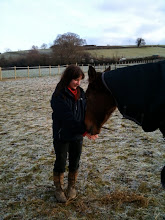
Today i hacked Spice out with Ebbie - a horse which can be quite spooky and nappy and to my surprise Spice was more confident than ever -pushing to lead on the way out and happily going in front when pulling in for vehicles to pass - something she has had an issue with before. This made me wonder whether the notion (as many would believe) of hacking a nervous horse out with a more confident horse to help improve their confidence really works as often it seems the nervous horse ends up relying on and hiding behind the more confident horse rather building up their own confidence. I have also found that Spices attention seems to become completely absorbed by a more confident horse to the point where i have felt more like a passenger than a driver which also does nothing for building up your horses trust in you.
So i think from now on i will try to hack out with horses of equal or less confidence than Spice as i feel this works far better.
But as always only time will tell if i am right. :)
Showing posts with label Building Confidence. Show all posts
Showing posts with label Building Confidence. Show all posts
Monday, 4 October 2010

Sunday, 23 May 2010
138. Are some horses incapable of leading?
Today, i decided to sit and watch the horses for a while why they moved about in their herd. I like doing this because i feel it helps me learn more about the way they communicate with one another...
Anyway, when i split the herd up into two groups (for grazing reasons) which meant Spice would be the most dominant in terms of hierachy i noticed something very interesting...I noticed that although Spice was more dominant i.e able to move both the other two horses out of the way - she was completely reluctant to 'lead' them in fact i didn't see her 'lead' them anywhere i just saw her follow. And the one she chose to follow was Lucy someone she often 'hangs about with'.
So what i couldn't understand was: how could Spice be dominant over the other two horses and yet not able to lead them anywhere? Why when it came down to going anywhere would she take the position as a 'follower'?
What i realised is that Spice is a 'dominant' horse hence the reason why she sometimes challenges me but has no 'confidence' when it requires taking a lead role as 'herd leader' she exhibits herd leader type behaviour as far as being able to move another horse out of the way but revokes all responsiblity when it comes to leading them anywhere.
This makes even more sense when i think about what she is like out hacking because she always prefers to be behind rather than in front (even if the horse in front is lower down on the hierachy and if i am on my own with her she is far less confident because i am asking her to physically be in front of me rather than follow me.
I always thought that the more 'dominant' a horse the more 'confident' but actually dominance seems to have nothing to do with confidence in fact it seems to have more to do with not being confident. For I wouldn't describe Fen as particularly dominant - especially not towards people but she is extremely confident and perhaps this is what makes a horse a leader rather than a follower.
I once remarked on the fact that Spice's dominance was based on fear rather than confidence in that in her eyes if she is able to move all the other horses apart from Fen (the herd leader out of the way) she would be able to better keep her 'position' within the herd in times of danger and thus be safer.
This also explains why Fen who is only 4 is so great at hacking out because she is so used to 'leading' her herd every day that it becomes second nature for her. However, she is not so good at following in fact when her owner rides her out with another horse that over takes her she gets very tense and edgy.
So, i guess my concern is: how can i expect Spice to 'lead' me anywhere if she doesn't have the confidence to do it in her own herd in a place she feels secure and safe?
And thus am i fighting a losing battle? Will i only ever be able to hack her out with another horse?
Monday, 5 April 2010
93. Long Reining
So (as i said i would in my last post) i used long reins on Spice today and boy did i enjoy it! It was so nice to be in control and not feel threatened by Spices behaviour. I was able to remain completely calm and focused throughout the exercise and this allowed me to 'not give into her ' in ways i probably have before. Finally, Spice realized that i was not going to 'give up' and so it was really not worth the effort trying to make me. I'm not saying it was easy because it wasn't we had a big discussion with lots of 'i can't do this' by Spice and lots of 'you can do this' by me. She wasn't happy... for once her rears were ineffective and all the tricks she had learned were failing her.
What i found fascinating about the exercise was that i was actually able to make her move with just two long pieces of rope attached to her bridle. She had no bit, no leg pressure and no crop/whip. I am definitely going to continue long reining Spice in fact i will do this until we get to the point that she goes everywhere i want her to go without the slightest hesitation or reluctance and only then will i attempt to actually ride her out again.
I know this is going to take a lot of time but i've said before i don't want to resort to using violence against Spice. I want to work on the basis of applying pressure and releasing pressure with lots of reward as positive reinforcement.
My hope is that long reining prepares Spice for the eventuality of riding out alone so that she doesn't feel the need to react so violently but i guess only time will tell...
Thursday, 11 February 2010
38. How to make your horse more confident...
Case Study...
Millie was a Thoroughbred X, 6 year old mare who had been with her current owner for two years. Millie lived with four other horses and as a herd they had access to shelter but lived out 24/7.
Millie's problem was very obvious and very dangerous. If she found herself in a challenging situation when out on a hack she suffered from complete fear. Her reaction to problems was to bronc wildly and once she had unseated her rider she would either bolt for home or stand still and freeze.
Millie's problem was very obvious and very dangerous. If she found herself in a challenging situation when out on a hack she suffered from complete fear.
Previously Millie had limited training and experience of humans. She had the minimum of handling up to the age of 18 months old, with a farmer leaving her turned out with a herd of horses. Millie had virtually no handling after that, up until she was four. She arrived with the new owner wearing a broken head collar and having been herded on to the trailer.
Her new owner had equine experience as a child and had got back into horses three years earlier. She was very keen to help Millie and understand her horse's behaviour. When Millie initially arrived it took two weeks to get her head collar on. She escaped twice while being lead, hated being tied up and was always tense and nervous. Millie had been sent away to receive some training and this had made some improvement in her behaviour. However, the trust had gone between horse and rider and the dangers of Millie's behaviour now meant that she was not being ridden out or taken anywhere.
Possible causes of behaviour
* Lack of training and experience as a youngster
* Pain
* Lack of confidence and problem solving skill
* Lack of trust between horse and owner
* Owner confidence very low
Solving the Problem:
Pain is always the first possible area to be considered when dealing with problems and after an initial examination it was recommended that Millie was checked by a vet to establish if she was experiencing pain. Some physiotherapy followed that veterinary check.
Millie might have been six years old but she only really had two years experience and not all of that had been good. Essentially, Millie was a feral horse when she arrived with her new owner. In these situations it is best to forget the physical age of the horse and think about their age in relation to the amount of training they have experienced. In this case Millie was really about one and half years old. It was not surprising that Millie was unable to deal with problems out riding when she was terrified by a sheet of plastic on the floor of the sand school. She was also unable to accept the long lines on her body. When working with problem behaviours we have to find out just how small the comfort zones are, and what the animal will tolerate before we can write a shaping plan or begin training.
Equines have not evolved to have a great problem solving ability. Evolution has equipped them to "run" away from anything they find fearful and to avoid anything that might be dangerous. If they cannot escape, then using fight behaviour may be their only option for survival. In the wild, equine problem solving revolves around their normal behaviours such as, running, kicking, rearing, bucking, biting and any variable or multiples of these behaviours. In domestication they have to apply these same problem solving behaviours to the situations that they find themselves in. Domestication is really the process of limiting the use of these natural problem solving behaviours and teaching the equine more appropriate responses to the problems they may encounter. It is important to remember that problem behaviours are rarely a problem for the horse; they are only a problem for us humans.
Millie's training had to start all over again, with the emphasis on teaching her a calm relaxed new way of solving problems, while building trust between her and her owner. Shaping plans were created to allow her to learn standing still as a way of solving problems. Standing still when faced with a problem is not a naturally occurring evolutionary tactic. However, in domestication it is vital. The shaping plans involved the use of counter conditioning and systematic desensitisation to introduce Millie to having all areas of her body touched, right up to her happy acceptance of the long lines.
Other shaping plans involved allowing Millie to learn how to deal with different obstacles such as plastic sheets, bunting and water etc. The use of the obstacle course is to build confidence and problem solving ability, but this can only happen if the trainer recognises there is a difference in the learning that takes place when an equine is made to deal with something it fears and when it is allowed to learn that it can deal with its fear. Millie had to learn how to deal with problems so when out riding she could give her owner a chance to guide and direct her through difficult situations and so that she was relaxed enough to listen to her riders directions.
The shaping plans led Millie through dealing with obstacles and problems while being led in the school, in the yard and the field. Then the training progressed to being long lined over the obstacles in the school, yard and field. The next step was to ride Millie through and over the obstacle course in the school, yard and field. Doing difficult and challenging tasks successfully together builds trust in the relationship between horse and human.
Once she was happy with all this training, Millie was led in hand on the road to familiarise her to the most common routes and situations she was likely to encounter. From here short rides began to take place gradually increasing in the distance and duration.
During the four months of training, Millie's owner had to learn to long line, which she did on another older very experienced calm horse. A great deal of importance was placed on the owner's ability to use small steps and to stick to a written shaping plan. Millie was never forced to do things but her comfort zones were gently stretched. Millie's owner also had to learn that there was not going to be a relaxed hack for quite some time, she treated all her rides as a training session until Millie was confident and calm in all the possible situations she encountered. After all this training Millie and her owner were able to relax more and begin to just go for a hack.
Often the ability to deal with very difficult problems is just down to the trainer's readiness to take the time required to do the correct training thoroughly, and the ability to use good clear shaping plans to break large behaviours down in to small manageable steps.
Subscribe to:
Posts (Atom)