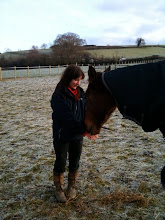
Unfortunately after a nice scab formed over Spices wounded hock she went and knocked it off whilst in her stable (probably when lying down) which re-opened the wound and allowed bacteria to get in :( So unfortunately it seems to have got re-infected.
She has been on antibiotics for 10 days now which do seem to be helping but there is still a tiny bit of pus showing on the cotton wool i use to clean it twice a day.
Not knowing what to do for the best (after leaving it uncovered for the last 10 days in the hope that the air would get to it and it would start to heal) a couple of the other liveries suggested i apply a wet poultice to it in order to draw out the remaining infection. Not knowing whether this was the right thing to do or the wrong thing to do i went along with this in the hope that their 20 years worth of experience over my 18 months worth would prove to be superior. So fingers crossed this is the case and it looks better tomorrow...I think if the wet poultice does manage to draw out the rest of the infection it might be worth just applying a dry poultice to help protect the wound whilst it heals which i'm hoping will not take too long.
However, i must admit i am beginning to worry. :(
I wonder what would have happened to Spice in the wild if this were to have happened...would she have made a full recovery naturally? or would she have been struck down by infection and become too lame to survive?
I can't help feeling anxious tonight...if it was somewhere more fleshy where there wasn't any bone involved and it wasn't making her lame i think i'd be fine but i can't help but think that the infection is too close for comfort to her hock joint and that ultimately this could be very serious if it is not controlled and dealt with effectively.
How the woman in the video below coped is beyond me. I consider myself to be quite strong when faced with such challenges but for some reason i can't help but fear the worst at the moment.
Please Get Well Soon Spice X
Showing posts with label Poulticing. Show all posts
Showing posts with label Poulticing. Show all posts
Friday, 15 October 2010

Sunday, 16 May 2010
131. Nature versus Nurture - Knowing when to intervene...
Something i have recently been thinking about is how to know when to let 'nature take its course' or when to lend it a helping hand...
There seem to be two schools of thought on the dreaded abscessing...one to find the entry point and drain as soon as possible and two to let it come out by itself. The latter tend to be the school of thought of the barefoot trimmers and the former the school of thought of the farriers and vets...So who is right?
Common sense tells me that if you have an infection in your body the first thing you want to do is get rid of it i.e before it develops into anything serious and gets into the bloodstream.
However, there is the idea that if we never allow our bodies to deal with infection they might never build up the antibodies to fight them...which may weaken their immune system and make them reliant upon us.
But more importantly it seems that when abscesses are drained (usually by digging a hole in the sole) there's a very good chance that you wont drain everything because you are relying solely on gravity - which lets face it as soon as the horse puts its foot down on ground is going to be somewhat compromised. However, it seems that those which are left become so pressurized that when they finally burst they seem to do so entirely.
In relation to the question above i think it is critical to assess a horses environment before deciding on which treatment to offer. I can see that the invasive route in a clean stall environment where poulticing was easy would quicken the recovery time and ease the horse of its discomfort sooner but in a more natural field environment - especially in the winter months you would have a very hard job keeping the hoof clean and probably therefore struggle to keep the abscess draining and prolong the recovery time.
I therefore think vets should consider how a horse is kept before taking any course of action as after care is often of paramount importance when invasive procedures are performed.
There seem to be two schools of thought on the dreaded abscessing...one to find the entry point and drain as soon as possible and two to let it come out by itself. The latter tend to be the school of thought of the barefoot trimmers and the former the school of thought of the farriers and vets...So who is right?
Common sense tells me that if you have an infection in your body the first thing you want to do is get rid of it i.e before it develops into anything serious and gets into the bloodstream.
However, there is the idea that if we never allow our bodies to deal with infection they might never build up the antibodies to fight them...which may weaken their immune system and make them reliant upon us.
But more importantly it seems that when abscesses are drained (usually by digging a hole in the sole) there's a very good chance that you wont drain everything because you are relying solely on gravity - which lets face it as soon as the horse puts its foot down on ground is going to be somewhat compromised. However, it seems that those which are left become so pressurized that when they finally burst they seem to do so entirely.
In relation to the question above i think it is critical to assess a horses environment before deciding on which treatment to offer. I can see that the invasive route in a clean stall environment where poulticing was easy would quicken the recovery time and ease the horse of its discomfort sooner but in a more natural field environment - especially in the winter months you would have a very hard job keeping the hoof clean and probably therefore struggle to keep the abscess draining and prolong the recovery time.
I therefore think vets should consider how a horse is kept before taking any course of action as after care is often of paramount importance when invasive procedures are performed.
Subscribe to:
Posts (Atom)