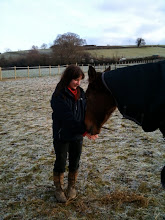
Today, i felt quite ill myself so had already decided that apart from soaking Spices hoof i wasn't going to do anything with her. The good news is her hoof feels a lot cooler than it did yesterday so it seems that the infection is definitely on its way out. I soaked Spices hoof for 5 mins in some tepid warm salt water and then sprinkled some salt over the abscesses exit point in the hope of drawing out whatever may be left in.
After i'd done this and my other friend on the yard had gone home i was just about to let Spice back into the field when she started galloping about like a mentalist. I looked over towards the rest of the herd and noticed that they were all out of sight... which immediately explained why Spice was feeling so anxious. So, since catching her was at that moment totally out of the question i herded her back into the paddock from the coral which she was liable to break through at any moment whether it be jumping over it or galloping straight through it and obviously i didn't want her to do this. So, after herding her back into the paddock (against her will) i basically just watched her gallop about for a couple of minutes. I thought about doing join up with her but to be honest she was in such a state due to her fear i thought this might only make her more afraid. So, i placed my self outside of the paddock against the fence and simply waited for her to come to me. What i noticed was that as soon as she realized she had 'no way out' and essentially 'no other options' she came over to me almost immediately and as soon as she did she willingly followed my every footstep.
This has taught me that when Spice is extremely anxious her first instinct is to 'run away' and 'seek safety'. Her first choice was her herd (quite rightly) but when she realized she didn't have the option of running to her herd she chose me and was more than happy with her choice.
I don't think there was any point in me doing 'join up' with Spice because she was already essentially ready to 'join up' and looking for comfort and solace in her herd i just wanted her to look for it in me (which by closing off her options) i did.
So, if i translate this to a riding situation...if i am out on a hack and there is something in front of us which Spice is afraid of and wants to run away from I need to essentially make her 'run to me' by closing off the option of running away from me. Whether it be walking backwards, turning sideways or going up i must find a way to 'close down' these options. If i allow her the option of 'running away' (in anyway) she will.
I love days like this... when i seem to learn the most important lessons without even expecting or trying to.
Showing posts with label Right Brain Extrovert. Show all posts
Showing posts with label Right Brain Extrovert. Show all posts
Wednesday, 14 April 2010

Wednesday, 10 March 2010
66. Linda Parelli's controversial video & statement...
http://www.ebaumsworld.com/video/watch/80925308/
With regards the controversy surrounding linda parelli's horse training exercise featured in the video above linda has given the following statement...
'If I was seeing this clip with no knowledge of what exactly was going on, I think I would get upset too! It invites a lot of questions if one doesn't know what the situation or the outcome was.
This horse, Barney, was presenting a lot of challenges to his owner. He was at the Parelli Center in Ocala for a five day Level 1 course over five years ago that we filmed for educational purposes and published in our Level 1 Pack.
On this particular day, it was windy and Barney was terribly spooked. He could not focus on his owner and in fact his behavior was becoming dangerous because he had no awareness for personal space and would run right over you. He also was not fond of humans, and his past ownership experiences had been tough.
In the clip that was posted, Barney was starting to have a lot of trouble with the wind in the trees and bushes. We needed to teach him to move away from the human when asked using the “Driving Game” to move his front end over, but he was so upset he could not yield. All he could think about was running away but this was our chance to change his dangerous habits and give him the confidence in the leadership of a human. We had to get through to him so he could successfully and safely interact with other horses and humans, and I had to increase the intensity until it matched the intensity of his fear, which was dangerously high. The moment he responded, we stopped the stimulus but it required several repetitions before he could do it and finally calmed down.
I have heard accusations that this will make a horse head shy, but the opposite is true. Horses are head shy because they fear the human or because people hit them to punish them. This horse was not afraid of humans, but he didn't believe in them either. He was respectful in very limited circumstances but as soon as he got worried, he was a force to be reckoned with. Barney was very spooky and dangerous to ride, his history with humans was not positive.
Finally fear subsided and he began to trust the leadership of his human. In fact the next day, he was a very different horse, more confident, more relaxed and more connected to his owner. Together, they completed the course with great results and have gone on to do amazing things.
I have dedicated my life to making the world a better place for horses and humans; to bringing them together in harmony and understanding and solving terrible problems that some horses are sedated or euthanized for, which is not an option for Parelli. This horse was on his way out and finding us was one last piece of hope his owner had. Barney has become so successful that he now HELPS his owner help other people with emotional problems.
When we were producing the Level 1 pack, we debated as to whether or not this footage should be included (the entire piece of course), but decided it should be because some people will be faced with an extreme situation and need to know what to do to solve it for good. Some people use love, love and love on their horses. Others use leadership, leadership, leadership. Neither of them are effective...you need love, language and leadership, in equal measures. When we did all that, this horse finally found understanding and began to trust us, looking to us for safety instead of just running away.
I am glad that some people have asked for an explanation. I appreciate your care and concern, and being interested in learning the facts. I reached out to Paul H., Barney’s owner, and asked how their relationship has grown since spending time at our Center in Ocala and studying Parelli on their own. He sent me the following feedback that I would like to share with you.'
Linda Parelli
A letter from the owner:
“I took the time to read one of the threads (Chronicle of the Horse Forum) that sprung up as a result of someone posting footage of Linda and my horse Barney from the Level 1 DVD on the web. I first have to say that I was profoundly saddened by the angry and vicious tone of many of the posts and astounded by the assumptions and judgments that people had about Linda, Barney, and myself as an owner.
Barney spent the first 11 years of his life in a prominent traditional foxhunting barn. He received a corneal scratch in the hunt field that subsequently got infected. When it was determined that the eye couldn't be saved, his owner requested that he be euthanized. It was only through the actions of a veterinary intern and my search for a local horse to adopt that Barney is even alive today. I met Barney the day after his eye was removed. From the day I met him it was clear that humans were not his preferred company. He avoided people preferring to keep a safe distance. After two years out in a pasture, being fed and handled every day I started to ride him. He was an extraordinarily spirited horse that, while often responsive, always seemed to act out of fear rather than trust or partnership. This was the legacy I inherited and the one that Barney learned and experienced in early life.
My time at the Parelli Center in Ocala during which the DVD was filmed was a challenging and profoundly rewarding time for both Barney and myself. I am grateful for the assistance I received in dealing with a very difficult and potentially dangerous situation captured, in part, on the video and for the subsequent mentorship I receive from Linda and the Parelli team in transforming both my relationship with Barney and Barney's relationship with the human race. We weren't on the fast track and I've taken lots of missteps but we have continued to grow and learn. We completed our Level 2 some years back. He is semi-retired now but he is my rock steady mount in sport psychology clinics I conduct with other riders, as well as my trusted partner on trail rides both alone and ponying my two young sons.
Barney is still a horse of tremendous spirit. I guess a good way to described the difference now is that his spirit is now shared with me rather than channeled into his fear of me and others. Barney's relationships with humans has also been transformed. He is now one of the main horses who partner with me in my work in equine assisted psychotherapy. It is amazing to watch as he reaches out to clients time after time, helping to transform their lives. I know I am grateful for what I learned from the Parelli program, and I think anyone who knows Barney will say that he is grateful as well.
All the best from a grateful friend of Parelli.”
- Paul H., Barney’s Owner
I am very pleased to hear that barney the horse in the video is now doing very well and that the training obviously worked. I have a better understanding of what linda was trying to acheive. However, personally i still think that join up - monty roberts style may have been more effective and a less aggressive approach to use on this horse. I find it difficult to condone any form of violence or aggression unless it is an act of self defence. However, i can only judge from a distance as i have not seen the full video from beginning to end.
With regards Barney's behaviour, I have the exactly the same problem with Spice... when she becomes fearful she is unable to focus on me or anything else for the matter but the object of her fear. She 'loses' herself in her own fear and can be dangerous as she becomes unaware of her surroundings.
Normally when this happens i try to re-direct her fear by asking her to do lots of things, whether it's following my lead, stopping when i ask her to, backing up, yielding her hind quarters anything that helps bring her focus back on me i normally find that this works well and am pleased to say that so far i have never felt the need to do what linda did with barney.
So, i am thinking that i might video what i do with spice when she becomes right brained so you can all watch them. :)
Thursday, 4 March 2010
57. Spice the Right Brain Extrovert
As Spice is a right brain extrovert i have been doing some research on training techniques which are more appropriate for her temperament...I found the following article really useful...
DO:
✓Use a lot of consistency, it’s calming. For example,
circles are great and the more worried your horse is,
the smaller you need to make the circles. You could
also weave around barrels or buckets placed six-feet
apart. Frequent transitions also uses the principle of
consistency… keep doing one-rein transitions every
few strides, from walk to trot, until your horse refo-
cuses and calms down.
✓ Speed up, match the energy and add “four ounces.”
You need to be asking your horse to go more quickly
than he really wants to; this interrupts the fear pat-
tern. If you don’t feel safe and confident doing this
when riding, get off and do it from the ground. For
example, if your horse gets frantic and wants to head
to the arena gate, paces at the gate, etc., take him
there and get him to pace back and forth faster than
he wants to do it! Do it until he relaxes and be ready
to start again.
✓ Use longer lines when playing on the ground, it will
give your horse more drift. (22’ is ideal unless you are
good with a 45’ Line).
✓ Respect thresholds; use approach and retreat to over-
come them.
✓ Keep learning sessions short and simple.
✓ Relax when he relaxes. Until then keep your energy up
and get your horse busy.
Calming strategies: A Million Transitions; Small circles;
Tiny figure eights; Falling Leaf (1/2 circle changes of
direction while you walk forwards); Do what he wants,
only faster and smaller—“and then some!”
DON’T:
✗ Straight lines help a horse gather speed. You don’t
want this! Use straight lines only when your horse is
more self-controlled.
✗ Don’t hold him back; this increases fear. Give the en-
ergy a focus!
✗ On Line is better than Liberty if your horse is upset.
That way you can “hold his hand”. He’ll tend to get lost
and disconnected at Liberty.
✗ Don’t teach your horse more than one thing at a time.
✗ Don’t try to teach him when he’s upset or unconfident.
That’s the time to use calming strategies.
✗ Forcing him over thresholds usually results in
an accident.
Make it worse by: holding him back;
using stronger bits, tie downs, martingales, etc.;being
too soft and not matching his energy; not knowing
what to do – strong and focused leadership is es-
sential; blasting through thresholds; getting mad or
frustrated or scared.
So... when your horse has a Right-Brain reaction, you need to match it. Bring your energy up but in a positive directing kind of way and then use that movement big time... but not in endless circles. Get him to do a million changes of direction without making a full circle. You're going to need a lot of energy to do this because a horse in full Right-Brain mode is a force to be reckoned with. The worst thing you can do is try to stop him and the next worst is to send him in circles or try to be soft and calming. He needs to know your presence and feel your leadership in a positive way... you have to be bigger than the problem and direct all that fear and energy, not add to it. In this way he'll calm down. It may take a little time the first time, but every time after that it will take less until finally your horse will look to you before he overreacts. The real lesson however is... how can you set it up for success so he never has to go there.
Subscribe to:
Posts (Atom)