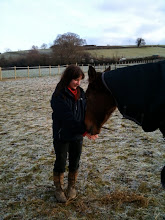
Establishing Trust with Your Horse
Relationship Exercises for Horse and Rider
Share Article |
Oct 10, 2008 Laura Thompson
Just like human relationships, the bond between horse and rider must be built upon a foundation of trust. Without it, neither of you will live up to your full potential.
Essentially, the relationship between a horse and his rider starts with comfort and accountability. Your horse must be comfortable with you, both on the ground and in the saddle, and he should be able to count on you to keep him safe.
Take the sport of show jumping, for example. One of the most frequent problems encountered in this discipline is refusal. The horse approaches the fence, then either slams on the brakes or runs out at the last minute. You might attribute this behavior to rebellion, when it is usually evidence of a lack of trust.
A seasoned horse might develop the habit of refusal if his rider is constantly catching him in the mouth over the fence. He can't trust his rider not to cause him pain when he jumps an obstacle, so he avoids the experience entirely. In order to correct this habit and any other trust issue, you'll need to show your horse that he can trust you.
Beginning on the Ground
Very few trust issues can be solved with the rider in the saddle. This advice might run contrary to everything you have ever been told, but consider the facts. In the saddle, it is much more difficult to eliminate rider mistakes. On the ground, the rider is on an even playing field with the horse.
Start building your trust relationship with your horse by spending some time in the round pen. You can lunge your horse with a lunge line or free lunge—whichever he is more comfortable with. Start working with him on voice commands: walk, trot, canter/lope, whoa. When he begins to respond correctly, reward him.
Ads by Google
FnE Endurance Saddles
The most adjustable saddle ever Free your horse's shoulders
www.fnesaddles.com
Badminton Chauffeur
Professional Corporate Chauffeur Hire For Badminton Horse Trials
www.royalechauffeurgroup.co.uk
Trust can also be built without actually working your horse in the round pen or on his back. Spend time with your horse in his stall, brushing him for at least twenty minutes at a time, or grazing him in the yard. Let him get to know the sound of your voice as well as your own habits.
Consistency in Trusting Your Horse
The largest obstacle most riders face when trying to build a trusting relationship with their horse is consistency. If your horse can't count on you to deliver the same commands, rewards and punishments each and every time he repeats a behavior, he's going to lose trust quickly.
For example, what do you do when your horse starts pawing in the cross-ties? Do you smack him on the shoulder, tell him to "stand!" in a firm voice, bop him on the nose? Your response should be the same each time he paws, and your reward should be the same when he stands still.
Trusting Your Horse
As with most things in the equestrian sport, trust is a two-way street. Not only must your horse trust you to take care of him and treat him fairly, but you must trust your horse to take care of you. If you are constantly afraid that your horse is going to buck you off or run out on a fence or fall on his forehand during a slide, trust issues will develop on both sides.
If you feel that you cannot overcome trust issues with your horse, it might be time to seek the counsel of an experienced trainer. A third party can pinpoint problems you wouldn't otherwise have noticed and offer specific advice tailored to your situation. Sometimes, it's best to admit you need help.
Gaining Your Horse’s Trust
There is nothing worse than owning a horse that is scared of you and does not trust you. It is also dangerous because your horse could harm you if he feels that you are a threat to his safety. A horse’s trust is hard to gain and is very easy to loose. It is possible to gain a horse’s trust, but it could be a slow and tedious process. Once you have gained your horse’s trust, the benefits are endless.
The first thing that you need to remember when trying to earn a horse’s trust is to be patient. Something happened to the horse to make him not trust people and it will take time for him to feel safe around people and to trust you. When you start working with your horse, make sure that you always approach him from the left side and show him what you have in your hands so that you do not accidentally scare him.
The second thing for you to remember is to always wear tight fitting clothes. If you are wearing loose clothing, they might get caught in the wind and scare your horse, and once he is scared of you it will be very difficult to make him think that you are not going to hurt him
You also want to talk to your horse in a low, soft voice. Don’t try yelling at your horse to get his attention, you will only scare him and make things worse. When your horse begins to trust you he will start to look at you more and will begin giving you his full attention.
You also want to be around your horse as much as possible. If you can, feed your horse in the morning and evening, clean your horse’s stall (if your horse is kept in a barn), personally turn your horse out and bring him in at night. Your goal is to be around your horse as much as possible. If you are your horse’s sole caregiver, he is going to gain your trust much faster than if several different people are caring for your horse at the same time.
The benefits of having a horse that trust you are endless. Once a horse trusts you he will do almost anything that you ask of him because he knows that you would never allow anything bad to happen. This will be extremely useful when taking you horse around new things or putting him in new surroundings. Your horse will be much calmer than horses that do not trust their owners. Having a horse that trust you will also be useful on a trail ride. You may ride upon an obstacle that the horse has never seen, but if you reassure your horse that it is OK and he trusts you, he should go right over the obstacle and not think twice about it.
Once you have gained your horse’s trust, your training possibilities are endless.
Tuesday, 27 April 2010

113. No Shoes Versus Shoes
Today, i feel myself once again becoming disheartened with the state of Spices hoof, the crack caused by the abscess bursting through the coronary band is looking worse than ever and is of obvious discomfort to Spice (visible lameness in trot) so i find myself pondering over what to do and becomming ever so increasingly frustrated with the differing opinions and advice.
Having changed podiatrists after my first podiatrist recommended that i ride Spice daily for 30mins a day every day and her getting an abscess just 72hrs later i am even more less confident about my judgements and choices.
All i want is the best for Spice but after 3 months of on/off lameness abscessing and reading articles like the one below i can't help but question my decisions...
The Natural Barefoot Horse Movement
posted by citizen.K on Tuesday, June 24th, 2008
Horseshoes are not evil. Marketing schemes might be.
Believe it or not, they are calling it a movement. Barefoot, natural trimming franchises are the new hot trend in horse care. It is a beautiful scam that has been developed specifically to target the inexperienced horseman or horsewoman. The fad has swept the horse world off its shoes and into new barefoot ground where lots and lots of horses are gimping around wishing the pain would stop.
How this movement came to be is a mystery, but Dr. Hiltrud Strasser, a German veterinarian, has been credited as the first to develop this new, radical, strong woman craze on “natural” holistic hoof care. Dr. Strasser has been described as “a rebel”. A woman who isn’t afraid to stand up to conformity. A woman who created a system, of hoof care conformity, to break conformity. A woman with a method, no, a state of mind, that asks all horse owners to think alike on the care about their horse’s feet.
Of course, those in the barefoot movement believe if you aren’t following this new, trendy, horse care method, you must be abusing your horse (for more on that concept, if you haven’t already, stop by the pro-clicker training comments). People who are completely brainwashed by a method or system see only black or white. Of course, if you aren’t clicker training, you MUST be training your horse by brutally beating them. Again, if you aren’t using natural barefoot trimming, you MUST be torturing your horse with horseshoes. Oh the humanity!
Farrier work should under no circumstances cause lameness, footsoreness, shortened stride, or any other displays of pain or discomfort.
As another genius horse person marketing scheme, the target audience, once again, is middle aged women who are hypersensitive to notions of bad things happening, anywhere. The Strasser barefoot method, the clicker training method, and the natural horsemanship method all exist, thrive on, and cultivate scare tactics to further their followings and resulting profits. That sound familiar to anyone?
Yet, do any of these people realize that fitting their horse into this Strasser method of trimming, or any other natural “balance” barefoot trimming method is like making every person wear the same size shoe? How is that correct, or natural? Or pain free?
The Barefoot movementers say trimming every horse foot exactly the same is the way “nature intended”, but yet, they call it abusive to nail a shoe on a horse’s foot, a shoe that fits that horse and enables comfort, traction and shock absorption?
Dr. Strasser has stated herself that her trim may cause death to a horse. What??? Oh, right, but it’s because the horse’s heart cannot heal from the abuse of shoes and a stall. What reasonable person reads that and thinks, “Yes, I need to free my horse from the abuse of a stall and shoes, so I will trim my horse with this method. If he dies, at least I freed him”?
That’s just nuts.
Don’t get me wrong. Dr. Strasser has some good points outside of actually touching a horse’s hoof. Yes, some horses, and almost all pleasure, pet and/or trail horses should live outside 24/7. But, a few of my own horses who lived their first 3 years outside 24/7 would not be happy being outside 24/7 now. No matter what, not every horse can be cared for the same.
Let’s say that again.
Not every horse can be cared for the same.
This is where the “nuts” part of the natural barefoot/Strasser trim comes into play. Each horse’s individual temperament, conformation, health, and job necessitate different care.
And long before Dr. Strasser hit the foot care scene, fore-thinking equestrians knew frequent trims (meaning, weekly, every other week, etc.) and low angles could be beneficial to keeping a horse’s foot balanced, most especially for corrective shodding or treating, for example, navicular and founder.
But, NOT EVERY HORSE’S FOOT IS THE SAME!!!! There is a lot more to equine hoof soundness and happiness than just cutting off so much hoof that the horse’s body has no choice but to increase bloodflow to the region.
Dr. Strasser no doubt has credentials to back up her hoof anatomy knowledge, but all in all she has zero practical, statistical data proving successes of her methods. As stated elsewhere, her insistence that horseshoe nails numb the equine’s foot is so off the wall unproven or tested that it doesn’t even rise to the level of hypothesis. The Strasser trim is also often marketed as a do-it-yourself system (just the right confidence builder insecure women need!), but hoof care is a science that can not be taught by reading one book or attending one clinic. Doing so, buying into a DIY “natural” barefoot trim attitude gives one just enough knowledge to do serious damage.
Trimming a hoof should never, ever leave a horse footsore.
Many horses have been euthanized after a Strasser trim, and horse owners and natural barefoot “farriers” alike have been charged in animal cruelty cases for using the Strasser trim and causing pain and suffering to horses. Horses dying and owners being charge for cruelty themselves should be enough of a red flag for everyone to stay away from Strasser’s naturally balanced, hoof care trimming method. Yet, there are still many advocates for Strasser’s scheme, and even more Strasser franchises going up around the world.
Some barefoot, natural horse care fanatics do actually see the Strasser trim as not only too radical, but also risky for their horses’ health. But, even these natural barefoot fanatics still don’t see any other option besides “natural” balanced, barefoot horse trims. Now available WITH shoes! Adding shoes to a naturally balanced, barefoot horse trims is like adding a McDonalds meal to your vegan, organic diet!
Now, the other methods of “natural” hoof and whole horse care have involved many different “developers”, thus creating different factions of followers. The common thread with each, “unique”, best-ever-everything-else-is-murderous-system is that they are all following the word natural. If barefoot trimmers are following “natural”, wild horse practices, why are they trimming their feet at all? Are there wild farriers that live out in the plains where the wild horses stop every once in a while to get their feet trimmed (and what’s natural about a horse sitting, or playing with a rubber ball?)
Moreover, susceptible people often forget that horses are no longer wild. You cannot put the genie back in the bottle. Just willing your horse’s foot, with a knife, to take the shape of a mythical, perfect, naturally existing horse hoof of yesteryear will not make it so. Taking a horse with horrible feet and cutting them with a stencil does not make them perfect, great, or natural, no matter how long you try.
So many inexperienced backyard breeders have produced so many terribly conformed horses; a special barefoot hoof trim will not conquer their genetics. In many cases, it may be your responsibility to put shoes on a horse with foot problems instead of mandating the horse conform to your needs as a system follower.
“I don’t see any lameness, he just doesn’t like to walk on rocks.”
The fad within this barefoot market is so strange to me. In so many ways, why not just find a great farrier? A great farrier is going to leave a horse barefoot if that is what is best for the horse. I have had many barefoot horses, some of which competed through 4′ jumpers barefoot even, only to get shoes on for bigger fences, for better traction, or for shock absorption. Since all of these horses that were able to live and compete barefoot also had awesome feet, my farriers would leave them without shoes until needed.
The most memorable experiences I’ve had with natural barefoot trimming, or natural balanced trims, were witnessing the soreness the horses experience after a trim, even after receiving these trims for over a year. These horses would be footsore for over a week AFTER a barefoot trim. The horses were in agony when walking through rocks, or walking on concrete.
Are there no hard surfaces in the wild?
I would be told, “Oh, that’s normal”, or in some cases, “I don’t see any lameness, he just doesn’t like to walk on rocks.” No horse my farrier has ever left barefoot has ever, ever been footsore. Not on rocks, not walking to and from pastures, not on any surface at any point.
Having a farrier work on your horse, whether you put shoes on or not, should under no circumstances cause lameness, footsoreness, shortened stride, or any other displays of pain and/or discomfort. You should be able to get on and ride your horse with no problems immediately after your farrier works on him. If you can’t, have a lengthy conversation with your farrier. If it happens a second time, find a new farrier. If that farrier is you, please stop playing farrier.
The number one most important element in horse care, and horse training, is uniqueness. Every horse is unique and must be treated and cared for as an individual. Following methods, fads, or systems limits the ability to tailor for your horse’s conformation, temperament, personality, and health. Why do all these radical people think that every horse should fit into a mold? What is even more interesting is that these are the people who claim other horse people are just scared of change or something new. When it comes to “natural” horse practice dissident, fear of the new is not an issue. Most good horse people take knowledge from every reputable source, method, and system, pull out what might be useful, and apply it when it is applicable. But above all, responsible horse people know THERE IS NO MOLD.
There is no magic button, no magic book, no magic savior, or no magic set of beliefs that will cause a horse to bond with you. Your program of beliefs are not special, and you are not suddenly rising to the top of all whom ever cared for horses, simply because your system title includes a derivative of the word “nature”.
And in this world, there are a lot of conventional farriers that shoe horses who don’t necessarily need it. It is also very true that a horse that has worn shoes for a long time will need time to adjust to being barefoot. Without the accustomed support of a shoe, hoof walls may chip and crack for a few trims until the nail holes grow out and the hoof becomes stronger, but never should this adjustment period include footsoreness.
And though it’s obvious the closed minded nature of anyone buying into these “natural” themed horse care/training, marketing schemes bothers me, the natural barefoot trimmers actually make me angry. Natural trims cause pain and suffering for far too many horses.
One thing is for sure, I’ll never give up horseshoes. I absolutely love torturing my horses by mounting, cold, cruel metal to their feet. The classically trained, traditional farrier and I have such a laugh at all the discomfort the horses experience while being shod! Oh, and the hot shoeing!
The courtesy and manners my horses show the farrier are surely just done out of fear; their blackened hearts singed from years of unnatural hoof trims, metal tearing their mouth apart, and all the abuse from spurs, whips, and nosechains. In fact, one of my horses is so dull and hates the farrier and the evil shoes he tacks on so much, that he stands perfectly still and tries to play with the handkerchief in the farrier’s back pocket!
Silly, tortured horse!
Shoes or no shoes, lets work away from the marketing schemes. Horse people are already crazy enough without all this bad propaganda.
Monday, 26 April 2010
112. Salt Blocks & Calming Herbs
Today, we bought Spice and the rest of the herd a salt lick as there isn't much grass in the paddock at the moment and they all look a bit sorry for themselves so we thought it would help keep them entertained aswell as being nutritionally good for them. Spice loved it and would not leave it alone for apparently the first hour of it being there so it was obviously something she needed. I also bought her a mixture of 'calming herbs' as i had ran out of the magnesium i was feeding her so thought i would replace it with some herbs which also happen to contain magnesium. I have given Spice herbs before and they really do work - i find they help 'take the edge off' of her anxiety so are well worth the money. The herbs i purchased are chamomile, lemon balm, vervain, scullcap and lime Flowers of which can be bought here:
http://www.dodsonandhorrell.com/products/horse-ranges/herbs-supplements/behaviour/placid.html
As for Spices hoof it is still on the mend the crack in the heel has almost grown out but she still seems tender on it. I will know more when the barefoot trimmer visits this s
Saturday.
http://www.dodsonandhorrell.com/products/horse-ranges/herbs-supplements/behaviour/placid.html
As for Spices hoof it is still on the mend the crack in the heel has almost grown out but she still seems tender on it. I will know more when the barefoot trimmer visits this s
Saturday.
Thursday, 22 April 2010
111. Shedding Soles
A few days ago i noticed that one of the soles of Spices hoof which had the abscess was starting to shed, i thought this was a good sign because it was probably making way for the new replenished sole to come through and having read about it on this site it seems i am right.
http://www.hoofrehab.com/horses_sole.htm - this is an absolutely brilliant site.
One of the most interesting sections i found on the website was about trimming...
'All we have to do is understand how deep the grooves are naturally, and we will immediately be able to tell if the inner structures are too close to the outdoors or too far away. This applies to the front of the foot and to the back. We can’t put exact dimensions to this, because different coffin bones have different amounts of solar concavity, and of course it varies by hoof size. A little bit too much sole bothers horses far less than having too little, so I tend to begin by erring on the side of caution. Wild hooves and healthy domestic hooves with uniform sole thickness tend to have their collateral grooves (at the deepest part) about ¾” off the ground at the apex of the frog, and about an inch off the ground toward the back (Near the termination of the bars). These measurements can be taken by laying a rasp across the foot and measuring down to the bottom of the groove.
If this measurement is ¼” deep at the apex of the frog, you can very safely assume that there is not enough sole between the coffin bone, its sensitive corium, and the outdoors. It must be allowed to build. If this measurement is 1 ½” deep, you can very safely assume material could be removed. The same exact logic applies to the back of the foot as well.
These measurements are far more critical to the horse than toe length or heel height measurements. The coffin bone and lateral cartilages often descend into a lower position in the hoof capsule and this leaves a hoof capsule that is longer than natural. This is unhealthy, of course, but trimmers and farriers who ignore this fact and trim to heel or toe length dimensions add injury to injury by overexposing the nerves in the corium on the bottom of the foot. Thinning the sole tends to cause the inner structures to move lower and lower, lengthening the overall hoof capsule. The flip side of this, is that allowing the sole to build and callus at optimum thickness drives the inner structures upward. The coronet moves down the skeleton, shortening the hoof capsule to natural proportions as the callus builds. The center and right pictures below show the natural sole thickness and concavity of a wild horse's foot.
The more i read about horses hooves, the more interested i am in learning how to care for them. I'd love to learn how to trim Spices hooves myself - the more i read the more sense it all makes and the more wonderfully robust i realise (if given a chance) horses hooves are.
If a horses hoof (when fully grown and conditioned) is naturally capable of baring at least 500lbs of the horses weight to assume that it would be incapable of doing this on hard ground just doesn't stand to reason. Unless there is a genetic/pathological reason why the hoof is compromised (which is probably very rarely the case) in my mind it stands to reason that a very good percentage of our riding horses could go barefoot.
Of course, i might well be wrong... i am only coming to this conclusion from what i have read and of course not everything i read could be true but it sure makes for a compelling argument.
I wont lie, i'm sick to death of having a horse that i can't ride and can't do anything with but walk in hand. It completely sucks which is probably why i am probably trying to convince myself that i am doing the right thing right? The inconvenient truth is it may well take Spice another 6 months to be sound but to go back to shoeing would at this moment in time be for myself rather than Spice. The only issue i have is lameness. I would be lying if i didn't say that Spice's lameness worries me as i wonder what the effects of this lameness are on the rest of her body? I can't help but wonder if i am compromising the rest of her body for the sake of her hooves?
Wednesday, 21 April 2010
110. Flies
How to keep away those pesty flies...
During the summer months flies are an annoyance to horses and their bites can be a major irritation. Fly rugs can provide relief and there are also a variety of fly repellents sold in equestrian stores but there are also fly repellent remedies that can be made at home.
Common recipes often involve a combination of essential oils, available from many chemists and health food outlets. Such oils include eucalyptus, tea tree, lavender and sandalwood, the first three being the most useful. These are most commonly mixed with water in a spray bottle and sprayed on as required.
Other fly repellent recipes involve garlic, probably the most powerful natural fly repellent there is, although spray-on garlic-based fly repellents tend to be rather unpleasant smelling especially when combined with the likes of lavender oil.
'Internal' fly repellent have the effect of either causing the horse's body to secrete oils that will repel flies (garlic), or raise the pH (acidity level) of the horse's blood enough to put flies off from biting. Such repellents take time to produce an effect so combining these with a fly repellent spray initially is recommended.
Below are some of the more popular home-made fly repellents.
* White wine vinegar, water and any combination of eucalyptus, lavender, sandalwood or tea tree oils. Mix a few drops of each essential oil into a little washing-up liquid and add to the vinegar and water. Put the resultant mixture into a spray bottle and shake well before using. Variations include the addition of strong, cold tea instead of water, crushed garlic (although this can clogs the 'spray' mechanism of the bottle), meths, and Dettol.
* Take a large lemon with a thick rind and slice thinly. Place in a bowl with a few sprigs of rosemary and cover both in boiling water. Allow to steep overnight and strain the mixture the following morning. Pour the mixture into a spray bottle and shake before applying. A similar response seems to be had by doing the same with leaves, stems and flowers from Elder bushes. (Slipping flowering elder twigs through your horse's browband can also act as a fly repellent.)
* Mix one part crushed garlic to five parts water. Shake the mixture and leave overnight. Strain and pour liquid into a spray bottle.
* An internal fly repellent. The addition of garlic to a horse's feed causes the skin to secrete garlic-scented oils that deter flies. Garlic powder can be bought from most saddleries and feed merchants.
* An internal fly repellent. Adding a little vinegar or cider vinegar to a horses water raises the pH of the horse's blood sufficiently to put flies off from biting.
Tuesday, 20 April 2010
109. Sore backs and Sore hooves!
Today, i attempted to lunge Spice but after a few steps of trot i could see that she was uncomfortable and slightly lame on her hoof. My heart sank because i thought the lameness had subsided but due to the two cracks where the abscess burst through i think Spice is understandably still tender on it. So, apart from groundwork it looks like i can pretty much write of the next month in terms of doing any real work. I'm so gutted, if it weren't for this dam abscess she'd be fine by now but it really seems to have set us back. I completely understand why so many people are put off by going barefoot as i think the majority of horses struggle with it and are no doubt un ride-able for a considerable amount of time. Having got this far i really don't want to give up but boy do i feel like it!
It also looks like Fen our herd leader may have a sore back :( as she bucked her rider off the other day which was unusual (although at the time we put it down to her being spooked after the saddle slipping). However, it seems like we could have been wrong as today she made it quite clear that she didn't want to be mounted, was difficult to girth up and then acted very out of character for the duration of the ride. She was first diagnosed with a bad back last summer and was then given treatment and time off which seemed to do her the world of good as when her back was assessed just a few weeks ago she was pretty much given the all clear.
But it seems that after just a short time of her being ridden she has become sore again. Fingers crossed, it will just be something she has done in the field and easily mendable because Fen is our herd leader and needs to be fit for her job!
Monday, 19 April 2010
108. The power of Garlic
Today i decided to give Spice a day off since we had done quite a bit yesterday and her hoof is still repairing itself. I've been cleaning the exit point of the abscess up and applying some pure garlic paste to it to fend off any infection which i think has really helped, i decided to do this after speaking to my partners sister about it and then reading up more about it on the net...
Garlic has anti-septic, anti-inflammatory and antibiotic effects, reducing blood pressure, improving respiratory problems in horses and acting as a fly repellent -
Garlic is used by many horse and pony owners as a regular equine feed supplement. It contains substances with benefits of pain-relieving, anti-inflammatory and reduce swelling.
It is believed that garlic is one of the most effective natural healing substances in the world. It is popularly used, in conjunction with anti-biotics to treat equine respiratory diseases and infections in the horse's lungs.
Garlic is rich in Selenium and Sulphur. Sulphur is recognised as having blood cleansing properties that are useful in treating and preventing equine disease. It is also believed to contain over 25 germ-killing compounds.
Many horse owners feed an equine garlic supplement for its insect repelling qualities - the sweat produced by a horse fed on garlic gives out an odour that keeps flies, ticks and midges away - making it a natural fly repellant.
Horse owners also find feeding garlic useful as part of their equine worming program. Regular feeding of Garlic is effective in deterring tapeworms, pinworms and roundworms - but this should not exclude the use of regular wormers.
Garlic can be used used to give relief from the symptons of coughs - it contains a substance that helps to clear mucus in the airways. This cleansing action, together with its ability to reduce inflammation, also benefits the urinary tract.
The recommended amount to feed is half an ounce to 2 ounces per day depending on the horse or pony's size. It comes in several forms for equine use - powder, freeze dried granules and some herbalists claim freshly grown garlic is the best way to feed it.
The benefits of garlic are many and if you do decide to feed a garlic supplement just be careful not to overdo it.
Spice is booked in for another trim in just under 2 weeks time so i will hopefully be able to do more with her then.
I really want to focus on building up her topline as she has definitely lost some muscle tone over the winter period so i was thinking i could lunge her twice a week with side reins and start schooling her twice a week in the arena.
On the other days i think i will do ground work and jumping at liberty and if all these things go well actually start hacking her out again for 30 mins or so but i don't want to do any of these things until i have the all clear from the barefoot trimmer as the last thing i want to do is risk getting another abscess so i am happy to wait 3 more weeks after all i've already waited 3 months.
Subscribe to:
Posts (Atom)