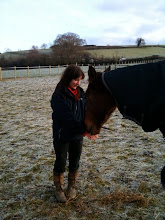
Today, i decided to do some 'join up' with Spice - just to mix things up a bit but whilst we were doing it she chose to incorporate a 3 foot jump into the exercise! The jump was set up from the day before and it wasn't my aim to try and make her jump it especially as the ground is so dry and hard but as i sent her away from me she just broke into a canter and jumped it clear!
Aside from this i didn't really do much else with her apart from give her a nice groom and spray her with some fly spray as the flies have come back with a vengeance!
Showing posts with label Join up. Show all posts
Showing posts with label Join up. Show all posts
Friday, 18 June 2010

Sunday, 2 May 2010
120. Herd Dynamics: The Variables Of Fear by Marv Walker
'I am still working on this experiment, but it seems not easy. Does any one from this list have idea's about Pat Parelli's. His theory is based on positive and negative reinforcement. Thorndake one of leading theorist in psychology developed this theory So it is not something new.Experience and Genetics. As we all know, fear is a universal emotion that motivates animals to flee predators. Scientist discovered that both animals and people can develop permanent fear memories that can never be erased. A good example would be a horse bashing its head on a trailer the first time it was loaded. This may make him difficult to load for the rest of his life. the fear memory is recorded in the amygdala, a center in the lower brain. So you need to be very careful to prevent the information of fear memories, which can interfere with training. Has anyone had a horse who was difficult to trailer load and with the bonding technique it disappeared? And if i was going to do trailer loading what do you think I should manipulate in this experiment.
Now we'll discuss some of the finer points of fear.
In my experience, fear is not a constant. Depending on a number of situations fear can either be absent or it can be debilitating. I'm not sure how scientists *know* that fear memories are stored in the amygdala, but I certainly do not take issue with their belief that fear *memories* can't be erased because I'm not that all-seeing. But if they say they the *actual* fears cannot be removed I have to take issue with that.
I have long ago lost count of the number of fears that have been removed in minutes in the horses we work with. I'm also not able to total the times I did some mighty rough things to horses before my much more enlightened times. To my knowledge, as far as I could tell as one who is far more observant than the average person thanks mainly to my tracking experiences, not one of them held it against me.
I have had horses bash their heads and more while loading. I have had them flip upside down in the trailer and never had them hesitate to go back in afterwards. You name the fear, and the reaction to it and chances are I have had it happen. I cannot recall one of those horses being adversely affected by it for any great length of time. By the same token, I have had horses that have performed an action flawlessly for years suddenly become afraid of it.
Fear can be caused by a change in the situation, pain, a part missing from a sequence, a part added to a sequence, too many people around, not enough people around and what have you.
Fear can pop up at any moment. The horse looks to the herd leader for justification of the fear and the reaction to it. If the herd leader is acknowledging the fear THAT acknowledgement gives it credibility. If a horse feels fear and there is no leader to acknowledge it one way or another, it must deal with that fear on its own. In that case, instinct says it's better to be safe than sorry and fleeing is the only logical option.
I have had horses who were abnormally nervous (fearful) but the cause of that nervousness could not really be pin pointed. Some horses are just born more nervous than others. Before my concepts became instinctive to me, I did the best I could with that nervousness and over time, it became manageable. But it still made for some interesting moments - some of which were nearly fatal for me.
Just this afternoon while waiting in the vet's office I was reading an old National Geographic dating back to the beginning of El Nino. One of the photographs was this large herd of wild elephants at a dry water hole patiently standing around two guys with shovels waiting for them to dig to the water. Granted, we're talking about horses and not elephants but they were obviously not afraid of the humans. Since elephants have extensive experience with poachers they have fear of humans, but in this case, that fear was obviously gone.
We have a 24 year old Morgan Park Saddle/Harness Show Broodmare here that we have had practically all of her life. Most of the time we owned her she was at the trainers in New York and he was totally paying all her bills and making sure he did us every favor he could to keep her there. She was what is called a "ribbons horse". He took her to every show he went to even if he wasn't planning on showing her. If his paid training horses weren't doing real well, he'd tack her up and enter her in a class. If he was still on her at the end of the class, he would place very high, if he didn't win the class. The ribbons, rosettes and platters would go on his stall drapes - hey, ribbons are ribbons when you're a trainer at a show.
When we stopped showing the Morgans and pensioned them off to live out their lives in the manner they had earned, she came back home at 17. The trainer warned us to not ANYONE ride the horse. When the trainer's brother handed me her leadline as she got off the trailer he said, "I rode that horse, once." My partner and her husband were against me riding her. They said respectively, "It is like riding a motorcycle with no brakes," and "It was a religious experience, I said, 'I have made a grave tactical error, get me off and I will never ask for anything again.'"
She was dangerous to be around and lead. You had to be on your toes at all times. She was incredibly spooky and extremely nervous. If she was spooked, she'd head in the direction she was facing regardless of who or what was there. If she got loose in the barn and started up the aisle there was no blocking the aisle you WOULD be run over.
After a couple years of her around here I got real tired of her antics and took her to the round pen just to put some better leading manners on her. This was also the day that years of study SLAMMED into place. I had just finished Monty Roberts book and as I read the snippets of horse stuff buried in the pages of his paternal angst, I thought to myself, "Herd dynamics - little too mysterious and smoke screeny, but it's herd dynamics none the less." In the entire book I only found two short forgotten phrases of value to me - the justifying ear and the processing mouth - that I'd also heard discussed while sitting at the feet of Linda Tellington-Jones years before. Someone else had noticed what I had noticed many times before and when I realized that and remembered Linda's words, I instantly ****KNEW**** that I could repeat the successes that earned me an area reputation for "getting inside the horse's head" with ANY horse in mere minutes. The focusing on these two phrases and the recalling their appearances in my concepts made everything fall into place.
I had been using herd dynamics for years before that and they had always produced the same results they produce now - it just took me longer to accept them. I'd just keep working the horse until it was SCREAMING at me, "YOU MORON!!! WHAT DO I HAVE TO DO TO TELL YOU I'VE GOT THE PROGRAM????" At that point I'd always tell the horse, "Glad to see you finally came along." It wasn't the horse that was taking so long, it was me. I needed evidence of success that was so strong only a moron would overlook it. And that day, I realized, one was, me.
I took Dee to the round pen to test my conclusions. With no physical connection at all, in less than five minutes I had a totally different horse. NO SPOOKINESS. NO NERVOUSNESS. Just quiet, attentive, patient, respectful, compliant standing beside me.
I thought to myself, "I can ride this horse." I went and got my saddle and put it on her just like I'd been doing it all her life and she never moved or showed the least bit of concern. I had the saddle on her and I got on her. Not the first problem, not one bit of concern. She was as quiet and obedient as one could possibly ask.
She is my all time trail horse. She is an absolute delight to ride. I have fallen asleep on her and woke up miles down the trail. She is no trouble to handle or be around. Now when she "spooks" she spreads her feet out for balance in case we have to leave and she asks, "What are we going to do about that?" I tell her we're going to ignore it and she goes right on by. Before, she would have just took off.
The things she feared that made her dangerous she no longer fears. And if she has any memory of her past fears, I simply cannot tell it by her actions.
The other day we had a person ask for a demonstration. Most horse trainers don't have much time for their own horses and we have a 20 year old TB brood mare that's been here for about a year. Extremely nervous and fearful, spooky, low horse on the pecking order. Half hour, different horse - stunned observer. Yesterday she was booking up the aisle heading out of the barn. I signaled her to stop and she did. She stood there patiently and compliantly until I released her. Different horse.
Rather than trying to find a number of horses with a common fear to test the theory, it may be easier to take horses with ANY fear reaction. Identify and assess the fear. Then put the horse through the herd dynamic we call the Bonder. Then reassess the fear at the successful conclusion of the bonder.
I do not pre-screen horses for my clinics. I will take on ALL problems as long as participant safety is not compromised. If fear is a problem it can be overcome with the use of herd dynamics faster than any other method I have seen or tried.
Horse after horse after horse after horse. I have seen that bonder dramatically change horses. I have had horses with pretty much every problem you can think of come to my clinics. If it is not a physically rooted problem, if it is a fear or respect issue the bonder flat makes a difference.
Is it infallible? No. Of course not. We're dealing with horses and humans here. And the connection must be a two way street. There is a constant stream of communication going back and forth - the horse tells you how it feels, you tell it how to deal with those feelings. You must exhibit leadership qualities. You must display leadership actions.
"Most of our horse's fears are still in our heads." Marv Walker
Now we'll discuss some of the finer points of fear.
In my experience, fear is not a constant. Depending on a number of situations fear can either be absent or it can be debilitating. I'm not sure how scientists *know* that fear memories are stored in the amygdala, but I certainly do not take issue with their belief that fear *memories* can't be erased because I'm not that all-seeing. But if they say they the *actual* fears cannot be removed I have to take issue with that.
I have long ago lost count of the number of fears that have been removed in minutes in the horses we work with. I'm also not able to total the times I did some mighty rough things to horses before my much more enlightened times. To my knowledge, as far as I could tell as one who is far more observant than the average person thanks mainly to my tracking experiences, not one of them held it against me.
I have had horses bash their heads and more while loading. I have had them flip upside down in the trailer and never had them hesitate to go back in afterwards. You name the fear, and the reaction to it and chances are I have had it happen. I cannot recall one of those horses being adversely affected by it for any great length of time. By the same token, I have had horses that have performed an action flawlessly for years suddenly become afraid of it.
Fear can be caused by a change in the situation, pain, a part missing from a sequence, a part added to a sequence, too many people around, not enough people around and what have you.
Fear can pop up at any moment. The horse looks to the herd leader for justification of the fear and the reaction to it. If the herd leader is acknowledging the fear THAT acknowledgement gives it credibility. If a horse feels fear and there is no leader to acknowledge it one way or another, it must deal with that fear on its own. In that case, instinct says it's better to be safe than sorry and fleeing is the only logical option.
I have had horses who were abnormally nervous (fearful) but the cause of that nervousness could not really be pin pointed. Some horses are just born more nervous than others. Before my concepts became instinctive to me, I did the best I could with that nervousness and over time, it became manageable. But it still made for some interesting moments - some of which were nearly fatal for me.
Just this afternoon while waiting in the vet's office I was reading an old National Geographic dating back to the beginning of El Nino. One of the photographs was this large herd of wild elephants at a dry water hole patiently standing around two guys with shovels waiting for them to dig to the water. Granted, we're talking about horses and not elephants but they were obviously not afraid of the humans. Since elephants have extensive experience with poachers they have fear of humans, but in this case, that fear was obviously gone.
We have a 24 year old Morgan Park Saddle/Harness Show Broodmare here that we have had practically all of her life. Most of the time we owned her she was at the trainers in New York and he was totally paying all her bills and making sure he did us every favor he could to keep her there. She was what is called a "ribbons horse". He took her to every show he went to even if he wasn't planning on showing her. If his paid training horses weren't doing real well, he'd tack her up and enter her in a class. If he was still on her at the end of the class, he would place very high, if he didn't win the class. The ribbons, rosettes and platters would go on his stall drapes - hey, ribbons are ribbons when you're a trainer at a show.
When we stopped showing the Morgans and pensioned them off to live out their lives in the manner they had earned, she came back home at 17. The trainer warned us to not ANYONE ride the horse. When the trainer's brother handed me her leadline as she got off the trailer he said, "I rode that horse, once." My partner and her husband were against me riding her. They said respectively, "It is like riding a motorcycle with no brakes," and "It was a religious experience, I said, 'I have made a grave tactical error, get me off and I will never ask for anything again.'"
She was dangerous to be around and lead. You had to be on your toes at all times. She was incredibly spooky and extremely nervous. If she was spooked, she'd head in the direction she was facing regardless of who or what was there. If she got loose in the barn and started up the aisle there was no blocking the aisle you WOULD be run over.
After a couple years of her around here I got real tired of her antics and took her to the round pen just to put some better leading manners on her. This was also the day that years of study SLAMMED into place. I had just finished Monty Roberts book and as I read the snippets of horse stuff buried in the pages of his paternal angst, I thought to myself, "Herd dynamics - little too mysterious and smoke screeny, but it's herd dynamics none the less." In the entire book I only found two short forgotten phrases of value to me - the justifying ear and the processing mouth - that I'd also heard discussed while sitting at the feet of Linda Tellington-Jones years before. Someone else had noticed what I had noticed many times before and when I realized that and remembered Linda's words, I instantly ****KNEW**** that I could repeat the successes that earned me an area reputation for "getting inside the horse's head" with ANY horse in mere minutes. The focusing on these two phrases and the recalling their appearances in my concepts made everything fall into place.
I had been using herd dynamics for years before that and they had always produced the same results they produce now - it just took me longer to accept them. I'd just keep working the horse until it was SCREAMING at me, "YOU MORON!!! WHAT DO I HAVE TO DO TO TELL YOU I'VE GOT THE PROGRAM????" At that point I'd always tell the horse, "Glad to see you finally came along." It wasn't the horse that was taking so long, it was me. I needed evidence of success that was so strong only a moron would overlook it. And that day, I realized, one was, me.
I took Dee to the round pen to test my conclusions. With no physical connection at all, in less than five minutes I had a totally different horse. NO SPOOKINESS. NO NERVOUSNESS. Just quiet, attentive, patient, respectful, compliant standing beside me.
I thought to myself, "I can ride this horse." I went and got my saddle and put it on her just like I'd been doing it all her life and she never moved or showed the least bit of concern. I had the saddle on her and I got on her. Not the first problem, not one bit of concern. She was as quiet and obedient as one could possibly ask.
She is my all time trail horse. She is an absolute delight to ride. I have fallen asleep on her and woke up miles down the trail. She is no trouble to handle or be around. Now when she "spooks" she spreads her feet out for balance in case we have to leave and she asks, "What are we going to do about that?" I tell her we're going to ignore it and she goes right on by. Before, she would have just took off.
The things she feared that made her dangerous she no longer fears. And if she has any memory of her past fears, I simply cannot tell it by her actions.
The other day we had a person ask for a demonstration. Most horse trainers don't have much time for their own horses and we have a 20 year old TB brood mare that's been here for about a year. Extremely nervous and fearful, spooky, low horse on the pecking order. Half hour, different horse - stunned observer. Yesterday she was booking up the aisle heading out of the barn. I signaled her to stop and she did. She stood there patiently and compliantly until I released her. Different horse.
Rather than trying to find a number of horses with a common fear to test the theory, it may be easier to take horses with ANY fear reaction. Identify and assess the fear. Then put the horse through the herd dynamic we call the Bonder. Then reassess the fear at the successful conclusion of the bonder.
I do not pre-screen horses for my clinics. I will take on ALL problems as long as participant safety is not compromised. If fear is a problem it can be overcome with the use of herd dynamics faster than any other method I have seen or tried.
Horse after horse after horse after horse. I have seen that bonder dramatically change horses. I have had horses with pretty much every problem you can think of come to my clinics. If it is not a physically rooted problem, if it is a fear or respect issue the bonder flat makes a difference.
Is it infallible? No. Of course not. We're dealing with horses and humans here. And the connection must be a two way street. There is a constant stream of communication going back and forth - the horse tells you how it feels, you tell it how to deal with those feelings. You must exhibit leadership qualities. You must display leadership actions.
"Most of our horse's fears are still in our heads." Marv Walker
Wednesday, 14 April 2010
102. Controlling the flight!
Today, i felt quite ill myself so had already decided that apart from soaking Spices hoof i wasn't going to do anything with her. The good news is her hoof feels a lot cooler than it did yesterday so it seems that the infection is definitely on its way out. I soaked Spices hoof for 5 mins in some tepid warm salt water and then sprinkled some salt over the abscesses exit point in the hope of drawing out whatever may be left in.
After i'd done this and my other friend on the yard had gone home i was just about to let Spice back into the field when she started galloping about like a mentalist. I looked over towards the rest of the herd and noticed that they were all out of sight... which immediately explained why Spice was feeling so anxious. So, since catching her was at that moment totally out of the question i herded her back into the paddock from the coral which she was liable to break through at any moment whether it be jumping over it or galloping straight through it and obviously i didn't want her to do this. So, after herding her back into the paddock (against her will) i basically just watched her gallop about for a couple of minutes. I thought about doing join up with her but to be honest she was in such a state due to her fear i thought this might only make her more afraid. So, i placed my self outside of the paddock against the fence and simply waited for her to come to me. What i noticed was that as soon as she realized she had 'no way out' and essentially 'no other options' she came over to me almost immediately and as soon as she did she willingly followed my every footstep.
This has taught me that when Spice is extremely anxious her first instinct is to 'run away' and 'seek safety'. Her first choice was her herd (quite rightly) but when she realized she didn't have the option of running to her herd she chose me and was more than happy with her choice.
I don't think there was any point in me doing 'join up' with Spice because she was already essentially ready to 'join up' and looking for comfort and solace in her herd i just wanted her to look for it in me (which by closing off her options) i did.
So, if i translate this to a riding situation...if i am out on a hack and there is something in front of us which Spice is afraid of and wants to run away from I need to essentially make her 'run to me' by closing off the option of running away from me. Whether it be walking backwards, turning sideways or going up i must find a way to 'close down' these options. If i allow her the option of 'running away' (in anyway) she will.
I love days like this... when i seem to learn the most important lessons without even expecting or trying to.
After i'd done this and my other friend on the yard had gone home i was just about to let Spice back into the field when she started galloping about like a mentalist. I looked over towards the rest of the herd and noticed that they were all out of sight... which immediately explained why Spice was feeling so anxious. So, since catching her was at that moment totally out of the question i herded her back into the paddock from the coral which she was liable to break through at any moment whether it be jumping over it or galloping straight through it and obviously i didn't want her to do this. So, after herding her back into the paddock (against her will) i basically just watched her gallop about for a couple of minutes. I thought about doing join up with her but to be honest she was in such a state due to her fear i thought this might only make her more afraid. So, i placed my self outside of the paddock against the fence and simply waited for her to come to me. What i noticed was that as soon as she realized she had 'no way out' and essentially 'no other options' she came over to me almost immediately and as soon as she did she willingly followed my every footstep.
This has taught me that when Spice is extremely anxious her first instinct is to 'run away' and 'seek safety'. Her first choice was her herd (quite rightly) but when she realized she didn't have the option of running to her herd she chose me and was more than happy with her choice.
I don't think there was any point in me doing 'join up' with Spice because she was already essentially ready to 'join up' and looking for comfort and solace in her herd i just wanted her to look for it in me (which by closing off her options) i did.
So, if i translate this to a riding situation...if i am out on a hack and there is something in front of us which Spice is afraid of and wants to run away from I need to essentially make her 'run to me' by closing off the option of running away from me. Whether it be walking backwards, turning sideways or going up i must find a way to 'close down' these options. If i allow her the option of 'running away' (in anyway) she will.
I love days like this... when i seem to learn the most important lessons without even expecting or trying to.
Wednesday, 10 March 2010
65. Linda Parelli - the controversial video...
http://www.ebaumsworld.com/video/watch/80925308/
I just received this video link by one of my readers and i am quite honestly shocked. Personally, i feel as though join up monty roberts style would have been a far better exercise for this horse... and feel the force Linda uses is completely unnecessary. I see this video as 'an attack' on a horse rather than a powerful and positive training exercise. It seems to go against all what parelli preach...i am confused to say the least. I hope linda provides her fans with an explanation for her behaviour as i aswell as many others are clearly mystified.
Julie Goodnights - advice for trying to exert control over a horse....
Often when people use circling work to establish more control over a horse, it is done with harshness and quick jerking movements. This will only serve to make a horse more anxious, not less; faster not slower. Speed and harshness will always exacerbate a horse’s emotions and may trigger the flight response.
With any circling or disengagement of the hindquarters, it is imperative that it is done calmly and quietly, encouraging the horse to slow down and soften. If it is done with fast, reactive movements, it will cause the same reaction in the horse. Remember, horses are programmed to mirror the emotions of the animals around them. Therefore, if we let our emotions (fear, anger, frustration) get involved in training, it will always cause more problems.... See More
Training with softness and with a calm and objective demeanor will lead to success in your horse. Also, when you are calm and objective versus reactive and emotional, it is easier to see the ideal moment for the release. Make sure that whenever you give a horse a cue, you release the cue the instant the horse begins to respond; do not wait until you get the finished result or it may be too late. Whatever the horse is doing when you release him, is what you are training him to do. When you are caught up in emotions yourself, it is almost impossible to have the right timing; and timing of the release is everything with horses.
To me this makes more sense than anything i saw linda do in the video...
I know from having my own right brain extrovert horse that matching her energy increases her stress and although eventually the horse may give in - it does so through fear and learned helplessness not trust or respect. It's easy to get angry at right brain horses but as julie goodnight says i think this often serves to exasperate the problem... At the end of the day...it's far easier actually just hitting a horse to make it do what you want it to do than use the appropriate cues body language/signals which is why i think many people result to these harsh training methods.
Here are a couple more uplifting videos i found...
I just received this video link by one of my readers and i am quite honestly shocked. Personally, i feel as though join up monty roberts style would have been a far better exercise for this horse... and feel the force Linda uses is completely unnecessary. I see this video as 'an attack' on a horse rather than a powerful and positive training exercise. It seems to go against all what parelli preach...i am confused to say the least. I hope linda provides her fans with an explanation for her behaviour as i aswell as many others are clearly mystified.
Julie Goodnights - advice for trying to exert control over a horse....
Often when people use circling work to establish more control over a horse, it is done with harshness and quick jerking movements. This will only serve to make a horse more anxious, not less; faster not slower. Speed and harshness will always exacerbate a horse’s emotions and may trigger the flight response.
With any circling or disengagement of the hindquarters, it is imperative that it is done calmly and quietly, encouraging the horse to slow down and soften. If it is done with fast, reactive movements, it will cause the same reaction in the horse. Remember, horses are programmed to mirror the emotions of the animals around them. Therefore, if we let our emotions (fear, anger, frustration) get involved in training, it will always cause more problems.... See More
Training with softness and with a calm and objective demeanor will lead to success in your horse. Also, when you are calm and objective versus reactive and emotional, it is easier to see the ideal moment for the release. Make sure that whenever you give a horse a cue, you release the cue the instant the horse begins to respond; do not wait until you get the finished result or it may be too late. Whatever the horse is doing when you release him, is what you are training him to do. When you are caught up in emotions yourself, it is almost impossible to have the right timing; and timing of the release is everything with horses.
To me this makes more sense than anything i saw linda do in the video...
I know from having my own right brain extrovert horse that matching her energy increases her stress and although eventually the horse may give in - it does so through fear and learned helplessness not trust or respect. It's easy to get angry at right brain horses but as julie goodnight says i think this often serves to exasperate the problem... At the end of the day...it's far easier actually just hitting a horse to make it do what you want it to do than use the appropriate cues body language/signals which is why i think many people result to these harsh training methods.
Here are a couple more uplifting videos i found...
Monday, 25 January 2010
16. Monty Roberts - Join Up
My first attempt to do Join Up! Monty Roberts Style!
So today, i attempted to do 'join up' with Spice for the very first time. At first i attached a lead rope and halter and tried my best to guide spice around the outside of the ring but each time we got to the half way point of the pen she'd cut through the middle and end up just doing semi circles. Try as i might i could not get her to stop cutting through the middle towards me... and each time she'd do this i'd lose the tension in my rope and worry that she was going to trip over it preventing me from focusing on her. So, i decided to try doing it without the rope and just use my body language to communicate with her. I found this heaps easier. Before she even tried to cut through the middle of the pen i was ready for her to do it and positioned myself in such away that allowed me to push her towards the outside. I was focused purely on her movement and nothing else and was reaping the rewards when she was going around the outside. However, then she attempted to try going in the opposite direction without me asking her to so sInce i hadn't asked her to do this i knew i had to block her path way and send her round the other way. She was clearly being defiant - all the signs were there rearing up and tossing her head but i was not phased and if i'm honest i enjoyed the fact that she was communicating with me and felt completely in control. After a few attempts at over dominating me she soon gave in and decided that i wasn't asking that much of her and that the sooner she'd oblige the sooner i'd stop asking her.
At the end she came and met me in the middle of the pen and followed me around so overall for our first attempt i think we did really well. I think i will aim to do this for at least 10 mins every other day as i think it helps set the right boundaries in your relationship with your horse and massively aids communication and respect.
Subscribe to:
Posts (Atom)