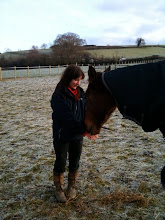
Today i decided to give Spice a day off since we had done quite a bit yesterday and her hoof is still repairing itself. I've been cleaning the exit point of the abscess up and applying some pure garlic paste to it to fend off any infection which i think has really helped, i decided to do this after speaking to my partners sister about it and then reading up more about it on the net...
Garlic has anti-septic, anti-inflammatory and antibiotic effects, reducing blood pressure, improving respiratory problems in horses and acting as a fly repellent -
Garlic is used by many horse and pony owners as a regular equine feed supplement. It contains substances with benefits of pain-relieving, anti-inflammatory and reduce swelling.
It is believed that garlic is one of the most effective natural healing substances in the world. It is popularly used, in conjunction with anti-biotics to treat equine respiratory diseases and infections in the horse's lungs.
Garlic is rich in Selenium and Sulphur. Sulphur is recognised as having blood cleansing properties that are useful in treating and preventing equine disease. It is also believed to contain over 25 germ-killing compounds.
Many horse owners feed an equine garlic supplement for its insect repelling qualities - the sweat produced by a horse fed on garlic gives out an odour that keeps flies, ticks and midges away - making it a natural fly repellant.
Horse owners also find feeding garlic useful as part of their equine worming program. Regular feeding of Garlic is effective in deterring tapeworms, pinworms and roundworms - but this should not exclude the use of regular wormers.
Garlic can be used used to give relief from the symptons of coughs - it contains a substance that helps to clear mucus in the airways. This cleansing action, together with its ability to reduce inflammation, also benefits the urinary tract.
The recommended amount to feed is half an ounce to 2 ounces per day depending on the horse or pony's size. It comes in several forms for equine use - powder, freeze dried granules and some herbalists claim freshly grown garlic is the best way to feed it.
The benefits of garlic are many and if you do decide to feed a garlic supplement just be careful not to overdo it.
Spice is booked in for another trim in just under 2 weeks time so i will hopefully be able to do more with her then.
I really want to focus on building up her topline as she has definitely lost some muscle tone over the winter period so i was thinking i could lunge her twice a week with side reins and start schooling her twice a week in the arena.
On the other days i think i will do ground work and jumping at liberty and if all these things go well actually start hacking her out again for 30 mins or so but i don't want to do any of these things until i have the all clear from the barefoot trimmer as the last thing i want to do is risk getting another abscess so i am happy to wait 3 more weeks after all i've already waited 3 months.
Showing posts with label Hoof Abscess. Show all posts
Showing posts with label Hoof Abscess. Show all posts
Monday, 19 April 2010

Tuesday, 16 March 2010
75. Groundwork and abscess update
 'I'm really enjoying this sunbathing session'
 'Uh Hello...'
 'Don't mind me i'm just smelling your bum'
 'mmm your bum smells good'
Today i took Spice for another walk and we came across a tractor, a bus and a lorry so it was a great experience for her. She was very anxious around the tractor (this is her main object of fear) but she followed my lead and remained sensible.
As for her abscess...it is now day 21 believe it or not and the amount of puss on the nappy was almost non-existent. I am quite certain that by thursday there will be no need to apply any more poultices...thank god!
As for her other hooves they are all nice and cool and have low pulses so they seem to be healthy. She is coping well on the roads but we are only doing short bursts of 20 mins at a time (hand-walking).
Monday, 15 March 2010
73. Groundwork, Going Barefoot, Lameness, Hoof Abscess
Today i took Spice for a 15 minute walk and am pleased to say she was as good as gold. I am trying to make the experience as pleasant as possible for her with a piece of carrot at the beginning, middle and end of our session so she associates leaving the herd with getting a nice treat. She did not seem at all sore on the road which is good but with regards her abscess it is STILL draining and i am beginning to think it will be draining forever! but at least she is moving well and seems comfortable.
Talking about moving well and feeling comfortable my friend had the back lady come out today to treat two of her horses and unfortunately Syrup the cheeky but loveable pony of the herd is lame. The back lady seems to think it could be to do with her hooves and that she would probably be better of going barefoot so alex my friend has now decided to take her shoes off. I loved the back lady's attitude to horse care in general and will definetly be using her to treat Spice. I hope Syrup (the cheeky pony) finds some comfort in her shoes being taken off and look forward to seeing how she compares to Spice in her transition. I am going to take some pictures soon of Spices hooves so i can see how they change throughout her transition.
http://www.horse-back.co.uk/
http://www.sarahoofgirl.com/
Talking about moving well and feeling comfortable my friend had the back lady come out today to treat two of her horses and unfortunately Syrup the cheeky but loveable pony of the herd is lame. The back lady seems to think it could be to do with her hooves and that she would probably be better of going barefoot so alex my friend has now decided to take her shoes off. I loved the back lady's attitude to horse care in general and will definetly be using her to treat Spice. I hope Syrup (the cheeky pony) finds some comfort in her shoes being taken off and look forward to seeing how she compares to Spice in her transition. I am going to take some pictures soon of Spices hooves so i can see how they change throughout her transition.
http://www.horse-back.co.uk/
http://www.sarahoofgirl.com/
Sunday, 14 March 2010
72. Day 19 Spices hoof abscess & Groundwork
So, it's now day 19 of Spices hoof abscess and it's barely draining at all now which is good because she is no longer at all lame which would indicate that it has almost healed. I did notice today that it seems to be draining from the back of the coronary band too but only slightly and in a way i think it is easier if it drains from here as there is no contact with the ground where it may be prone to becoming re-infected or clogged up.
I can't wait to start actually doing stuff with Spice, at the moment i've just been leading her in walk and trot around the yard...backing her up, making her stop, and yielding her hind quarters etc which has been great because every day i have seen a marked improvement in the way she responds. She is finally 'following' my every move and actually 'listening' to me and looking to me for direction. I have found that the less force i use the more willing she is to respond. She teaches me every day that i don't need to use force i just need to ask using the correct body language and she will willingly oblige.
I find Spice quite special because as a naturally nervous horse she often has to cope with feeling very anxious and listening to me at the same time but the more i ask her to listen to me the more she seems to want to listen to me. She is a pleasure to work with so gentle...so honest.
As soon as i can stop poulticing her hoof which should be in two days time my plan is to lead her around the block for around 15-20 mins so we can come face to face with any demons and work through them. I want to be able to feel confident that i could lead her almost anywhere before i actually start riding her out again as if i can't do this i don't think i stand a chance on her back.
I feel as though Spice is the kind of horse that will just give and give and give once i become her leader, i actually get the feeling that she wants to please me.
She no longer hesitates when leaving the yard and the best thing of all is she never walks away when i go to catch her - this tells me that she would rather be with me than not and that i am not putting too much pressure on her.
I am going to start making some videos of our training sessions soon so will be posting them on here as a diary.
Very excited...
I can't wait to start actually doing stuff with Spice, at the moment i've just been leading her in walk and trot around the yard...backing her up, making her stop, and yielding her hind quarters etc which has been great because every day i have seen a marked improvement in the way she responds. She is finally 'following' my every move and actually 'listening' to me and looking to me for direction. I have found that the less force i use the more willing she is to respond. She teaches me every day that i don't need to use force i just need to ask using the correct body language and she will willingly oblige.
I find Spice quite special because as a naturally nervous horse she often has to cope with feeling very anxious and listening to me at the same time but the more i ask her to listen to me the more she seems to want to listen to me. She is a pleasure to work with so gentle...so honest.
As soon as i can stop poulticing her hoof which should be in two days time my plan is to lead her around the block for around 15-20 mins so we can come face to face with any demons and work through them. I want to be able to feel confident that i could lead her almost anywhere before i actually start riding her out again as if i can't do this i don't think i stand a chance on her back.
I feel as though Spice is the kind of horse that will just give and give and give once i become her leader, i actually get the feeling that she wants to please me.
She no longer hesitates when leaving the yard and the best thing of all is she never walks away when i go to catch her - this tells me that she would rather be with me than not and that i am not putting too much pressure on her.
I am going to start making some videos of our training sessions soon so will be posting them on here as a diary.
Very excited...
Saturday, 13 March 2010
71. Unbiased Viewpoint on Barefoot Transition...
It's now day 18 of Spices abscess and it is still draining ever so slightly from the hole which the vet made but i noticed when taking off the poultice today that it now seems to have sealed over with a whitesh yellowish film...from what i read this is good and means it is healing over and within 5 days or so there shouldn't be any reason to keep applying a poultice as by this time the hole will have healed over enough to resist getting punctured. I have read however that it is advisable to wait a further two weeks before taking her onto roads which could have sharp stones.
Having read many articles on barefoot transition i have found that most tend to be quite biased and i thought that since i am embarking on this journey it would be wise to get an unbiased viewpoint which is likely to be more realistic. The following article i found is perhaps the least biased article i have read so far...
Barefoot Transition
Horse owners who own a shod horse and wish to pull the shoes and allow their horse to go barefoot will experience what is known as a barefoot transition period. This is the period during which the horse becomes accustomed once again to going without shoes. During the period when the horse was shod, the shoes and the way the hooves were trimmed hindered the function of the hooves. Since the parts of the hooves respond like muscles, the parts that were unable to function became weak and atrophied. This led to hoof deformity and may have resulted in hoof and lameness problems to one degree or another. When the shoes are pulled and the hoof is left alone, eventually the parts of the hoof will begin to function naturally again and will strengthen. If left alone, the hoof will naturally shed the deformity through the processes of flaring, splitting, cracking, chipping, and breaking off. This is not cause for alarm but is Nature's way of shaping the hoof so that all parts can perform their functions. As the hoof begins functioning normally once again, the parts that atrophied will grow back and regain their strength and functionality. This is most important for the internal hoof structures...the parts of the hoof that you can't see. When the hoof deformity has been shed and all parts of the hoof are able to function normally again and when all structures of the hoof have regenerated and recovered their functionality, then it is said that the horse has made the transition from shod to barefoot.
It is vitally important to realize that this process takes time...it is equally important to realize that hoof structures that have been chronically weak and underdeveloped for years as a result of shoes, improper trimming, or detrimental environments may never be able to fully heal and regain full functionality. In other words permanent damage may have been done to the hoof structures. In this case a horse would be said to have made the transition when the hooves have recovered as best as they can. This will be the case for the majority of horses who have been shod for a number of years or who have lived, especially the first months and years of their lives, in stall or paddock confinement.
There's a lot of talk going around now about barefoot horses, and most of it concentrates on a certain kind of trim, usually referred to as a "natural trim" or a "barefoot trim" or a "mustang trim." If you've been influenced by the barefoot trimming/natural hoof care movement, you may have the idea that the transition period from shod back to barefoot will be relatively easy and short....the shoes are pulled, the hooves are trimmed a certain way every four or six weeks, there will be rapid improvement in your horse's hooves, and after five or six months, you'll have a barefoot horse that you can ride wherever you want to. It all seems so easy...it seems that this certain kind of "natural trim" works magic on the hooves. After all, isn't that what happened in all the success stories you read or heard about? Having a barefoot horse seems to be all about this "magic trim," and it is promoted as being able to work wonders, as being able to take a horse with severe hoof deformity and severe hoof weakness and turn it into a horse with rock-crushing hooves within just a few months.
But, unfortunately, for most people, it's not going to work out that way. In reality the "magic trim" proves not to be so magic, and depending on your particular horse, the transition period may not be as easy and quick as those in the barefoot trimming/natural hoof care movement may lead you to believe. You might soon realize that the success stories which are so publically bragged about are in fact well-chosen success stories...and maybe that's why barefoot gurus are branching out and have signed hoof boot endorsement contracts.
I've received numerous calls from people who've tried the "magic trim," fully expecting it to work wonders changing their horses' hooves into rock-crushers...but whose experiences have been somewhat less than expected. Initially most were convinced the problem was that their trimmer was not doing the "magic trim" properly, and if they could just find a trimmer who REALLY knew how to do the "magic trim," they could experience the magical results. The exaggerated claims made by the barefoot trimming/natural hoof care movement about the magic trim have caused problems for hoof care professionals from all corners, for, intentionally or not, they have led many horse owners to believe that ANY horse can magically have rock-crushing feet in just a few months with the application of the magic trim. And when it doesn't work, whose fault is it? Well, of course, it's the trimmers fault! The trimmer obviously didn't know how to do the magic trim properly.
The hoof care industry is really a commercial venture, and it's full of personalities. I got a call from a woman with a horse who had previously foundered and who she suspected was a chronic founder horse. She had been through all the farrier/vet recommendations, with the wierd shoes, chopped-off toes, and high heels...and, as is usually the case, her horse hadn't done so well. But, this woman had a lot of money, and she eventually contacted one of the personalities in hoof care who came up and got rid of all the junk her horse had been fitted with by the vets and farriers...and the horse naturally showed some improvement. At that time, the horse was not in a founder state, and the symptoms it was showing were not in fact from the founder at all, but the results of the conventional founder treatments that had been applied. So, when she went with the natural hoof care guy and discontinued the treatments, naturally her horse improved. Anyway, it was going to be impossible for this personality to continue regular hoof care on her horse, so she needed to find someone locally. The problem was that this guy had basically convinced her that he was one of only a handful of people in the entire United States who understood horses' feet and who understood how to do the "magic trim" properly, and that the only way her horse wouldn't plunge back into lameness was that if he could instruct someone in the area exactly how to maintain her horse's hooves. You see, he convinced her that it was this "magic trim" that had saved her horse, and he also convinced her that only he and the people he instructed knew about this "magic trim." So, she called me to ask if I would be willing to come up and let this guru enlighten me and bring me out of the deep darkness of ignorance about hoof care and then take over care of her horse's feet. I politely told her no. It wasn't only that I had no intention of being a groupie around a personality in hoof care, it was also that I realized that if she did indeed have a chronic founder horse, the horse would eventually founder again, and when it did I would be the one left holding the bag, as the conclusion would be that I wasn't doing the magic trim properly....that I was not doing it as well as the guru did. And that is in fact what happened...the horse eventually foundered again, and the poor guy who did agree to be enlightened by the guru and took over the hoof care got blamed for the founder incident....because, you see, it MUST have been that he wasn't doing the "magic trim" properly. It HAD to be that way, because the guru had "cured" founder with his magic trim, so if the horse foundered again, there was no other explanation than that the trimmer was not doing exactly what the guru had told him to do.
I've just seen so many people who got taken by the gurus, who believed the stuff about the magic trim, who didn't realize that the success stories were well-chosen success stories, and who believed that having a barefoot horse was going to be that easy. And then I've seen what happened as they experienced the reality of the promises made by the barefoot trimming movement....eventually they became disgusted, believed barefoot riding to be impossible, and went back to horseshoes.
Now, I like barefoot horses and don't like to see people get disgusted and go back to horseshoes. I've worked with a lot of people who were genuinely trying to get rid of the shoes and the problems they can cause and ride a barefoot horse. But the fact that the barefoot trimming/natural hoof care movement has sort of taken over the whole area of barefoot horses in an attempt to sell and prmote a certain kind of trim has created a lot of problems for those who realize that there is a LOT more to having a barefoot riding horse than just a "magic trim." It's caused so many unrealistic expectations among horse owners. Barefoot riding IS possible, but your success or failure with barefoot is not going to hinge on the magic trim. In fact, in many cases, the magic trim may actually contribute to barefoot failure. And, depending on your horse, the transition period may well be a lot longer than the few months the barefoot trimming movement talks about...and even with the magic trim, you may never experience the results you read about in the well-chosen success stories. So let's look briefly at what does matter if you want to transition a horse from shod to barefoot.
The most important thing is the condition of your horse. A horse that's been shod and maintained with an abnormal hoof setup for years is going to have pathologically weak and underdeveloped hooves. This will be true not only for the structures you can see, but most importantly, for the structures inside the hoof that you can't see. Everything will be thin, weak, and underdeveloped, and it will have been that way for years. In order for you to have success riding this horse barefoot, that entire hoof, inside and out, is going to have to change....become strong and well-developed. That's not going to happen in a few months. Realistically it might take years, and the fact is that on an older horse, who's 10 or more years old, it may never totally happen. In other words, no matter what you do, that horse may never have hooves like it would have had without the years of deformity the shoes caused. No doubt you'll see improvement, but such a horse may never be like the barefoot riding horses you hear about in the success stories.
A second factor is how the horse is used. The hooves will adapt themselves to the environment which the horse lives on and to the stresses they encounter on a daily basis. This means that if your horse lives in a grass pasture, its hooves will become adapted to the grass pasture and not the hard, rocky trails with tree roots that you normally ride on. If you house your horse on grass pasture and ride for extended periods on severe terrain, you probably won't have much luck barefoot. If you house your horse on terrain similar to what you ride on, it'll be better, but keep in mind even then....your horse is used to walking over that terrain without your weight on his back. When you ride, you are putting different stresses on the feet and changing the way the hoof mechanism operates. If you ride often, the hooves will adjust to that, because your riding is part of the normal, daily environment and normal, daily stresses the feet are exposed to. But if you just ride only occasionally, you'll have to take it easy if you want to ride barefoot.
There's a third factor. The growth and renewal rate of the parts of the hoof exposed to wear will depend on what the horse is exposed to on a daily basis. A shod horse will have a slow growth and renewal rate. When you pull the shoes, the rate will speed up, but that takes time and will be as a result of necessity...in other words, the feet may show signs of increased wear to the point it may alarm you, and as a result, the horse may be sore. If you house your horse in a soft grass pasture, this probably won't be an issue, but if you house it in more varied terrain, it may....because the shoes have insulated the hooves from the rougher terrain, and it will take time for the hooves to adjust to this terrain after the shoes are no longer there. Eventually, if you can have patience and realize what's happening, the growth and renewal rate will catch up and provide what the horse needs for its daily wear....but this won't happen overnight.
Regarding the magic trim, it's very important to realize that your horse is not living in the same environment that the wild horses lived in who were the foundation for the so-called barefoot model. It's also important to realize that your horse's daily routine is different....it's not running 25 or 30 miles per day over rugged terrain. So....don't expect your horse's feet to ever look like that mustang model. Horses' hooves are the product of the environment and daily stresses they're exposed to. Nature knows how to adapt each horse's foot to what is required for that particular horse in that particular environment. Your horse does NOT have to have feet that match the barefoot model in order to have natural hoof function. In fact, since your horse lives in a different environment and its feet are exposed to different stresses each day, if you allow someone to take nippers and a rasp and force the feet to match the barefoot model, you will HINDER natural hoof function. A natural hoof is not dependent on looks, but function. To read more about this, please refer to the articles on A Natural Hoof and Natural Hoof Care.
There is no doubt that shoes and/or stall and paddock confinement result in hoof deformity that often leads to lameness and hoof problems down the road, as the horse ages. This is the reason for the increasing interest in barefoot. You can take any horse and transition it to barefoot. BUT....the barefoot trimming movement has somewhat misled people, because it is a commercial enterprise that has something to sell--trimming services and trimming education, and lately, hoof boots. They have been very good at promoting themselves and the boots for which they have endorsement contracts....after all, if you do an internet search on barefoot horses, you'll mostly get results about a certain kind of trim, and it may seem that this trim will allow you to transition any horse to barefoot with just a short, easy transition period. This makes it seem like having a barefoot riding horse is all about a certain kind of trim. But that is absolutely not true. Just because you can transition any horse to barefoot does NOT mean that you will be able to do exactly the same things with it barefoot that you did when it was shod. It'll be different....especially on an older horse who had a lot of hoof deformity, it may be unreasonable to ever expect that horse to develop rock-crushing feet. On any horse who's been shod for a number of years, and on any horse who was born in and lived the first part of its life in stall or paddock confinement, you can expect a lot of hoof deformity, especially on the inside where you can't see. The transition period for such a horse will be a lot longer than just 5 or 6 months, and you probably won't experience this smooth, magical transition you might expect from reading the well-chosen success stories.
The most important factor in determining how much trouble you can expect during a transition period is the condition the horse's feet are in when you begin. On a younger horse with little pre-existing hoof deformity, expect a relatively brief and easy transition. But on a horse who's 8 or 9 years old and has lots of hoof deformity, expect a longer and more troublesome transition. And please realize that no trim will give a horse magic feet....you probably won't be able to keep a horse standing in a grass pasture for a month and then ride it barefoot on a 4-hour trail ride over harsh, rocky terrain...and no trim will change that.
When I talk to someone about the possibility of barefoot, I tell them first of all to stop and think and use their instincts and common sense. The barefoot movement has largely become a commercial enterprise, and the promoters have developed sort of a barefoot establishment around their magic trim and most of all around themselves, so that "barefoot" has basically come to mean the application of their magic trim. The existence of that establishment has basically shut out any discussion of barefoot that does not recognize that trim as primary. Their monopolization of the subject of barefoot has in itself lent credibility to their claims and promises. We live in a society where we are not taught to think critically, not taught to question, but rather to believe what we're told.....if someone has certain credentials and has published books and leads seminars and has founded an organization, then we don't question what they say. I talked with a woman who recently retired from teaching on the college level. She said that where our educational system has failed is not that we don't teach enough science and math, it's that we don't teach students to THINK...to think for themselves. Instead, we basically teach them to believe what they're told. This is apparent in the society as a whole. On the political level, we don't need the details, we don't need to know what happened....."Trust us...we know best." On the medical level, we don't need to know the details and intricasies about our diagnosis and treatment options, we only need to know a broad-brush summary from one perspective and then are expected to blindly follow the recommendations..."Trust me, I know best." If it's in print and/or if the person saying it has credentials, we're conditioned to not question. Who are we to dare question? But really, I have faith in my own instincts and common sense, and I try to teach other horse owners to have faith in their own instincts and common sense...even if it means going against those who have made themselves into personalities and have amassed credentials. That's hard to do....but I think that to understand hoof care, and horse care in general, we really have to step back a little and take some time to just think, and let our insincts and common sense guide us.
Barefoot is undoubtedly best for the horse. But it may not be best for all horse owners. Whether or not your horse can go barefoot is really not dependent on your horse, it's dependent on you, on what's important to you. There are no horses who "need" shoes for themselves, there are only horses who need some form of hoof protection because of what their owners do with them. So YOU are the determinant of whether of not your horse "needs" shoes. Some horse owners' main concern is the health and well-being of their horses, and they will adjust how they keep their horses and how they use their horses accordingly. Barefoot is suited for them. But some horse owners' main concern is being able to use their horses for whatever uses they want whenever they want to do it. For those horse owners, being able to use their horses is more important than the long term well-being of the horses. If that describes you, then barefoot is probably not right for you. That doesn't make a moral judgment, it just describes reality.
I got a call from a very nice couple who wanted to keep their horses barefoot. They had two horses, both around 15 years old, who had been shod all their lives and who were used occasionally for trail riding. They had seen the hoof deformity that the shoes had caused, and they were attached to their horses and cared about them, so they had tried barefoot. But they had believed the success stories from the barefoot trimming/natural hoof care movement and expected a short and easy transition to barefoot and then to have two horses who could stand for 6 weeks in a grass pasture and then be ridden barefoot over hard, rocky trails for 6 or 7 hours. It didn't work out that way. Their horses had severe hoof deformity and very weak hooves, and after a 5-month period, their horses still couldn't walk up a gravel road without being sore. They tried the hoof boots that the gurus endorsed but didn't feel they were suitable for their horses. My heart went out to them, because they really didn't know what to do. They had these two horses, who they wanted to be able to ride occasionally...that's really the reason they had them...but at the same time, they were genuinely concerned with their long term well-being. They first wanted to be mad at farriers, but I tried to remind them that a farrier's job is to make a horse rideable, and that a farrier can't really be blamed for the lameness problems shoes might cause, because after all, a farrier is just responding to customer demand, and it should be clear to a horse owner that nailing metal shoes on a horse's hoof is not good. There's a trade-off....you chance sacrificing your horse's soundness down the road so that you can ride today, so that you can do with your horse what you want to do with it. I told them that, considering the age of their horses and the condition of their feet, what they wanted to do was asking too much....you can't take two older horses with severe hoof deformity who stand in a soft grass pasture and expect to be able to ride them barefoot occasionally over harsh terrain. It just isn't reasonable. But yet from what they had heard from the barefoot trimming/natural hoof care movement, they thought they could...after just 5 months. And they ended up feeling betrayed and going back to horseshoes....but at the same time feeling guilty, because they knew the shoes were harming their horses' hooves. Sometimes it isn't possible to have it all; sometimes we have to make a choice. What's more important to us? That's a question that every horse owner must answer for him- or herself.
For a realilstic and extended discussion of how to choose and maintain a barefoot riding horse, as well as to learn how all wild horse feet do not match the mustang model, please refer to the manual Maintaining a Natural Horse.
Having read many articles on barefoot transition i have found that most tend to be quite biased and i thought that since i am embarking on this journey it would be wise to get an unbiased viewpoint which is likely to be more realistic. The following article i found is perhaps the least biased article i have read so far...
Barefoot Transition
Horse owners who own a shod horse and wish to pull the shoes and allow their horse to go barefoot will experience what is known as a barefoot transition period. This is the period during which the horse becomes accustomed once again to going without shoes. During the period when the horse was shod, the shoes and the way the hooves were trimmed hindered the function of the hooves. Since the parts of the hooves respond like muscles, the parts that were unable to function became weak and atrophied. This led to hoof deformity and may have resulted in hoof and lameness problems to one degree or another. When the shoes are pulled and the hoof is left alone, eventually the parts of the hoof will begin to function naturally again and will strengthen. If left alone, the hoof will naturally shed the deformity through the processes of flaring, splitting, cracking, chipping, and breaking off. This is not cause for alarm but is Nature's way of shaping the hoof so that all parts can perform their functions. As the hoof begins functioning normally once again, the parts that atrophied will grow back and regain their strength and functionality. This is most important for the internal hoof structures...the parts of the hoof that you can't see. When the hoof deformity has been shed and all parts of the hoof are able to function normally again and when all structures of the hoof have regenerated and recovered their functionality, then it is said that the horse has made the transition from shod to barefoot.
It is vitally important to realize that this process takes time...it is equally important to realize that hoof structures that have been chronically weak and underdeveloped for years as a result of shoes, improper trimming, or detrimental environments may never be able to fully heal and regain full functionality. In other words permanent damage may have been done to the hoof structures. In this case a horse would be said to have made the transition when the hooves have recovered as best as they can. This will be the case for the majority of horses who have been shod for a number of years or who have lived, especially the first months and years of their lives, in stall or paddock confinement.
There's a lot of talk going around now about barefoot horses, and most of it concentrates on a certain kind of trim, usually referred to as a "natural trim" or a "barefoot trim" or a "mustang trim." If you've been influenced by the barefoot trimming/natural hoof care movement, you may have the idea that the transition period from shod back to barefoot will be relatively easy and short....the shoes are pulled, the hooves are trimmed a certain way every four or six weeks, there will be rapid improvement in your horse's hooves, and after five or six months, you'll have a barefoot horse that you can ride wherever you want to. It all seems so easy...it seems that this certain kind of "natural trim" works magic on the hooves. After all, isn't that what happened in all the success stories you read or heard about? Having a barefoot horse seems to be all about this "magic trim," and it is promoted as being able to work wonders, as being able to take a horse with severe hoof deformity and severe hoof weakness and turn it into a horse with rock-crushing hooves within just a few months.
But, unfortunately, for most people, it's not going to work out that way. In reality the "magic trim" proves not to be so magic, and depending on your particular horse, the transition period may not be as easy and quick as those in the barefoot trimming/natural hoof care movement may lead you to believe. You might soon realize that the success stories which are so publically bragged about are in fact well-chosen success stories...and maybe that's why barefoot gurus are branching out and have signed hoof boot endorsement contracts.
I've received numerous calls from people who've tried the "magic trim," fully expecting it to work wonders changing their horses' hooves into rock-crushers...but whose experiences have been somewhat less than expected. Initially most were convinced the problem was that their trimmer was not doing the "magic trim" properly, and if they could just find a trimmer who REALLY knew how to do the "magic trim," they could experience the magical results. The exaggerated claims made by the barefoot trimming/natural hoof care movement about the magic trim have caused problems for hoof care professionals from all corners, for, intentionally or not, they have led many horse owners to believe that ANY horse can magically have rock-crushing feet in just a few months with the application of the magic trim. And when it doesn't work, whose fault is it? Well, of course, it's the trimmers fault! The trimmer obviously didn't know how to do the magic trim properly.
The hoof care industry is really a commercial venture, and it's full of personalities. I got a call from a woman with a horse who had previously foundered and who she suspected was a chronic founder horse. She had been through all the farrier/vet recommendations, with the wierd shoes, chopped-off toes, and high heels...and, as is usually the case, her horse hadn't done so well. But, this woman had a lot of money, and she eventually contacted one of the personalities in hoof care who came up and got rid of all the junk her horse had been fitted with by the vets and farriers...and the horse naturally showed some improvement. At that time, the horse was not in a founder state, and the symptoms it was showing were not in fact from the founder at all, but the results of the conventional founder treatments that had been applied. So, when she went with the natural hoof care guy and discontinued the treatments, naturally her horse improved. Anyway, it was going to be impossible for this personality to continue regular hoof care on her horse, so she needed to find someone locally. The problem was that this guy had basically convinced her that he was one of only a handful of people in the entire United States who understood horses' feet and who understood how to do the "magic trim" properly, and that the only way her horse wouldn't plunge back into lameness was that if he could instruct someone in the area exactly how to maintain her horse's hooves. You see, he convinced her that it was this "magic trim" that had saved her horse, and he also convinced her that only he and the people he instructed knew about this "magic trim." So, she called me to ask if I would be willing to come up and let this guru enlighten me and bring me out of the deep darkness of ignorance about hoof care and then take over care of her horse's feet. I politely told her no. It wasn't only that I had no intention of being a groupie around a personality in hoof care, it was also that I realized that if she did indeed have a chronic founder horse, the horse would eventually founder again, and when it did I would be the one left holding the bag, as the conclusion would be that I wasn't doing the magic trim properly....that I was not doing it as well as the guru did. And that is in fact what happened...the horse eventually foundered again, and the poor guy who did agree to be enlightened by the guru and took over the hoof care got blamed for the founder incident....because, you see, it MUST have been that he wasn't doing the "magic trim" properly. It HAD to be that way, because the guru had "cured" founder with his magic trim, so if the horse foundered again, there was no other explanation than that the trimmer was not doing exactly what the guru had told him to do.
I've just seen so many people who got taken by the gurus, who believed the stuff about the magic trim, who didn't realize that the success stories were well-chosen success stories, and who believed that having a barefoot horse was going to be that easy. And then I've seen what happened as they experienced the reality of the promises made by the barefoot trimming movement....eventually they became disgusted, believed barefoot riding to be impossible, and went back to horseshoes.
Now, I like barefoot horses and don't like to see people get disgusted and go back to horseshoes. I've worked with a lot of people who were genuinely trying to get rid of the shoes and the problems they can cause and ride a barefoot horse. But the fact that the barefoot trimming/natural hoof care movement has sort of taken over the whole area of barefoot horses in an attempt to sell and prmote a certain kind of trim has created a lot of problems for those who realize that there is a LOT more to having a barefoot riding horse than just a "magic trim." It's caused so many unrealistic expectations among horse owners. Barefoot riding IS possible, but your success or failure with barefoot is not going to hinge on the magic trim. In fact, in many cases, the magic trim may actually contribute to barefoot failure. And, depending on your horse, the transition period may well be a lot longer than the few months the barefoot trimming movement talks about...and even with the magic trim, you may never experience the results you read about in the well-chosen success stories. So let's look briefly at what does matter if you want to transition a horse from shod to barefoot.
The most important thing is the condition of your horse. A horse that's been shod and maintained with an abnormal hoof setup for years is going to have pathologically weak and underdeveloped hooves. This will be true not only for the structures you can see, but most importantly, for the structures inside the hoof that you can't see. Everything will be thin, weak, and underdeveloped, and it will have been that way for years. In order for you to have success riding this horse barefoot, that entire hoof, inside and out, is going to have to change....become strong and well-developed. That's not going to happen in a few months. Realistically it might take years, and the fact is that on an older horse, who's 10 or more years old, it may never totally happen. In other words, no matter what you do, that horse may never have hooves like it would have had without the years of deformity the shoes caused. No doubt you'll see improvement, but such a horse may never be like the barefoot riding horses you hear about in the success stories.
A second factor is how the horse is used. The hooves will adapt themselves to the environment which the horse lives on and to the stresses they encounter on a daily basis. This means that if your horse lives in a grass pasture, its hooves will become adapted to the grass pasture and not the hard, rocky trails with tree roots that you normally ride on. If you house your horse on grass pasture and ride for extended periods on severe terrain, you probably won't have much luck barefoot. If you house your horse on terrain similar to what you ride on, it'll be better, but keep in mind even then....your horse is used to walking over that terrain without your weight on his back. When you ride, you are putting different stresses on the feet and changing the way the hoof mechanism operates. If you ride often, the hooves will adjust to that, because your riding is part of the normal, daily environment and normal, daily stresses the feet are exposed to. But if you just ride only occasionally, you'll have to take it easy if you want to ride barefoot.
There's a third factor. The growth and renewal rate of the parts of the hoof exposed to wear will depend on what the horse is exposed to on a daily basis. A shod horse will have a slow growth and renewal rate. When you pull the shoes, the rate will speed up, but that takes time and will be as a result of necessity...in other words, the feet may show signs of increased wear to the point it may alarm you, and as a result, the horse may be sore. If you house your horse in a soft grass pasture, this probably won't be an issue, but if you house it in more varied terrain, it may....because the shoes have insulated the hooves from the rougher terrain, and it will take time for the hooves to adjust to this terrain after the shoes are no longer there. Eventually, if you can have patience and realize what's happening, the growth and renewal rate will catch up and provide what the horse needs for its daily wear....but this won't happen overnight.
Regarding the magic trim, it's very important to realize that your horse is not living in the same environment that the wild horses lived in who were the foundation for the so-called barefoot model. It's also important to realize that your horse's daily routine is different....it's not running 25 or 30 miles per day over rugged terrain. So....don't expect your horse's feet to ever look like that mustang model. Horses' hooves are the product of the environment and daily stresses they're exposed to. Nature knows how to adapt each horse's foot to what is required for that particular horse in that particular environment. Your horse does NOT have to have feet that match the barefoot model in order to have natural hoof function. In fact, since your horse lives in a different environment and its feet are exposed to different stresses each day, if you allow someone to take nippers and a rasp and force the feet to match the barefoot model, you will HINDER natural hoof function. A natural hoof is not dependent on looks, but function. To read more about this, please refer to the articles on A Natural Hoof and Natural Hoof Care.
There is no doubt that shoes and/or stall and paddock confinement result in hoof deformity that often leads to lameness and hoof problems down the road, as the horse ages. This is the reason for the increasing interest in barefoot. You can take any horse and transition it to barefoot. BUT....the barefoot trimming movement has somewhat misled people, because it is a commercial enterprise that has something to sell--trimming services and trimming education, and lately, hoof boots. They have been very good at promoting themselves and the boots for which they have endorsement contracts....after all, if you do an internet search on barefoot horses, you'll mostly get results about a certain kind of trim, and it may seem that this trim will allow you to transition any horse to barefoot with just a short, easy transition period. This makes it seem like having a barefoot riding horse is all about a certain kind of trim. But that is absolutely not true. Just because you can transition any horse to barefoot does NOT mean that you will be able to do exactly the same things with it barefoot that you did when it was shod. It'll be different....especially on an older horse who had a lot of hoof deformity, it may be unreasonable to ever expect that horse to develop rock-crushing feet. On any horse who's been shod for a number of years, and on any horse who was born in and lived the first part of its life in stall or paddock confinement, you can expect a lot of hoof deformity, especially on the inside where you can't see. The transition period for such a horse will be a lot longer than just 5 or 6 months, and you probably won't experience this smooth, magical transition you might expect from reading the well-chosen success stories.
The most important factor in determining how much trouble you can expect during a transition period is the condition the horse's feet are in when you begin. On a younger horse with little pre-existing hoof deformity, expect a relatively brief and easy transition. But on a horse who's 8 or 9 years old and has lots of hoof deformity, expect a longer and more troublesome transition. And please realize that no trim will give a horse magic feet....you probably won't be able to keep a horse standing in a grass pasture for a month and then ride it barefoot on a 4-hour trail ride over harsh, rocky terrain...and no trim will change that.
When I talk to someone about the possibility of barefoot, I tell them first of all to stop and think and use their instincts and common sense. The barefoot movement has largely become a commercial enterprise, and the promoters have developed sort of a barefoot establishment around their magic trim and most of all around themselves, so that "barefoot" has basically come to mean the application of their magic trim. The existence of that establishment has basically shut out any discussion of barefoot that does not recognize that trim as primary. Their monopolization of the subject of barefoot has in itself lent credibility to their claims and promises. We live in a society where we are not taught to think critically, not taught to question, but rather to believe what we're told.....if someone has certain credentials and has published books and leads seminars and has founded an organization, then we don't question what they say. I talked with a woman who recently retired from teaching on the college level. She said that where our educational system has failed is not that we don't teach enough science and math, it's that we don't teach students to THINK...to think for themselves. Instead, we basically teach them to believe what they're told. This is apparent in the society as a whole. On the political level, we don't need the details, we don't need to know what happened....."Trust us...we know best." On the medical level, we don't need to know the details and intricasies about our diagnosis and treatment options, we only need to know a broad-brush summary from one perspective and then are expected to blindly follow the recommendations..."Trust me, I know best." If it's in print and/or if the person saying it has credentials, we're conditioned to not question. Who are we to dare question? But really, I have faith in my own instincts and common sense, and I try to teach other horse owners to have faith in their own instincts and common sense...even if it means going against those who have made themselves into personalities and have amassed credentials. That's hard to do....but I think that to understand hoof care, and horse care in general, we really have to step back a little and take some time to just think, and let our insincts and common sense guide us.
Barefoot is undoubtedly best for the horse. But it may not be best for all horse owners. Whether or not your horse can go barefoot is really not dependent on your horse, it's dependent on you, on what's important to you. There are no horses who "need" shoes for themselves, there are only horses who need some form of hoof protection because of what their owners do with them. So YOU are the determinant of whether of not your horse "needs" shoes. Some horse owners' main concern is the health and well-being of their horses, and they will adjust how they keep their horses and how they use their horses accordingly. Barefoot is suited for them. But some horse owners' main concern is being able to use their horses for whatever uses they want whenever they want to do it. For those horse owners, being able to use their horses is more important than the long term well-being of the horses. If that describes you, then barefoot is probably not right for you. That doesn't make a moral judgment, it just describes reality.
I got a call from a very nice couple who wanted to keep their horses barefoot. They had two horses, both around 15 years old, who had been shod all their lives and who were used occasionally for trail riding. They had seen the hoof deformity that the shoes had caused, and they were attached to their horses and cared about them, so they had tried barefoot. But they had believed the success stories from the barefoot trimming/natural hoof care movement and expected a short and easy transition to barefoot and then to have two horses who could stand for 6 weeks in a grass pasture and then be ridden barefoot over hard, rocky trails for 6 or 7 hours. It didn't work out that way. Their horses had severe hoof deformity and very weak hooves, and after a 5-month period, their horses still couldn't walk up a gravel road without being sore. They tried the hoof boots that the gurus endorsed but didn't feel they were suitable for their horses. My heart went out to them, because they really didn't know what to do. They had these two horses, who they wanted to be able to ride occasionally...that's really the reason they had them...but at the same time, they were genuinely concerned with their long term well-being. They first wanted to be mad at farriers, but I tried to remind them that a farrier's job is to make a horse rideable, and that a farrier can't really be blamed for the lameness problems shoes might cause, because after all, a farrier is just responding to customer demand, and it should be clear to a horse owner that nailing metal shoes on a horse's hoof is not good. There's a trade-off....you chance sacrificing your horse's soundness down the road so that you can ride today, so that you can do with your horse what you want to do with it. I told them that, considering the age of their horses and the condition of their feet, what they wanted to do was asking too much....you can't take two older horses with severe hoof deformity who stand in a soft grass pasture and expect to be able to ride them barefoot occasionally over harsh terrain. It just isn't reasonable. But yet from what they had heard from the barefoot trimming/natural hoof care movement, they thought they could...after just 5 months. And they ended up feeling betrayed and going back to horseshoes....but at the same time feeling guilty, because they knew the shoes were harming their horses' hooves. Sometimes it isn't possible to have it all; sometimes we have to make a choice. What's more important to us? That's a question that every horse owner must answer for him- or herself.
For a realilstic and extended discussion of how to choose and maintain a barefoot riding horse, as well as to learn how all wild horse feet do not match the mustang model, please refer to the manual Maintaining a Natural Horse.
Wednesday, 10 March 2010
64. Spices first ever Barefoot Trim!
So, today i had the podiatrist come out to see spice for her first barefoot trim and i am pleased to say she was happy with her progress.
With regards the hoof abscess she has said to keep dry poulticing the hoof with the abscess for the next week so the internal structures of the hoof start to rebuild without the risk of any further infection/puncture as what is there at the moment is quite soft.
Apart from the walls being thin and slight flaring (something which is to be expected after de-shoeing) she said spice is doing well and that the holes from the where the nails were are almost grown out. I asked her today about whether she really thought spice was going to be able to hack out barefoot and she said that she is 100% certain that she wont have any problems. She also said that she wouldn't expect spice to get any more abscesses and that once the abscess has fully healed over i should be able to hack her out barefoot on tarmac for 30 mins without any problems. Overall, i am really pleased, i feel the visit has given me the encouragement and confidence i needed to carry on with the transition and fingers crossed spice will not suffer from any more abscesses. She is also almost 100% back to normal in terms of her comfort levels which makes me feel much better. Will keep you all posted over the next few weeks with regards her progress.
With regards the hoof abscess she has said to keep dry poulticing the hoof with the abscess for the next week so the internal structures of the hoof start to rebuild without the risk of any further infection/puncture as what is there at the moment is quite soft.
Apart from the walls being thin and slight flaring (something which is to be expected after de-shoeing) she said spice is doing well and that the holes from the where the nails were are almost grown out. I asked her today about whether she really thought spice was going to be able to hack out barefoot and she said that she is 100% certain that she wont have any problems. She also said that she wouldn't expect spice to get any more abscesses and that once the abscess has fully healed over i should be able to hack her out barefoot on tarmac for 30 mins without any problems. Overall, i am really pleased, i feel the visit has given me the encouragement and confidence i needed to carry on with the transition and fingers crossed spice will not suffer from any more abscesses. She is also almost 100% back to normal in terms of her comfort levels which makes me feel much better. Will keep you all posted over the next few weeks with regards her progress.
Tuesday, 9 March 2010
63. The best article i found on how to treat a hoof abscess...
FOOT ABSCESSES
A relatively common after-hours emergency call sounds something like this: " I think my horse has broken its leg. It can barely even touch its toe to the ground and doesn't want to walk on it al all. I think you're going to need to come out and probably have to put him down." These calls often are accompanied by the owner holding back tears as they tell the news about their 'broken-legged' horse.
More often than not, what they are describing turns out to be a hoof abscess and fortunately these are typically easy to diagnose relatively simple to treat.
Hoof abscesses are literally bacterial infections within the hoof capsule. Another name for this condition is called ‘subsolar abscesses’ and this simply describes a common location for the infection, i.e. just inside the sole of the hoof. The cause of hoof abscesses can also be simplified; they are caused by :
a puncture,
or separation in the outer, non-living hoof wall or sole which allows dirt, manure, and bacteria to gain entrance into the inside, living tissue of the hoof.
Once contaminants are inoculated into the sensitive tissues of the hoof, and abscess forms. An abscess is an accumulation of pus and cellular debris as bacteria, tissue cells, and white blood cells die in their attempt to fight off the infection.
The hoof capsule is quite non-yielding when a pocket of pus forms on the interior. This means that tremendous pressure is created within the hoof as a result of this expanding infection. Since the hoof can not ‘give’, the sensitive tissues within the hoof, such as the lamina, become compromised. The laminae are the soft tissue attachments between the outer hoof capsule and the inner sensitive soft tissue structures of the hoof. There are a tremendous amount of pain receptors, or nerve endings, in this tissue; this explains why subsolar abscesses are so exquisitely painful. In addition to that, imagine all the weight a horse bears on their small hooves and how that pain would be amplified tremendously when they attempt to walk on an infected foot.
When the vet arrives at a case such as this, the first thing they will do is examine the digital pulse. They are checking for a bounding or strong pulse when compared to the other legs. If the lame leg has a bounding pulse, that is a good indication that there is a problem within the foot. It does not mean specifically an abscess, as a broken coffin bone or an infected joint could produce a similar strong and bounding pulse. A pulse is not always detected if the abscess is very deep or a puncture has just occurred.
They would then produce hoof testers to apply pinpoint pressure to specific parts of the sole and frog. This is done to localize a specific portion of the sole that causes a pain response. The horse may flinch mildly or may rear up and explode as the veterinarian applies pressure over the abscess. It unfortunately is necessary, however, to use this crude diagnostic tool since our patients can not talk and tell us exactly where it hurts. Once the specific location of the pain is determined, a hoof knife (or abscess probe) is used to carefully pare away (or drill into) and examine the nature of the sole and hoof wall deep to that area. Sometimes sedation may be needed if the process is too painful for the horse. Often the shoe will need to be removed.
Often a black tract is seen which can then be followed through careful and conscientious dissection directly to the pocket of pus. When this is accomplished, the pressure is relieved, sometimes with pus squirting several feet from the hoof due to the great pressure. As you can imagine, this produces almost-instant relief to the horse.
So the cure for a hoof abscess is drainage of the pus. This is not always as easy as described above. Many times there is not just one focal area of pain, but the entire hoof hurts. In those cases, it is difficult to know where to dig a hole to drain the infection. Other times, there is no black tract to follow and the veterinarian can not just unscrupulously dig various holes in the horse’s sole hoping to get lucky and find the correct spot. In those difficult cases, many times vets will recommend soaking the hoof once or twice daily in epsom salts and wrapping the hoof with a poultice bandage in attempts to draw the infection out. This should be followed up in 48 hours with a re-check examination to attempt locating and draining the abscess again as this will be the quickest method to achieve soundness in your horse and avoid other more serious complications.
When the abscess is located and drained, half of the battle is over. The horse should regain soundness over the next 5-7 days assuming proper follow-up care is given. Your horse now literally will have a hole in its hoof that must be kept clean to prevent more contamination from setting up shop in there. So the key is to keep the drainage hole and sole cleaned regularly, and apply an antiseptic medication to the area to prevent re-infection while the horse’s body heals the defect in its hoof. This requires a bandage to be maintained on your horse’s hoof until it is sound and the drainage hole has healed to the point that re-infection will not occur. A tetanus toxoid immunization should also be administered at this time if it has been longer than 9 months or it the horse has a questionable vaccine history.
A relatively common after-hours emergency call sounds something like this: " I think my horse has broken its leg. It can barely even touch its toe to the ground and doesn't want to walk on it al all. I think you're going to need to come out and probably have to put him down." These calls often are accompanied by the owner holding back tears as they tell the news about their 'broken-legged' horse.
More often than not, what they are describing turns out to be a hoof abscess and fortunately these are typically easy to diagnose relatively simple to treat.
Hoof abscesses are literally bacterial infections within the hoof capsule. Another name for this condition is called ‘subsolar abscesses’ and this simply describes a common location for the infection, i.e. just inside the sole of the hoof. The cause of hoof abscesses can also be simplified; they are caused by :
a puncture,
or separation in the outer, non-living hoof wall or sole which allows dirt, manure, and bacteria to gain entrance into the inside, living tissue of the hoof.
Once contaminants are inoculated into the sensitive tissues of the hoof, and abscess forms. An abscess is an accumulation of pus and cellular debris as bacteria, tissue cells, and white blood cells die in their attempt to fight off the infection.
The hoof capsule is quite non-yielding when a pocket of pus forms on the interior. This means that tremendous pressure is created within the hoof as a result of this expanding infection. Since the hoof can not ‘give’, the sensitive tissues within the hoof, such as the lamina, become compromised. The laminae are the soft tissue attachments between the outer hoof capsule and the inner sensitive soft tissue structures of the hoof. There are a tremendous amount of pain receptors, or nerve endings, in this tissue; this explains why subsolar abscesses are so exquisitely painful. In addition to that, imagine all the weight a horse bears on their small hooves and how that pain would be amplified tremendously when they attempt to walk on an infected foot.
When the vet arrives at a case such as this, the first thing they will do is examine the digital pulse. They are checking for a bounding or strong pulse when compared to the other legs. If the lame leg has a bounding pulse, that is a good indication that there is a problem within the foot. It does not mean specifically an abscess, as a broken coffin bone or an infected joint could produce a similar strong and bounding pulse. A pulse is not always detected if the abscess is very deep or a puncture has just occurred.
They would then produce hoof testers to apply pinpoint pressure to specific parts of the sole and frog. This is done to localize a specific portion of the sole that causes a pain response. The horse may flinch mildly or may rear up and explode as the veterinarian applies pressure over the abscess. It unfortunately is necessary, however, to use this crude diagnostic tool since our patients can not talk and tell us exactly where it hurts. Once the specific location of the pain is determined, a hoof knife (or abscess probe) is used to carefully pare away (or drill into) and examine the nature of the sole and hoof wall deep to that area. Sometimes sedation may be needed if the process is too painful for the horse. Often the shoe will need to be removed.
Often a black tract is seen which can then be followed through careful and conscientious dissection directly to the pocket of pus. When this is accomplished, the pressure is relieved, sometimes with pus squirting several feet from the hoof due to the great pressure. As you can imagine, this produces almost-instant relief to the horse.
So the cure for a hoof abscess is drainage of the pus. This is not always as easy as described above. Many times there is not just one focal area of pain, but the entire hoof hurts. In those cases, it is difficult to know where to dig a hole to drain the infection. Other times, there is no black tract to follow and the veterinarian can not just unscrupulously dig various holes in the horse’s sole hoping to get lucky and find the correct spot. In those difficult cases, many times vets will recommend soaking the hoof once or twice daily in epsom salts and wrapping the hoof with a poultice bandage in attempts to draw the infection out. This should be followed up in 48 hours with a re-check examination to attempt locating and draining the abscess again as this will be the quickest method to achieve soundness in your horse and avoid other more serious complications.
When the abscess is located and drained, half of the battle is over. The horse should regain soundness over the next 5-7 days assuming proper follow-up care is given. Your horse now literally will have a hole in its hoof that must be kept clean to prevent more contamination from setting up shop in there. So the key is to keep the drainage hole and sole cleaned regularly, and apply an antiseptic medication to the area to prevent re-infection while the horse’s body heals the defect in its hoof. This requires a bandage to be maintained on your horse’s hoof until it is sound and the drainage hole has healed to the point that re-infection will not occur. A tetanus toxoid immunization should also be administered at this time if it has been longer than 9 months or it the horse has a questionable vaccine history.
Monday, 8 March 2010
61. Day 13...Spices abscess continues...
Today we took off what we hoped would be Spices last poultice but there was still a smell of puss on the poultice which would indicate that it is still draining albeit ever so slightly as visually there was next to nothing on it. So, my first thoughts were to apply yet another poultice and assess the situation tomorrow. However, Spice was behaving quite frantically with it being so windy and looked as though she was going to be a bit of a nightmare to keep still so reluctantly i postponed applying the poultice with the view of coming back to do it later.
I came back roughly 4 hours later to apply the poultice which was actually quite easy due to the fact that spice was happy to stand still for me but her hoof was full of mud due to being outside so it was quite a job cleaning it. I only hope that i managed to clean away the debris from the draining hole so that if there is anything left to drain it has an easy escape but as i said it was quite difficult.
I'm so over the whole hoof abscessing thing. It's times like this when you wish you had a stable just because it would be easier treating a horse in somewhere clean, dry and out of the wind than in an open muddy field.
I came back roughly 4 hours later to apply the poultice which was actually quite easy due to the fact that spice was happy to stand still for me but her hoof was full of mud due to being outside so it was quite a job cleaning it. I only hope that i managed to clean away the debris from the draining hole so that if there is anything left to drain it has an easy escape but as i said it was quite difficult.
I'm so over the whole hoof abscessing thing. It's times like this when you wish you had a stable just because it would be easier treating a horse in somewhere clean, dry and out of the wind than in an open muddy field.
Sunday, 7 March 2010
60. Applying the last poultice day 12
Quick update on spices hoof abscess, it's almost finished draining now i think as there was only the smallest amount of puss on the poultice today so with any luck it will have stopped draining by tomorrow. Am actually quite bored of writing about it now...Am really looking forward to being able to do some groundwork with her as i haven't been able to do any for the past two weeks!
Saturday, 6 March 2010
59. Saying goodbye to Spices Hoof Abscess - Day Ten!
.jpg)
Hoorah! Spices hoof abscess definitely seems to be on the mend, as you can see from the poultice above the abscess is still draining but hardly anything has come out over the past 24hrs so it is definitely on it's way out. I wasn't sure whether to apply a wet poultice today or a dry poultice but since she has had a wet for the last three days and there's hardly any muck draining i thought perhaps a dry one would be better. She is also far less lame in fact she's walking fine now so all good signs. I'm hoping that we will only have to dry poultice it for another three days at most and that then we will be able to leave it alone and let nature do the rest. My only hope is that it doesn't come back like it did before...I'm not sure how long it will take for the hole which was made to grow out and for her hoof to be sound in general but hopefully the podiatrist will be able to tell me more on wednesday.
Friday, 5 March 2010
58. Day nine of spices abscess...

So, it's day nine of spices abscess and it is still draining...once again there is not quite as much puss on the poultice as yesterday and it is also not as dark but there is still a fair amount.
On the plus side there was no wind and the sun was shining so spice stood still without me even putting a lead rope on her...If only she could be like this all the time...
Thursday, 4 March 2010
55. Day eight of spices hoof abscess

So, it looks as though Spices abscess is still draining, there was quite a bit of puss on the poultice but not quite as much as yesterday and not as dark which i am guessing is a good sign. She made it really hard to apply a poultice today though. It was a bit windy and being the skitty horse that she is she just wouldn't stand still. How my friend got the poultice on i don't know. I just hope it stays on otherwise i fear we'll probably be back to square one. I still think if you can go barefoot you should and physically/genetically i think spice can but i fear that the process of getting her may be far more difficult than i first perceived. If she was a quiet natured horse that was calm and had no problems with standing still the job of applying a clean poultice and dealing with the issues of going barefoot would be easy but as she is not and it seems likely that she may get more abscess whilst in transition i am doubting whether or not i will be able to continue this path. Feeling a bit down about the fact that sometimes just doing the simplest of things with spice seem sooo difficult. Yet seconds later she is the calmest, softest and easiest horse to be around...?! SIGHS...
Wednesday, 3 March 2010
53. Spices Hoof abscess is getting better...i think!
.jpg)
It's day seven of spices abscess and the good news is...it's definetly draining! We took the poultice off today and it was absolutely covered in puss. Luckily i have a blocked nose so couldn't smell it! I am hoping that some more will drain today but not as much as this would suggest that the infection is clearing. As soon as the wet poultice looks clean i will apply a dry poultice to protect the hoof from becoming re infected until it has fully repaired itself. I am also pleased to say that spice is definitely more comfortable than she was the day before and that the rest of her hooves look brilliant, they are not warm/hot and they do not appear to have any splits or cracks in them so all is not bad. I just can't wait until the podiatrist comes, once she has been i think i will feel a bit more confident about the condition of spices hooves.
Well done spices hoof for being strong and fixing yourself. :)
Tuesday, 2 March 2010
52. Spices Hoof Abscess is getting worse again!
It's now the sixth day of spices abscess and when i got to the yard i decided to have the vet come and see her as she seemed a little worse than she did yesterday and from what i could see on the poultice nothing was draining so i thought there could be a chance that the abscess was still live especially given the fact that she was still lame. Unfortunately i was right they said that the abscess had spread so had to make another hole to drain it (pictured below). I then cleaned it thoroughly and applied a warm wet poultice so hopefully this will help drain the rest of the abscess and all i have to do then is apply a dry one so the area stays clean while it is healing.
.jpg)
I think the most important thing is keeping it completely clean and free of debris so that it can drain freely but with all the mud and rain that there's been up until now it hasn't been easy to do this so i am hoping that the weather will stay dry and help with the healing process. I am beginning to see why people give up with the whole idea of going barefoot. It's a lot more hassle than just wacking on a pair of shoes...will have to just see how it goes i guess, whilst i am still 100% determined i completely appreciate the reasons why many people choose to shoe their horses.
Below is a video i found about how to treat an abscess which i found quite helpful...
.jpg)
I think the most important thing is keeping it completely clean and free of debris so that it can drain freely but with all the mud and rain that there's been up until now it hasn't been easy to do this so i am hoping that the weather will stay dry and help with the healing process. I am beginning to see why people give up with the whole idea of going barefoot. It's a lot more hassle than just wacking on a pair of shoes...will have to just see how it goes i guess, whilst i am still 100% determined i completely appreciate the reasons why many people choose to shoe their horses.
Below is a video i found about how to treat an abscess which i found quite helpful...
Monday, 1 March 2010
51. Spices Hoof abscess is getting better...
It's the fifth day of spices abscess today and i am pleased to say it seems to be a lot better than it was yesterday. The abscess still seems to be draining a bit but she isn't in nearly as much pain with it and she is far less lame. I only hope she continues to improve, I have the podiatrist coming to visit in 9 days time so fingers crossed she will say all is well.
Sunday, 28 February 2010
50. Spices Hoof abscess is getting worse...

So, it's day four of spices abscess and she is still hopping lame. :( I feel a bit guilty today because i guess i think that if i hadn't have removed her shoes the chances are she'd be fine. But i know or at least think that in the long run what i am doing is best for her. I just hope she doesn't have too many more abscesses because they're obviously pretty painful.
.jpg)
I am keeping my fingers crossed that tomorrow she will look a bit better and be less lame.
I question what i am doing only because i am only going along with what i have read rather than seen first hand and so far all i see is my horse looking miserable and half crippled. I hope i am doing the right thing. :(
.jpg)
On the plus side, at least she still has an appetite!
Friday, 26 February 2010
49. Update on Spices Hoof Abscess...
Today was so messy and muddy. I arrived at the fields this morning to find our horses had escaped for a third time :( so spent the first hour just tidying up after them and mending the electric fence. After being rained on for about one hour my friend turned up to help me apply a new poultice to spices hoof but that didn't go so well as i think spice was certain that we were trying to kill her by putting her in the stable in order to do it out of the mud.
The good news is the puss and muck from her abscess is draining nicely but spice is still very sore and is limping around. :( I hope it starts to feel less painful for her soon. It's not nice having a disabled horse.
I really hope the weather starts getting better soon too. All this mild weather and rain makes for a bit of a mud bath in the fields and wheelbarrows and mud are two things that should never be put together.
On top of this i am feeling as though i am coming down with the flu but apart from that everything else is great. ahhhh
The good news is the puss and muck from her abscess is draining nicely but spice is still very sore and is limping around. :( I hope it starts to feel less painful for her soon. It's not nice having a disabled horse.
I really hope the weather starts getting better soon too. All this mild weather and rain makes for a bit of a mud bath in the fields and wheelbarrows and mud are two things that should never be put together.
On top of this i am feeling as though i am coming down with the flu but apart from that everything else is great. ahhhh
Thursday, 25 February 2010
48. Spices Hoof Abscess
So, i said i'd give you an update on spices hooves and here it is....
I arrived at the yard today to find her hobbling along like she was crippled! Luckily i had my friend on hand to show me how to apply a poultice after the vet had been down to lance it but all the same it was pretty horrible to see spice in so much pain.
It's funny because just as i thought spice was making a brilliant transition this happens but i guess it's to be expected after all its only been 4 weeks and i was reading too that sometimes if a horse has had trauma to it's leg in the past where an infection has been present it can sometimes be trapped and unable to disperse due to the hoof being shod and lacking circulation so it can 'hide away' and lurk inside and not come to the surface so to speak until the shoes are removed. So, in view of the fact that both of spices hind legs were sliced by bramble a week or so prior to shoe removal it is quite possible this is what has caused the abscess.
Anyway, I have an expert on hand with lots of experience with abscesses to help me with the poultices so hopefully within a few days it will have diminished.
http://www.successful-natural-horsecare.com/hoof-abscess.html
Below is a video of what spice looked like...
I arrived at the yard today to find her hobbling along like she was crippled! Luckily i had my friend on hand to show me how to apply a poultice after the vet had been down to lance it but all the same it was pretty horrible to see spice in so much pain.
It's funny because just as i thought spice was making a brilliant transition this happens but i guess it's to be expected after all its only been 4 weeks and i was reading too that sometimes if a horse has had trauma to it's leg in the past where an infection has been present it can sometimes be trapped and unable to disperse due to the hoof being shod and lacking circulation so it can 'hide away' and lurk inside and not come to the surface so to speak until the shoes are removed. So, in view of the fact that both of spices hind legs were sliced by bramble a week or so prior to shoe removal it is quite possible this is what has caused the abscess.
Anyway, I have an expert on hand with lots of experience with abscesses to help me with the poultices so hopefully within a few days it will have diminished.
http://www.successful-natural-horsecare.com/hoof-abscess.html
Below is a video of what spice looked like...
Subscribe to:
Posts (Atom)